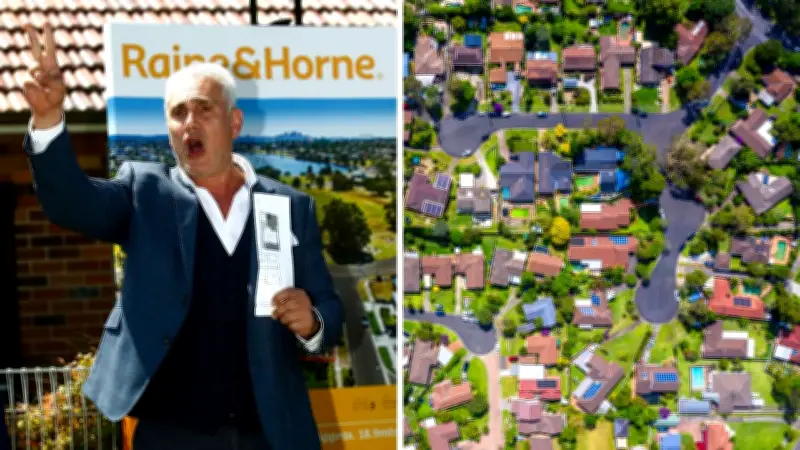
Auction clearance rates have plummeted to their lowest level in six years, as high interest rates and property tax changes spook home buyers and leave sellers in the cold. It comes as national house price growth flatlined in May, with a monthly increase of precisely 0 per cent, according to Cotality figures released on Sunday. The national figure was weighed down by Sydney and Melbourne prices, which fell 0.9 per cent and 0.8 per cent respectively over the past month. The stalling of national dwelling prices is an ominous sign for vendors and lends weight to forecasts from a growing number of economists that Australia’s housing market is heading for its sharpest correction in decades.
At the weekend, the auction clearance for the combined capital cities was 54.5 per cent, the lowest rate since April 2020, according to The Block auctioneer and real estate coach Tom Panos. Mr Panos said the market was undergoing a “confidence crisis”. Sydney fell to 51.8 per cent, Melbourne was at 58 per cent and Brisbane came in at about 43 per cent. Mr Panos gave a brutal update to his followers on Sunday, describing the results as indicative of a “confidence crisis”. “We’re talking about the weakest auction market since the days of Covid,” he said. “Buyers are hesitating, vendors are adjusting, and uncertainty is dominating decision-making.”
He predicted that clearance rates would probably remain stable over winter due to lower auction volumes, but it would be a different story from September as the spring selling season kicked in. “It’s a fragile market, and I’m going to let you know: spring I think is going to have so many listings,” he said. “Now if we have interest rate rises leading into spring, we’re going to see the biggest buying opportunity in living memory. Get yourself ready.”

While real estate commentators sought to encourage buyers — or reassure sellers — there was also sympathy for young Australians who had taken advantage of the government’s 5 per cent deposit scheme, only to see house prices fall in cities like Sydney and Melbourne, potentially turning their equity negative. Comedian Dave Hughes said he felt sorry for Aussies who had “recently committed their entire financial future to a home purchase that now face this personal catastrophe happening to them”. By way of an example, Mr Hughes described a hypothetical homebuyer who went “all in” on a $2.1 million property back in March.
“You voted for Albanese — he said he wasn’t going to do anything to negative gearing, didn’t mention anything about capital gains tax,” the comedian said in an online video. “...But he lied and he changed everything, and the property market crashes — it goes down 20 per cent. You spent $2.1 million and now all you can get for the house is $1.6 million. You’re not going to sell it, but then you lose your job, and you have to sell it. And so you’ve just lost $500,000, your life savings. Do you know why you lost your life savings? Because Albanese f***ing lied.”
Hughesy, who has repeatedly taken to social media to lash the Albanese government in recent weeks, warned that “AI is gonna change the employment situations for potentially millions of Aussies very soon”, leaving highly-leveraged first home buyers particularly vulnerable. “And a sizeable number of them may never recover financially,” he said. “All because of deliberate lies from unscrupulous leaders who just wanted to be re-elected. I feel a class action coming on.”
Property measures in last month’s federal budget included restricting negative gearing and replacing the capital gains tax (CGT) discount with an indexation model for established residential property — two changes aimed at warding off investors. But the housing market was already showing signs of cooling before the budget, thanks to consecutive 25-basis-point hikes by the RBA in February, March, and May, bringing the official cash rate to 4.35 per cent. Commonwealth Bank, ANZ, and NAB are predicting that the cash rate has peaked and will be held for an extended period. Westpac is the outlier, forecasting two additional 25-basis-point hikes in June and August, which would bring the cash rate to 4.85 per cent.