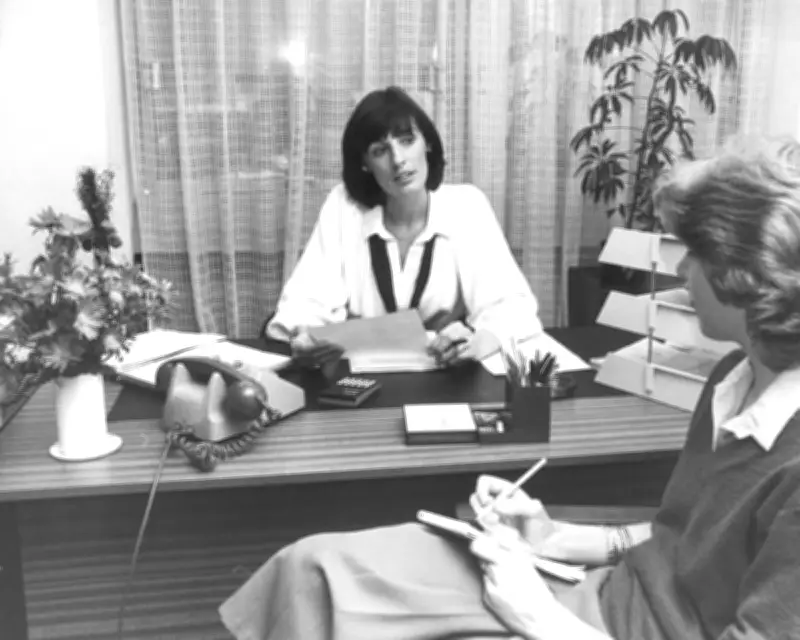
Caroline Marland, the former managing director of Guardian Media Group and the first woman to hold such a senior post on a national newspaper, has died aged 80. She was to a considerable extent the person who saved the Guardian financially in the 1980s.
Early Life and Career
Born in Dublin on 14 April 1946, Caroline was the eldest of three children of Peggy Ramsden and Desmond Rushton. Her father was a mural artist; her mother became a public relations consultant, representing among others the actor Roger Moore and Joseph Kagan, the Gannex raincoat manufacturer. The family moved to Yorkshire to be closer to her clients. Caroline was educated at a Quaker boarding school and then at the Ada Foster stage school in London.
She worked initially as a model in London and Paris but then started a job in telephone sales for the Yorkshire Post, selling space to local car dealers, before moving three years later, in 1972, to London, where she managed personal column sales at the Times.

Growing frustrated that the paper would not promote her to a managerial role, in 1976 she applied for a job at the Guardian after learning that the paper had a female news editor: “I thought they must all be liberated there,” she told an interviewer at Management Today in 1999.
Rise to Managing Director
Promotion was swift: telephone sales manager, then classified sales manager, deputy advertising director, and by 1983 advertising director (the first on a national newspaper). She joined the board of the Scott Trust, the Guardian’s owner, a year later, became deputy managing director in 1987 and finally managing director of Guardian Media’s national newspaper division in 1995.
Revolutionising Job Advertising
It was largely Marland’s initiative to wrest much of the job advertising market from the Times and Telegraph during the 1980s. This led to the creation of the paper’s successful weekly supplements: media on Mondays, education on Tuesdays, society on Wednesdays, all supported by tens and eventually hundreds of pages of job adverts, which produced revenues for the hitherto precariously financed paper that ran into many tens of millions annually.
At the start of that period, the Guardian’s jobs advertising share was less than 8%, compared with the Telegraph’s 50%. The spark came in 1979 when Marland, then the paper’s classified sales manager, spotted the ageing profile of the Times and particularly the Telegraph’s readerships and was able to present sceptical advertisers with the case that the Guardian’s lower age profile meant that its readers were much more likely to be in the jobs market.
The old image of the paper’s readership as sandal-wearing herbivorous lefties was successfully challenged, including by an advertising campaign showing an elderly Telegraph subscriber in a bath chair being pushed by a thrusting young Guardian reader – an image that led the Telegraph’s advertising manager to threaten to sue.
Overcoming Misogyny
Marland weathered the misogyny of being called a “Perrier queen” by rivals, or being asked by advertising executives when her male boss would be coming. Within 10 years the Guardian had a majority of the classified jobs advertising – the Telegraph’s share had sunk to 20%. At the same time, the paper’s advertising sales department expanded from 11 salespeople to 80.
In the sometimes fusty and male-dominated newspaper world, Marland stood out as charming, decisive and glamorous. Those who assumed she would be a soft touch were soon disabused. Her friendly manner concealed a firm determination for the paper’s editorial and commercial success.
Personal Life and Marriage
In 1983 she married Paul Marland, a farmer and rightwing Conservative MP for Gloucester West throughout the Thatcher years. After the Guardian’s successful mid-90s legal battle against the Tory minister Neil Hamilton, she told an interviewer: “Paul knew Hamilton well. We have an office at home and we share a desk: while the case was going on I had half the desk covered with Hamilton stuff and Paul had the other half covered in leaflets to get him re-elected. We laughed about the conflict but the one thing we never did was discuss it.”

It was a highly successful marriage. After weekdays at the paper, Marland drove home to support her husband as a loyal constituency wife, though former colleagues doubt that she was ever truly a Conservative. She was told by one elderly constituent at a function: “We’re so glad you have got a little job in London to keep you occupied while Paul is in the House of Commons.”
Later Years and Legacy
Marland retired in 2000 following a lengthy period of recuperation after a severe accident while walking her Jack Russell terrier, which initially seemed likely to cause the amputation of her leg. Campaign magazine named her Media Achiever of the Year and she became a non-executive director of the Arcadia retail group. Her charity work included helping a fundraising drive for the Royal Marsden hospital and cancer research charities.
Paul died in 2021. Marland died three days after being injured when she was a passenger in a car that was in a collision near her home in the Cotswolds. She is survived by her daughter, Sarah, and by three stepchildren, Lara, Lucinda and Alexander.