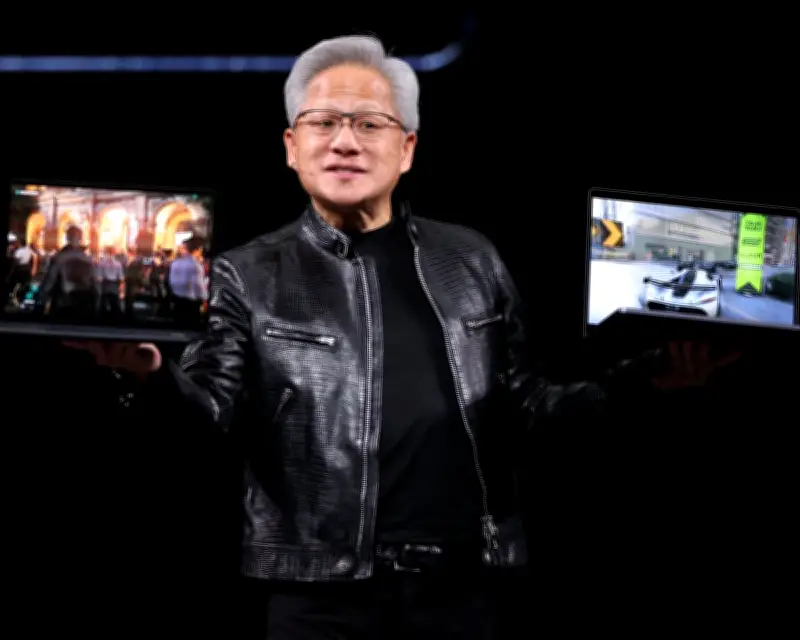
Nvidia has launched a new 'superchip' that brings artificial intelligence capabilities to laptops and desktop computers, potentially replacing the traditional mouse and keyboard in how people interact with their PCs. The US semiconductor company, valued at $5tn (£3.7tn), introduced the RTX Spark chip at the Computex conference in Taipei, marking a significant expansion beyond its dominant position in data centre AI chips.
RTX Spark: A New Era for PCs
The RTX Spark chip, developed in collaboration with Taiwan's MediaTek, combines a microprocessor and a graphics processing unit. It is designed to run AI agents locally on the device, reducing reliance on cloud computing. According to Nvidia CEO Jensen Huang, the chip will 'reinvent the PC' for the AI era after three years of collaboration with Microsoft. The chip will be available this year and will be used by major computer manufacturers including Dell, Lenovo, Asus, and HP, paired with Microsoft's Windows operating system.
Huang stated that the chip would allow AI agents to navigate PCs autonomously, replacing traditional mouse and keyboard interactions. Despite its power, the company assures that computers using the RTX Spark will remain thin and light. Huang described this as reimagining the PC 'for the first time in 40 years'.

Market Implications and Analyst Reactions
Analysts view Nvidia's foray into the consumer PC market as a strategic move that will open up a new business line, but they caution that it will take time to generate significant revenue. Neil Shah, co-founder of Counterpoint Research, compared the 'RTX Spark moment' to the advent of the iPhone, ChatGPT, and DeepSeek, predicting it will transform traditional app-centric PCs into 'agentic AI personal computers' that could become ubiquitous in homes.
Susannah Streeter, chief investment strategist at Wealth Club, noted that while the move is strategically significant, investors are likely to see it as a long-term growth opportunity rather than an immediate earnings driver. She emphasised that Nvidia's fortunes still depend heavily on global demand for AI infrastructure and data centre computing power.
Competition and Industry Trends
The launch intensifies competition in the AI chip market, pitting Nvidia against Intel, Apple, Qualcomm, and AMD. Intel has announced its own AI chip, the Xe3P graphics processing unit codenamed Crescent Island, which is 'purpose-built for this upcoming AI generation of agents', according to Anil Nanduri, vice-president of AI products at Intel's Data Center Group. Intel's chip uses cheaper memory and cooling technology compared to Nvidia and AMD.
Nvidia also introduced the Vera central processing unit (CPU), designed for AI agents and early adopters including OpenAI, Anthropic, and SpaceX. This demonstrates the company's growing focus on PC and CPU products.
AI and Job Market
Addressing fears that AI will destroy jobs, Huang dismissed concerns that the technology would reduce demand for software engineers. He argued that AI would actually increase hiring by making workers more productive. 'This is the promise of AI,' he said. 'The number of engineers, software engineers, is actually increasing. People talk about AI reducing jobs – complete nonsense. It's causing more software engineers to be hired.'
Arm CEO's Potential Billion-Dollar Pay Package
In related news, Rene Haas, CEO of Arm, is in line for a pay package that could make him a billionaire if he meets targets to turn the microchip firm into the UK's first trillion-dollar company. Arm, listed in New York but headquartered in Cambridge, has proposed a pay scheme including generous share awards worth over $1bn in total by 2031, contingent on achieving 'exceptional growth metrics'.