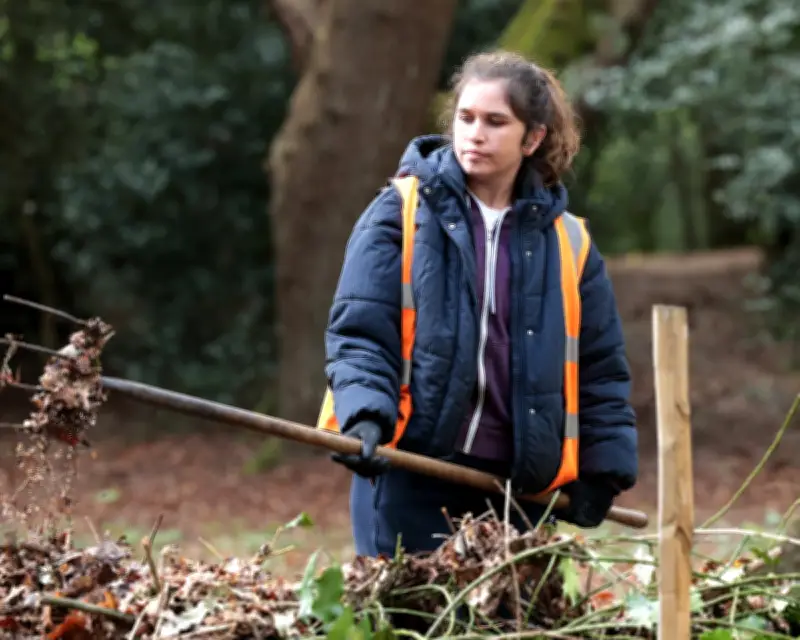
A group of young adults with learning disabilities is playing a key role in planting a ring of trees around London, an ambitious project aimed at creating wildlife corridors and boosting biodiversity across the capital.
Transforming Woodlands and Lives
In Hadley Wood, north London, 20-year-old Harry Ewing is busy piling branches and foliage onto a dead hedge to protect newly planted saplings. He works in a glade created by a fallen oak, once overrun with brambles. “I feel very happy – the trees are growing already. It’s really nice seeing it when it starts,” says Ewing, one of several trainees with the Harington Scheme, a charity that supports young adults with learning disabilities into employment.
The trainees are helping to establish a section of the London Tree Ring, a project launched in 2023 by CPRE London to create an “M25 for nature.” The initiative aims to encircle the capital with unbroken corridors of plant and animal life, strengthening biodiversity and reconnecting people with their environment.

Building Skills and Confidence
Josh Limb, another trainee, carries a wheelbarrow loaded with forest debris. “I don’t like being stuck in offices the whole time. I love being outdoors – I can breathe,” he says. The trainees have cleared brambles, planted willow, hornbeam, and hazelnut trees, and are testing ways to protect them from deer. Their work diversifies the age structure of the woodland and enhances its ecological value.
Saman Shahabi, operations manager of Harington Gardeners, explains that training young adults in conservation future-proofs their skills as the UK economy becomes greener. He notes that people with disabilities often face greater barriers to accessing nature, and this project helps bridge that gap. “It’s amazing that the Harington Gardeners team are part of that change,” he says.
A Growing Network of Green Spaces
Over 25 years, the London Tree Ring will work with hundreds of groups, landowners, councils, and volunteers to create flourishing wildlife corridors. Already, showcase sites have been established: a community tree nursery in Hounslow, a micro forest in Sutton planted with students from Glenthorne High School, and disease-resistant elms in Chessington’s farm hedges.
Phil Paulo, director of the London Tree Ring, emphasizes that the project is not about planting a single line of trees but restoring diverse ecosystems. “We want to have bigger habitats that are better connected and more diverse. Those are the secrets to halting nature decline,” he says.
Community Collaboration
At Hadley Wood, the trainees work alongside volunteers from the Monken Hadley Common Trust, which has cared for the woodland since 1777. Linden Reilly, a 67-year-old retired lecturer, discovered through ancient documents that her cottage entitles her to be a commoner. Instead of grazing cattle, she joined the trust to protect the land, pointing out features like acid grassland, badger dens, and yellow meadow ants.
Roger De La Mare, curator of the common, welcomes the younger crowd. “It’s good fun working with them. A couple of days were really miserable weather-wise, and both groups were spurring each other on,” he says.
Future Growth and Opportunities
As the London Tree Ring expands, CPRE London hopes to collaborate with more communities. With additional investment, the charity aims to procure new sites for habitat creation and provide training and employment support for young people. For Ewing, the initiative has been a success. “It’s nice to do something like this for a change. We do have fun. I’ve enjoyed this,” he says.