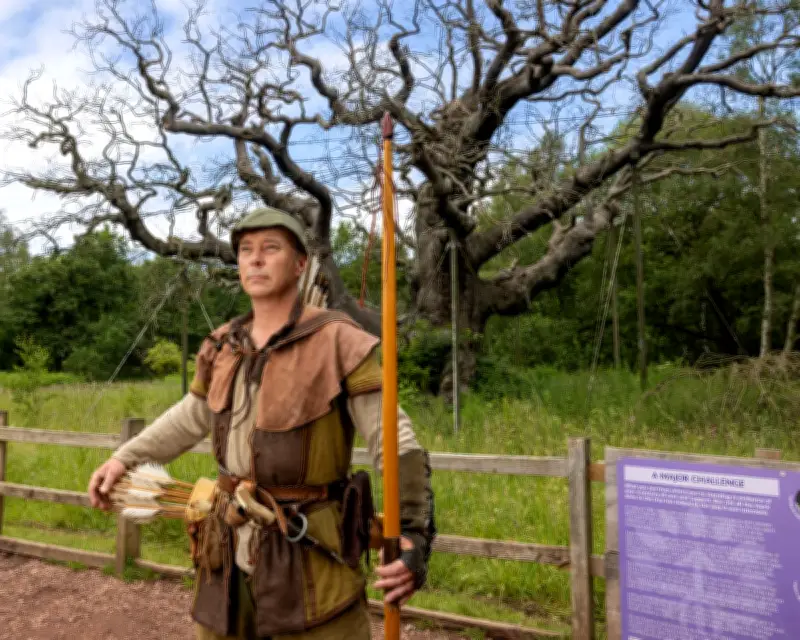
One of Europe's oldest, largest, and most celebrated ancient trees, the Major oak in Sherwood Forest, Nottinghamshire, England, has died after standing for at least 1,000 years. The massive tree failed to produce leaves this year, stressed by a series of hot, dry summers.
A Legendary Tree
Thousands of visitors annually admired the oak, whose immense age, 11-metre girth, and 28-metre canopy inspired folklore. While not hollow in Robin Hood's time, legend says it sheltered the outlaw and his band from the Sheriff of Nottingham. In 2010, snow on the trunk eerily traced Friar Tuck's image; other winters saw snow avoid its limbs entirely.
Causes of Decline
Recent summers and human admiration likely hastened the tree's end. Like other ancient oaks, it suffered repeated stress from heat and drought linked to global heating, notably the July 2022 heatwave when Britain hit 40°C. Well-intentioned human interventions also contributed: props and chains installed in 1904, concrete fills in the 1960s, lead and fibreglass cladding, and fire-retardant paint.

Since the RSPB took over in 2018, studies revealed the trunk was depleted of water as it was pumped to artificially supported outer branches. The props "probably impacted its ability to sustain itself," said Chloe Ryder, RSPB Sherwood Forest estates operations manager, but removal would have collapsed the tree. Underground tests showed "a strangled and starved root system" in nutrient-poor soil, starved of microbial life.
Final Years
Over the past three winters, the RSPB gently excavated around roots to aerate and feed them. Although soil life returned, the oak produced hardly any leaves last year and none this year. Arborist Reg Harris noted multiple factors: 200 years of tourist footfall, vehicular compaction, coal mining altering the water table, and climate changes—especially in the last 10% of its life. "The lack of summer rainfall over the last five years, coupled with unprecedented high temperatures, have had a significant hand in it," he said.
Farewell and Legacy
Robin Hood—portrayed by outdoor educator Robert Brackley—arrived in an electric van for an impromptu funeral. Brackley, who taught thousands of children about the tree while dressed in outlaw furs, said: "The stories it has given us is the legacy. It's the most famous tree in the world." Visitors from Spain, Sheffield, the US, South Korea, and Australia paid respects. Eight-year-old Carter Jackson called it "ginormous" and "really beautiful." Kirsty Champion from Adelaide remarked: "It's so sad that we tried to help it and conserve it but it probably made it worse."
Conservation Concerns
England hosts 114 living ancient oaks over nine metres in girth—described as "the white rhinos of the UK"—with only 98 across the rest of Europe. The Major oak attracted 350,000 visitors yearly. Despite a protective barrier installed in the 1970s, poor soil health and compaction from visitors and wartime military use weakened it. The tree will remain standing, as its deadwood is highly valuable for wildlife. Ed Pyne of the Woodland Trust said a quarter of forest species depend on deadwood at some life stage. He called for government protection, noting: "We lose a tree like this every year. They have no designated legal protection."