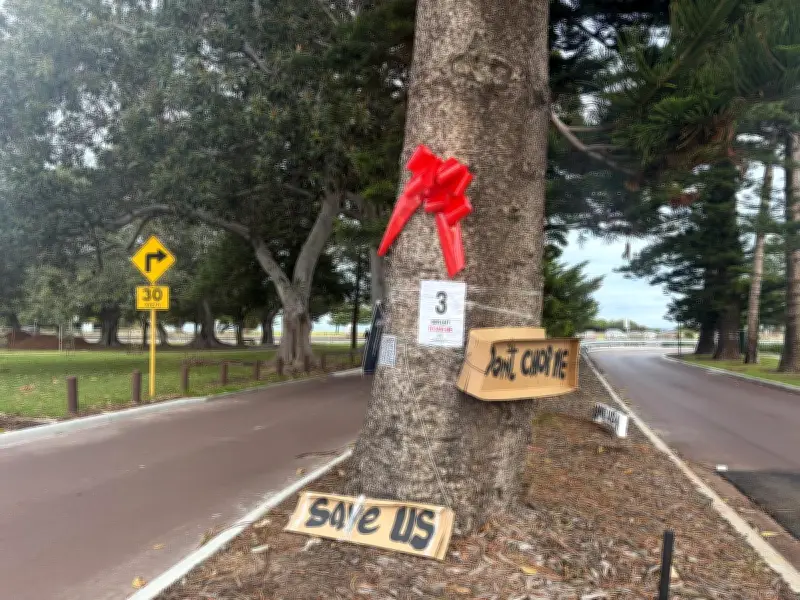
The City of Fremantle has reversed a plan to remove two 118-year-old Norfolk pines at the Douro Road and South Terrace roundabout in South Fremantle, following intense community backlash. The trees, which were proposed for removal to make way for pedestrian crossings, will now be preserved, the council confirmed on Wednesday.
Community rallies to save historic trees
Residents quickly mobilised after learning of the proposal, placing ribbons and signs on the trees reading “don’t chop me” and “save us”. An online survey closed last week showed overwhelming support for saving the pines, which have stood for 118 years.
At a council meeting on June 24, South Fremantle resident Hayley Parker questioned the decision, stating: “These trees are 118-years-old. They have survived two world wars and the Great Depression and even Y2K… Why do these trees not qualify for heritage value under the council’s own register of significant trees?”

Council responds to concerns
The city’s director of infrastructure, Graham Tattersall, explained that the significant tree register applies only to trees on private land, not the city-owned road where the pines stand. He previously stated that if removal were necessary, the city would aim to replace them “at least two to one”. Multiple assessments, including a sightline survey, had indicated the trees posed a risk and would need management per Main Roads requirements.
Councillor Jemima Williamson-Wong argued at the May 27 meeting that removal was needed for pedestrian safety, especially for small children and pets who could be hidden from drivers’ view.
Environmental and heritage concerns raised
Another resident, Brendan Verrier, warned against creating a “concrete jungle” and questioned the environmental impact on endangered black cockatoos. “Has the city assessed the full environment value of these trees including their potential contribution to the black cockatoo habitat and food sources, and how long it would take for replacement plantings to provide the same benefits?” he asked.
Mr Tattersall admitted no environmental assessment had been conducted on the pines, but said the parks team would aim to replant with endemic and native species if removal were necessary. That is now moot, as the trees will be retained.
Pedestrian crossing plans revised
The original proposal included two pedestrian crossings on the northern and western legs of the roundabout, based on public consultation using interactive mapping. However, resident Lehani Williams noted that 2026 pedestrian counts recorded 40% more activity on the eastern leg than the western leg. “If desire lines are the route people take most naturally and frequently, why is pedestrian traffic being shifted from naturally occurring eastern desire lines to the lesser used west?” she asked.
Mr Tattersall responded that pedestrian crossings must consider a range of factors beyond desire lines, including traffic volumes, vehicle movement, sight distances, accessibility, cycling, bus movements, and compliance with Main Roads data. He said the eastern leg carries higher traffic volumes and presents “operational and geometric constraints” that make a crossing there more challenging. The proposal had been reviewed by an independent road safety expert and the city’s engineering team.
Next steps
City officers are now evaluating feedback on the proposed plans and will provide a follow-up report with recommendations that do not involve removing the pines. The report will be considered at a future council meeting.