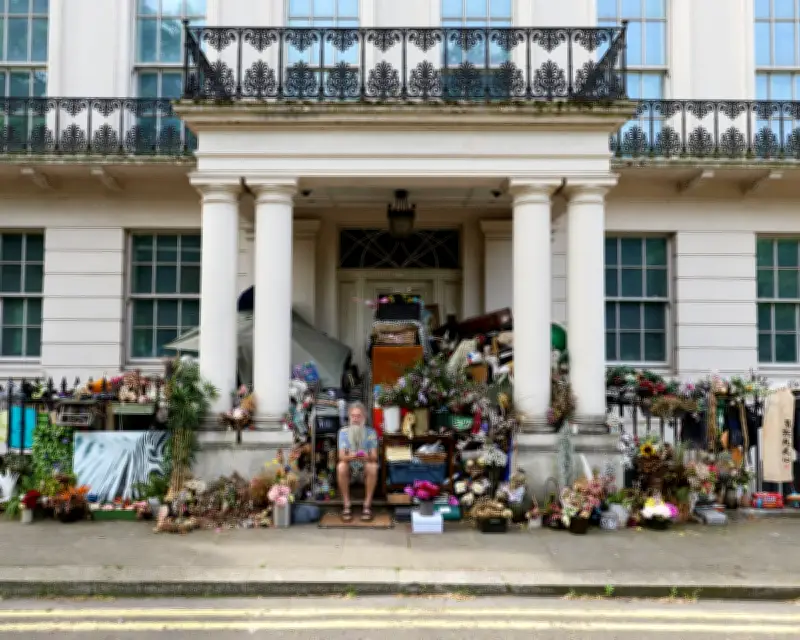
An absurd illustration of Britain’s housing problem: readers respond to an article about what was once the UK’s most expensive house, which has lain empty for years.
A Stark Contrast
Grand properties lying empty while we are in the midst of a housing crisis is ludicrous. Sam Wollaston’s article about a homeless person sleeping in the portico of a £200m palace, which used to be terrace houses, is the most apt and absurd illustration of the UK’s housing problem.
Personal Experiences
Kate Dudley from Crowmarsh Gifford, Oxfordshire, writes: “For a long time, my partner and I lived in the affluent town of Henley-on-Thames. There, behind the famous Leander club, sat a sizeable disused property. Most days I’d drive past it on my way to work and lament that the pigeon-filled building wasn’t occupied. It took over a decade before it was knocked down and the area finally developed; presumably somebody owned it for all that time and sat on it for whatever reasons.”

“Meanwhile, housing estates are being thrown up around every town where I live in South Oxfordshire. These are often described as affordable housing, which I and my millennial friends scoff at, as we struggle to get on the housing ladder.”
“Councils absolutely should have the right to seize these massive mansions and use them as temporary shelter (or anything they want, as long as it benefits the community). Housing shouldn’t be just an asset for the super-rich; shelter is a necessity for everyone.”
Innovative Solutions
Aisha Morrell from Beeston, Nottinghamshire, suggests: “Rather than framing this as a conflict between property owners and those in housing need, we should be looking for innovative solutions that recognise both realities. One possibility would be for the government to consider a targeted levy on long-term empty properties. Revenue generated could be ringfenced and passed directly to charities, community organisations and frontline services tackling homelessness, addiction, housing instability and poverty.”
“Those organisations already possess the expertise, local knowledge and trusted relationships needed to make a difference. What they usually don’t have, though, is sustainable funding. No single policy will solve homelessness – it’s too complex. But if wealth generated from housing that serves no immediate social purpose could help support those facing housing crisis, it would represent a practical step towards a fairer society – one that acknowledges that homelessness is rarely a personal failure and far more often a collective challenge.”
Compulsory Sale Orders
John Boxall from Frome, Somerset, comments on compulsory purchase powers: “Your article on empty homes talks about councils’ compulsory purchase powers. These orders, however, have two limitations. First, and in particular in the case of commercial land and property where the market is not very ‘liquid’, establishing a value can be very contentious. Second, it leaves the local authority owning a property that neither it nor its partners may want.”
“The idea of compulsory sale orders has been discussed in Scotland, so why not in England and Wales as well? Instead of the local authority having to buy unused or badly managed property, it is instead sold at auction with much lower costs to public funds and no dispute as to what it’s worth. The reduced costs and simpler process would also have something of a deterrent effect that compulsory purchase orders lack.”
A Scourge on Communities
Alison Dark from Crayford, London, writes: “As a suburban Londoner who has worked in London since 1976, none of this is a surprise. Vacant properties are a scourge wherever they are. I’d fully support compulsory possession (not purchase) of any property that has been left empty like the one in the article. When the London homeless are being moved hundreds of miles away, this kind of asset could be converted and bring life back into the community. I’m quite surprised no one has squatted in it!”