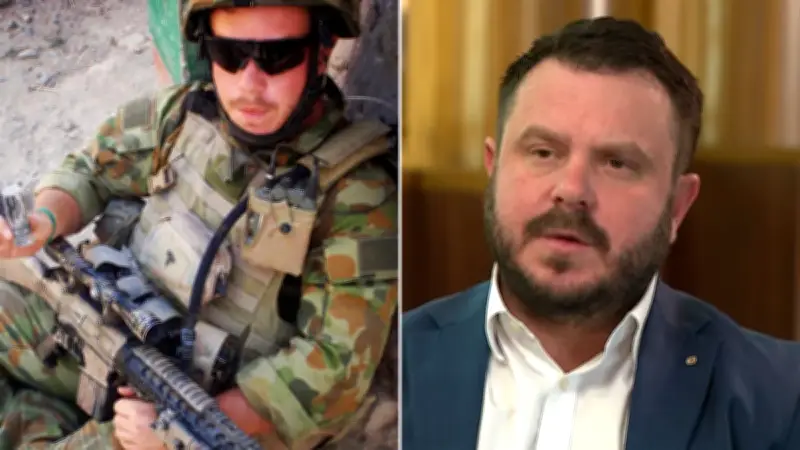
Unlike many politicians, Phil Thompson has stared death in the face, and now he is ramping up his fight in Canberra on behalf of other veterans over health funding caps. The Liberal MP served in the Australian Army, deploying in East Timor and Afghanistan. A patrol in Uruzgan Province on October 19, 2009, changed his life forever.
Thompson has opened up to 7NEWS podcast The Issue about the moment an improvised explosive device (IED) detonated within one metre of him. The blast resulted in Thompson sustaining severe injuries, and he was medically evacuated back to Australia. He has suffered from traumatic brain injury, hearing loss, and depression.
“As I went to come forward, a big explosion happened, an IED went off, an improvised explosive device threw me back,” Thompson tells The Issue. “I was unsure if I was conscious or unconscious before I hit the deck. I kind of looked up and I could only see out of one eye because I was peppered, my glasses had rocks and a bit of frag in it. I couldn’t hear anything in my right ear. My left ear was just ringing, it was just loud.”

It was the journey out of depression and trauma that really tested Thompson. “Having a beer at 5pm then turns into 12 beers, then turns into 9am because you’ve got no accountability. You’ve got no purpose,” Thompson says of his mental health struggles. But he eventually found his purpose working in mental well-being and suicide prevention organisations. In 2018, he was named the Queensland Young Australian of the Year for his work in those fields. Thompson entered politics upon being elected in 2019 for the Liberal Party to the Division of Herbert, which includes the city of Townsville.
Allied health funding fight
His latest fight is with Labor’s $5000 cap on veterans’ allied health services, which starts on July 1, 2027. The fiery debate saw him booted from parliament for 24 hours in May, when he refused to withdraw his claim that the prime minister was a liar. Fees paid to service providers, from psychology to physiotherapy, will increase under a $169 million budget boost next year. But veteran card holders will be capped at $5000 a year, in a move to crack down on provider fraud. The Department of Veterans’ Affairs says the average veteran uses $1900 and estimates one in 10 will exceed the limit.
“It spits in the face of every soldier, sailor and aviator in the country,” Thompson says. “So previously, under all colours of shirt that have been the government, there’s never been a cap on allied health services for veterans.” The Veterans’ Affairs Minister says a pathway is being worked on for those who need extra support. “It means veterans get better access,” Minister Matt Keogh tells 7NEWS. “We had allied health professionals saying they would refuse to service veterans because of the fees we were paying. So by increasing those fees, it means there are more allied health professionals willing to service those veterans.”
RSL weighs in
The RSL National President says the plan currently lacks clarity and is causing 25,000 of the nation’s most vulnerable veterans to lose sleep. “Here they are putting a wall in front of veterans,” Peter Tinley says. “We think there is a better way to do it.” Thompson says if the Coalition gets back into government, the cap will be scrapped. “It will be gone, one of the first priorities.”