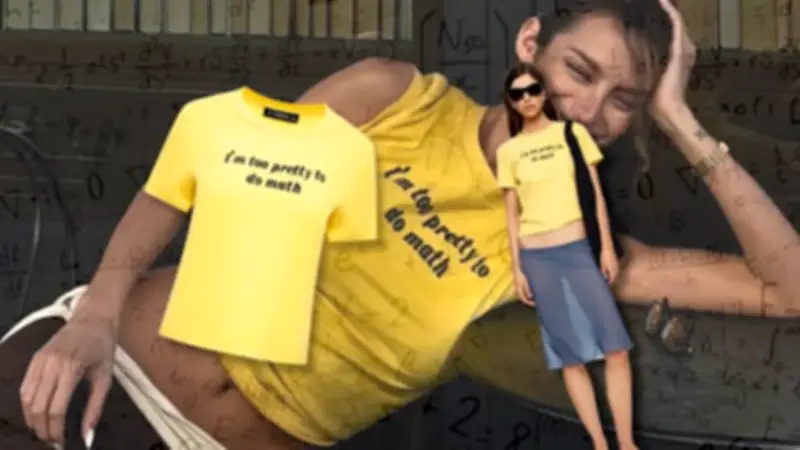
A yellow cotton t-shirt from Australian label Lioness, emblazoned with the phrase 'I'm too pretty to do math', has ignited a fierce debate about the messages girls receive regarding mathematics. The shirt, marketed for 'everyday wear', has drawn widespread criticism from science leaders who argue it reinforces harmful stereotypes that deter girls from pursuing maths.
Research debunks biological differences
Decades of research consistently show that girls are just as capable as boys in mathematics. The notion that boys are naturally better at maths has been widely debunked. Instead, gender differences in maths achievement are largely attributed to motivational and social factors. According to experts, girls receive signals from family, teachers, and the community that it is acceptable—and even desirable—not to be 'a maths person'. In contrast, boys are more likely to have their mathematical potential recognised and encouraged.
Alarming participation statistics
As of 2025, only 36.5% of higher mathematics students in Australia were female. In the 2025 NAPLAN tests, 14.4% of Year 9 boys achieved the top level in numeracy compared to 9.2% of girls. These figures highlight a persistent gender gap in maths participation, despite equal ability. The issue is not capability but perception: girls often see themselves as less capable even when they perform equally, and they report lower interest in the subject.

Messages start early
Children develop beliefs about who maths is 'for' from a young age, shaped by parents, teachers, peers, media, and society. When girls repeatedly encounter the idea that maths is a 'masculine domain', it undermines their confidence, sense of belonging, and willingness to continue. The Lioness t-shirt perpetuates this stereotype, implying that femininity and mathematical ability are mutually exclusive.
Reinforcing 'pretty privilege'
The shirt also suggests that physical beauty can compensate for intellectual effort. This framing encourages girls to value external appearance over their capacities and interests. Given the well-documented pressures girls face around body image, reinforcing beauty as a primary source of value is dangerous. As one commentator noted, 'The problem has never been girls’ ability to do maths. It is that too often society fails to tell them they can.'
Why maths matters
Advanced maths is a gateway subject to tertiary education and a wide range of careers, including science, technology, engineering, economics, medicine, finance, and business. Strong numeracy skills are also linked to general wellbeing and better employment opportunities. Therefore, messages like 'too pretty to do math' cannot be dismissed as harmless; they contribute to closing doors for girls.
A better approach
The solution is not to force every girl to become a mathematician, but to ensure every child can pursue maths free from stereotypes. Maths involves creativity, reasoning, problem solving, collaboration, and persistence—qualities unrelated to gender. These skills benefit students far beyond the classroom. Ultimately, girls do not have to choose between being feminine and being mathematically capable; society must stop implying they do.