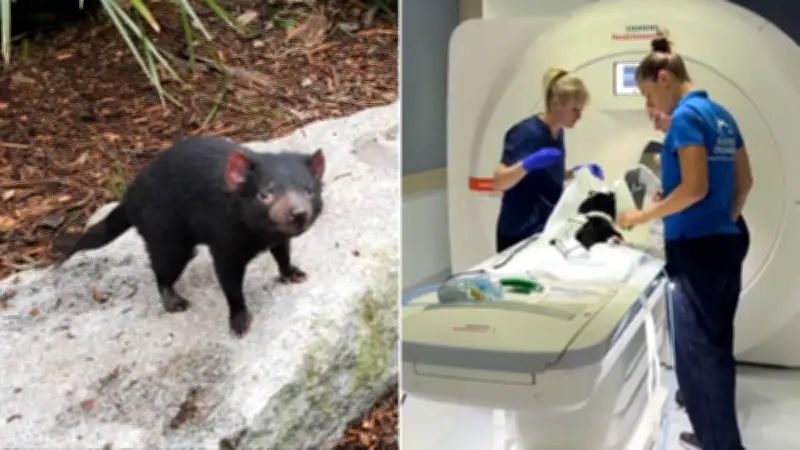
The missing Tasmanian devil found alive after weeks on the run remains in a stable but critical condition after undergoing emergency procedures, according to wildlife carers.
Mary was located on Tuesday night by the Paradise Country wildlife park team in bushland off Kopps Rd on the Gold Coast, over a fortnight from when she first went missing. Staff discovered the two-year-old less than 2km from the park where she escaped after CCTV footage captured her about 4am that morning.
However, Mary was found in an unstable condition, with teams rushing her to a specialist veterinary hospital where they were able to stabilise her condition. On Thursday morning, wildlife carers confirmed Mary had undergone an anaesthetic procedure to undergo an MRI scan with specialised veterinarians reporting she remains in a stable, but critical condition.

“Mary’s dedicated wildlife team remain by her side 24/7 to provide care and support, while the veterinarian team perform high-end diagnostics to help inform a targeted treatment plan,” Paradise Country said in a statement. Footage released by Mary’s specialist team show the small animal being placed in an MRI machine as vets use diagnostic tools to assess her condition.
MRI tests have also been carried out on the recaptured escapee. It is still unclear what caused Mary’s ill health, however her long disappearance in an urban area may have made food choices scarce for the carnivorous marsupial.
Mary escaped by performing what wildlife keepers described as an “abnormally large leap” over a 1.4m fence surrounding her quarantine enclosure. She had arrived at the park alongside fellow Tasmanian devil Mavka as part of conservation efforts to help support the endangered species.
Mary’s mammoth rescue involved a dedicated team of 15 to 20 experienced wildlife keepers from Paradise Country with support from other South East Queensland wildlife parks completing dawn, day, dusk and night searches, with help from sniffer dogs. Researchers were also involved in the two-week search, using sightings to create geographical projection modelling as well as relying on a thermal imagery drone team. Thermal imagery binoculars and monoculars were used in ground searches, while trail cameras and up to 30 humane animal capture devices were placed around the area in an attempt to catch the marsupial.