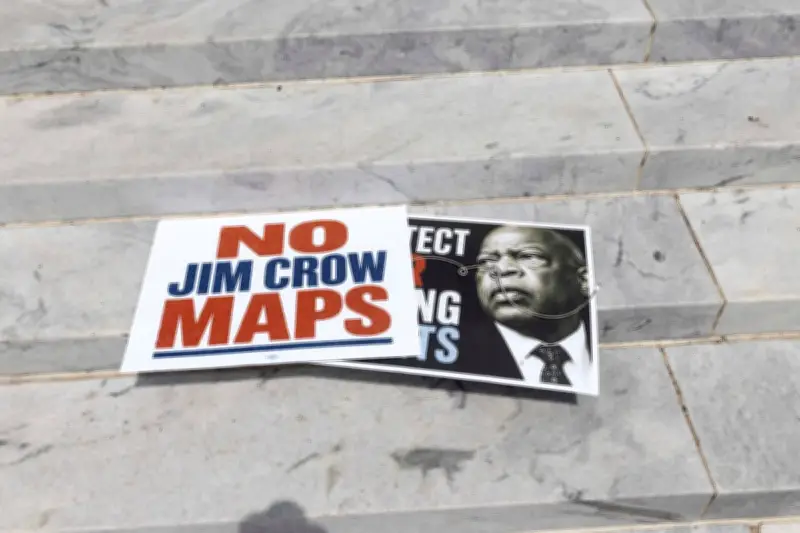
The United States Supreme Court has ruled in a 6-3 decision that Alabama may use a redrawn congressional map that eliminates one of the state's two majority-Black districts for the upcoming midterm elections. This emergency ruling marks a significant victory for Republicans and another major setback for Black voters.
Background of the Legal Battle
The ruling is the most consequential decision from the court since its landmark ruling in late April, which struck down a critical provision of the Voting Rights Act in the case of Louisiana v Callais. In that decision, the court's majority made it nearly impossible to win Voting Rights Act claims by requiring plaintiffs to prove intentional discrimination. However, on 26 May, a three-judge panel had determined that the map Alabama intended to use for this year's midterm was enacted with discriminatory intent.
The Long-Standing Dispute
This emergency ruling is the latest development in a protracted legal struggle over Alabama's congressional map. Following the 2020 census, Alabama enacted a congressional plan that resulted in six Republican districts and one Democratic district. The sole Democratic district was also the only majority-Black district in the state.

Black voters challenged the map, arguing that it violated the Voting Rights Act by unlawfully diluting the influence of Black voters. A three-judge panel agreed and ordered the state to produce a new map that would include two districts where Black voters either constitute a voting-age majority or something close to it. In a 5-4 decision in 2023, the Supreme Court upheld that order.
Alabama's Response
When Alabama Republicans redrew the map in 2023, they passed a plan that did not comply with the court's order. The proposed map again contained only one majority-Black district. The court blocked that map, citing discriminatory intent, and appointed a special master to draw a new congressional plan. That plan, which included two majority-Black districts, was used in the 2024 election, and both districts elected Black Democrats.
After the Supreme Court's decision in Callais, Alabama took the extraordinary step of moving its fast-approaching primaries and sought to implement the 2023 map once again. The three-judge panel again blocked that map on 26 May, stating: "We cannot see our way clear to requiring Alabamians to cast their votes in the 2026 elections under a districting plan tainted by intentional race-based discrimination."
This latest Supreme Court ruling overturns that block, allowing the 2023 map to be used in the upcoming elections. The decision has been met with sharp criticism from voting rights advocates, who argue that it undermines decades of progress in ensuring fair representation for minority communities.