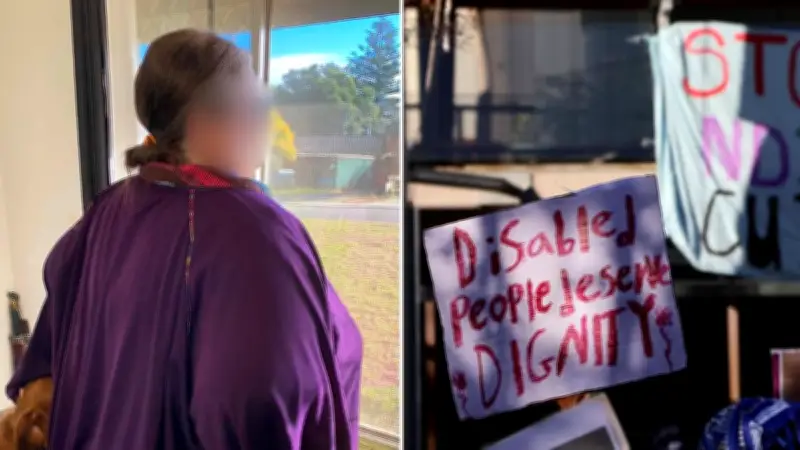
Shelly Lapel*, an NDIS participant who is legally blind and lives with complex post-traumatic stress disorder (CPTSD), wanted to join a recent rally protesting looming cuts to the National Disability Insurance Scheme (NDIS) but was unable to attend. Even the sound of footsteps can trigger her debilitating alarm bells of danger.
Shelly, aged in her 40s and from Western Australia, fears she will be one of 241,000 people removed from the scheme over the next four years. Despite her worries and determination to fight for funding, she told 7NEWS.com.au she had to stay home alone on the day of the rally because she could not afford a carer at weekend or public holiday rates on her current NDIS plan.
Government's plan and projected cuts
The number of participants to be cut was clearly outlined in Treasury modelling tabled in the Senate late last month, but the government's plan of action to overhaul the scheme is yet to be defined. The cuts, to be achieved in part through eligibility changes, are projected to save the government $35 billion over four years.

Cuts to certain NDIS pillars, such as the social and community participation component which is set to be slashed by 30 per cent, will be replaced by alternative services funded through programs like the $200 million Inclusive Communities Fund and the $4 billion Thriving Kids program. However, sector experts say funding for alternative services is likely to be inadequate, and it is unlikely the rollout will provide evenly distributed services in full and on time across the nation.
Concerns from disability advocates
Disability policy and advocacy organisation JFA Purple Orange interim CEO Tracey Wallace said she was "sceptical the reforms can be implemented effectively within the stated timeframes to ensure people with disability do not fall through the cracks." Wallace noted that "almost every other disability service and support" was cut when the NDIS was created. "It is very unlikely that regional, rural, and remote areas will have the same alternative options created within the same timeframes as cities, yet this anticipated discrepancy is not currently accounted for," she added.
The Grattan Institute also called it a challenging goal in its submission to the Senate Standing Committee on Community Affairs Legislation. "It will be a tall task to design, agree on, and implement this new system in time for January 1, 2028, when the new eligibility rules will come into place," the Institute noted. "It has taken governments two-and-a-half years just to agree on the design and funding of the Thriving Kids scheme."
Shelly's personal story
Lapel said a string of early-life tragedies, including a deadly car crash and child sexual assault, left her with a significant list of mental health conditions, including CPTSD. The lifelong and debilitating nature of her conditions make them a psychosocial disability. She is one of 65,000 participants with a primary psychosocial disability. More than half of those people did not receive funded disability supports before they were approved for NDIS plans, 7NEWS.com.au understands.
As federal Health Minister Mark Butler announces a shift away from diagnosis-dependent scheme entry toward a functional-capacity model, the reality of Lapel's conditions may be better recognised. But Lapel told 7NEWS.com.au: "I'm worried. I don't want to get too hopeful."
A government spokesperson told 7NEWS.com.au: "People with psychosocial disability will continue to be eligible for the NDIS." However, they added that "once standardised, evidence-based assessments of functional capacity are implemented, some current NDIS participants with psychosocial disability may no longer meet NDIS eligibility criteria." The spokesperson said: "People with psychosocial disability can continue to access mainstream and community support systems outside of the NDIS."
A 2025 report by the Australian Psychosocial Alliance showed a 62 per cent drop in NDIS approval rates for psychosocial disabilities over five years, with only 25 per cent of applications approved. 7NEWS understands there have been no changes to NDIS eligibility criteria for people with a psychosocial disability or how applications are assessed.

Criticism of the application process
People With Disability Australia acting CEO Megan Spindler-Smith previously described the NDIS application process to 7NEWS.com.au as "deeply dehumanising and exhausting." "The constant level of financial outlay and physical and mental energy that is needed to drive the process can itself be disabling," she said.
Greens Senator Jordon Steele-John told 7NEWS.com.au: "It is so unfair to ask disabled people who may have just demonstrated that they are eligible for the NDIS to go back through another invasive assessment process ... it risks re-traumatising people."
Spindler-Smith shares the same desire for careful and collaborative NDIS reform as Lapel, Wallace, and Steele-John, but said the budget announcement to cut before reform was not the right idea. "Reform is important, the NDIS is important, and it absolutely shouldn't be the only option for people. But you can't cut it first and then build the reforms later," Spindler-Smith said last month. "We need to know what safeguards are going to be there to ensure no one is left behind or damaged."
Concerns about automated decision-making
Butler has said "having humans involved" in functional capacity assessments will be "absolutely central" to the task, but has also not ruled out the potential role of new automated decision-making processes. Steele-John highlighted "massive concerns" that already exist about prejudices within AI systems used in aged care settings, and said of similar systems for the NDIS: "We have no reason as a community to have any faith that this process will be fair."
Impact on social participation
Social and community participation support are also being slashed — Wallace calls these cuts "arbitrary." "JFA Purple Orange has been raising the problem of widespread poor quality social and community participation support delivery for years," she said.
Lapel is worried that, even if she is not removed from the scheme, cuts in the social and community participation sector will further isolate her and leave her to socialise solely with other people with disabilities. "I don't mind going to events with disabled people, but it's not the only community and social access I want," she said. "That's one of my concerns. It's almost like a segregated event."
Wallace described these types of day programs as "exclusion, not genuine inclusion." "Individual plans and budgets enable choice and autonomy in decision-making so that people can be the author of their own lives and participate in the community on their own terms — something that many non-disabled people take for granted," she said.
If Lapel does have to give up her NDIS support, she is not sure what the alternatives will be. A federal government spokesperson told 7NEWS.com.au that "health and mental health ministers have agreed to prioritise addressing unmet psychosocial needs outside of the NDIS." The spokesperson added: "Ministers have also confirmed that funding for psychosocial supports outside the NDIS will be maintained. The Australian Government will work with state and territory governments to consider future cohorts for foundational supports. The needs of people with psychosocial disability both within and outside the NDIS will be part of those considerations."
Capacity building supports at risk
Capacity building supports, which allow a person to build skills to do things for themselves and work towards their goals, are also set to be slashed. This could impact Lapel's already waning ability to participate in academic endeavours from home. Since her vision deteriorated last year, she told 7NEWS.com.au she has not been trained to use public transport, and it took her six months to save up for a text-to-speech C-Pen Reader. She said the delay accessing this assistive technology has negatively affected her university studies, an aspect of her life she describes as one of the last joys left to her.
"I don't want to become a shut-in. It's a real risk with my CPTSD," Lapel said. "At times it feels like my home is my prison. But I also might get to the stage that I can't walk out the door either. I don't want to get there."
Frustration with government messaging
Government messaging key to the overhaul has also been called into question by disability policy advocates. Butler has leaned heavily on the idea of returning the scheme "to its original intent in terms of the scope of its coverage," which he says has blown out. However, Wallace says the information that led to the creation of the original NDIS was flawed. "The Productivity Commission's 2011 Inquiry that led to the creation of the NDIS was hampered by a lack of quality data from the states and territories, particularly about the degree of unmet need in the community and the poor quality of many disability services," Wallace said.
Fighting NDIS rorts has also been central to government messaging around the proposed reforms, but advocates say the level of commentary on the issue is out of balance with the measures laid out to curb dodgy providers. Steele-John said the government has "seemed to seize on the issue, not to tackle it, but to distract the community from what they're actually doing, which is making massive cuts." He said it is causing "frustration" in the disability community. Wallace added that "much has been made of fraud and misconduct in the scheme yet most of the reform measures target participants rather than those doing the wrong thing."
Delayed engagement with disability sector
There is just over a week until the government can vote on the legislation, and Wallace and Steele-John claim that so far the disability sector remains largely unconsulted over how the reform will take shape. The Department of Health website says the Technical Advisory Group will begin its work from mid-2026 and will engage with people with disability and the disability sector. Butler said in a National Press Club speech that "deeper reform" including framework design and eligibility details "will be done through genuine and respectful work with the states, and with the community."
But so far, Wallace said: "The development of these reforms and the new Bill itself does not appear to have involved any genuine attempt to engage with the disability community at all." She is also wary of "the potential for these changes to simply cost shift to other services like hospitals and mental health supports" and warned the overhaul could delay costs "until a person reaches crisis point when their needs will be greater and costs higher." Butler has knocked back questions of cost-shifting, but how potential flow-on effects to hospitals and other critical services might be modelled or measured remains unclear.
* The name of the NDIS participant interviewed for this article has been changed to protect their anonymity.