In mid-May, Elder Guerra, a Guatemalan immigrant, slipped and fell while showering inside the Delaney Hall immigration detention facility in New Jersey. The fall knocked him unconscious and triggered a seizure. Fellow detainees pleaded with guards to call an ambulance, and after considerable delay, Guerra was taken to a hospital. He was returned to the facility the same week and placed in a medical isolation cell.
Guerra has been detained for nearly five months after being arrested by Immigration and Customs Enforcement (ICE) in Newark in January while helping a friend move a snow-covered car. He has lived in the United States for eight years and is now fighting deportation from inside the detention center. According to a relative who spoke on condition of anonymity for fear of retaliation, Guerra's condition has worsened since the incident. 'His head hurts. Light bothers him, he gets fatigued. When he looks at a television screen, he feels dizzy. When he stands up and wants to walk, he gets dizzy,' the relative said. 'He needs medical attention. He's not in an adequate place to recover.' Guerra is also losing hearing in his left ear.
Guerra is one of two men held in medical isolation cells at Delaney Hall, according to U.S. Representative LaMonica McIver. A third detainee who uses a wheelchair was released on Thursday afternoon. The facility, operated by the private prison company GEO Group, opened last year and has faced repeated accusations of substandard medical care, inedible food, and neglectful guards. Multiple congressional oversight visits have confirmed detainees' complaints about conditions.

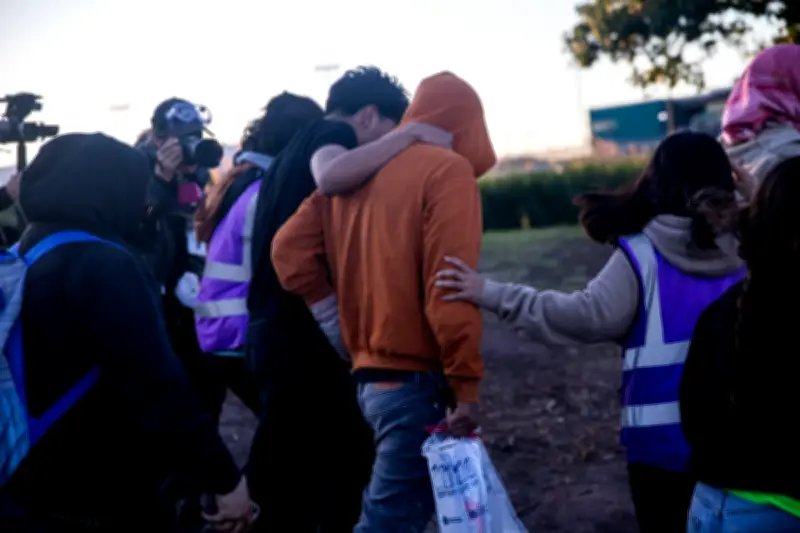
Since May 22, detainees have been on a hunger and labor strike to protest these conditions, drawing fierce protests outside the facility. Government officials, including ICE officers, New Jersey state police, and Newark police, have responded with pepper spray, tasers, tear gas, and arrests. Families of detainees describe confusion over visitation and deep worry for their loved ones. One relative visited Guerra after his fall and recounted through tears: 'He kept telling me, 'Help me. I need to leave here.' But I told him, 'I can't do anything, because it's not in my hands.''
Christopher Castro and his mother drove nearly three hours from Long Island for a 30-minute visit with his father last Tuesday. His father is not participating in the strike for fear of retaliation. 'My dad told me that a lot of people inside are pushing their lawyers to get them out,' Castro said. 'I hope they all get released and we can work on this on the outside.'
On Tuesday night, detainees released a fourth public letter repeating claims of 'medical neglect, water unfit for consumption, food that is past its expiration date and in poor condition, bathrooms that are unusable, and ventilation systems that have never been maintained.' They demand freedom, fair trials, and respect for their rights. Earlier letters also called for a meeting with Governor Phil Murphy, release of sick and elderly detainees, faster immigration proceedings, and an end to pressure to sign deportation documents.
The Department of Homeland Security (DHS) did not respond to detailed requests for comment. Meanwhile, DHS officials have claimed that those they arrest are 'criminals' and 'the worst of the worst.' However, data analysis by Austin Kocher of Syracuse University shows that as of mid-March, 88% of detainees at Delaney Hall had no criminal conviction, and over 70% had no criminal history at all. Most with convictions faced low-level offenses.
GEO Group, the largest private prison operator in the U.S., holds a $1 billion contract to run Delaney Hall for 15 years. A company spokesperson said, 'GEO strongly refutes these allegations,' citing around-the-clock medical care, legal and family visitation, translation services, dietician-approved meals, and other amenities. GEO referred questions about Guerra's case to DHS.

Gabriela Soto, whose husband Martin participated in the strike, helped organize protests. 'Once I started going to the visits and started seeing these people tell their stories, it made me so angry that they don't have a voice,' she said. 'What really boiled me over was the fact that they got served worms for food.' Martin was arrested by ICE in February while buying diapers for their child. On May 24, when lawmakers visited the facility, ICE officers pepper-sprayed protesters, including U.S. Senator Andy Kim, as they tried to prevent Martin's transfer to another detention center.
Guerra's relative has not visited since the strike began, fearing that providing his full name for visitation would be shared with ICE. 'What he told me made me very sad,' the relative said, recalling the visit after the fall. 'Because they can't do anything—it's like they're kidnapped there. We, their family members, we want to do something but we can't, it's not in our hands. What is happening is inhumane. They should have mercy; they're human beings.'