Domestic violence survivors will be left “isolated” during court appearances, critics say, after a nonprofit lost federal funding for volunteer support in family courts.
Funding Withdrawal Impacts Court Network Volunteers
Dozens of volunteers who assist victims of domestic and family violence in navigating the legal system will disappear from courthouses across Australia following the withdrawal of hundreds of thousands of dollars in federal funding. The Attorney-General’s Department decided in January not to renew an annual $300,000 funding package for the Victorian-based nonprofit Court Network. As a result, the organization will begin winding down its work in federal courthouses in Victoria, Queensland, and New South Wales by the end of June.
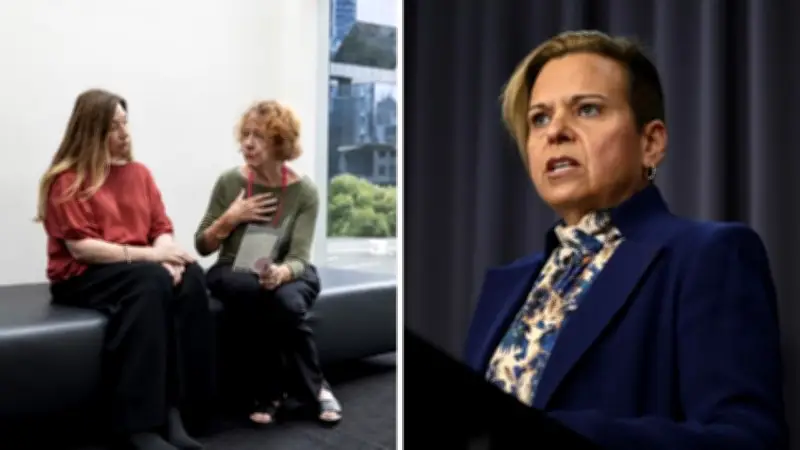
Court Network Executive Director Kate Kahill, who calls her volunteers “court networkers,” said she “couldn’t fathom” the potential negative impacts of being forced to stand down her staff.

Role of Court Networkers
Court networkers are specially trained volunteers who help people—more than half of whom are victims of family and domestic violence—navigate the complexities of court proceedings. They volunteer at the Federal Circuit and Family Court of Australia, as well as local, children’s, coroners, and county courts across Victoria.
“In Victoria, we really are an embedded part of the court system,” Ms. Cahill said. “After the end of June, we’re going to start dropping volunteers from courts, and to know that we won’t have people in those buildings is very hard for me to comprehend, especially when domestic and family violence is such a priority for the federal government.”
According to Ms. Cahill, volunteer services in Sydney have already been wound up. Brisbane volunteers will leave at the end of June, and if no additional funding is secured, Melbourne and Dandenong will lose their volunteers in October.
Impact on Survivors
Ms. Cahill said navigating the court system, especially for female victims of domestic and family violence, would be “isolating” without court networkers. She recounted a recent case where a vulnerable court user, due to domestic violence, had to wait in a safe room because the perpetrator was in the same building. “If our Networker wasn’t there, the only person she would have spoken with that day would have been the security guard at the front door, and then she would have sat by herself in that safe room for six hours with nobody by her side before she went to give evidence.”
Court Networker Nicky, who withheld her surname for privacy, has volunteered for 11 years. She said court networkers often make the difference between a smooth day in court and a crisis. “Some days, our volunteers are the difference between a person choosing to flee the courtroom and choosing to stay and give evidence. When people are unregulated and stressed, we calm them down to the point where they can actually go and give evidence on the witness stand.”
Consequences for Court Operations
Ms. Cahill warned that without her volunteers, Victorian courthouses could face “lengthy delays.” She explained that emotional regulation for vulnerable court users is key. “We enable them to participate in their proceedings, because if you’re emotionally unregulated, you can’t take in what is being said and you may react negatively. I think the consequence of that will potentially be lengthy delays to court proceedings, because people won’t be able to participate and matters will be continuously adjourned.”
Nicky added that court networkers are often the first people victims tell about the true extent of violence they face because volunteers seem “less threatening” than lawyers or court officers. “Volunteers are less threatening—this has been expressed to me many times. Many of these people have been led to believe that most people who are trying to help them have an agenda. When you tell them you’re a volunteer, they immediately relax, they immediately reveal things to you about their safety and wellbeing. It’s incredibly powerful.”

Testimonials and Government Response
The Court Network website features numerous testimonials from people helped by volunteers. One user wrote: “I was in court by myself with no one to support me. The Networker offered to be there for me and it made a huge difference to be supported through the court process.” Another said: “Having a friendly face approach you and offer you information and help is such a reassuring presence that helps alleviate some of the anxiety of the day … this service is priceless.”
The Attorney-General’s office stated that the funding was a “time-limited grant” intended to help train Court Networkers as part of a “Safety Net Service” following the 2021 merger of the Family and Circuit Courts of Australia. A spokesman said: “The funding has enabled the Court Network to establish volunteer training resources reflecting the operations of the Federal Circuit and Family Court of Australia, and a cohort of trained volunteers. The department acknowledges the contribution that the Safety Net program has made while the FCFCOA was being established, supporting families navigating court processes at the same time as managing challenging personal circumstances.”
Ms. Cahill called it “ridiculous” to assume volunteers could sustain a long-term presence without ongoing training. “Imagine if firefighters received training at the beginning of their career and then went on to serve for years without it ever being updated,” she said.
Future of Court Network
Court Network is currently seeking alternative funding to fill the $300,000 budget gap but remains optimistic. Nicky said: “It’s important to understand that although we’ve lost our government funding, we certainly will not be sitting back and just letting this disappear. If we’re forced to take other measures, we absolutely will.”