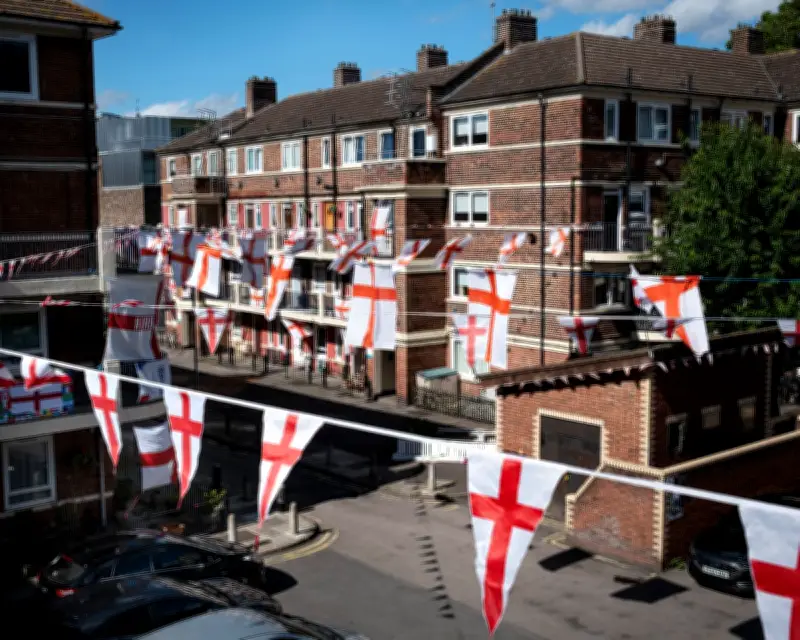
Football fans in Sheffield and Bermondsey have expressed concerns that the St George's Cross has been co-opted by rightwing nationalist groups, but they reclaim it during major tournaments like the World Cup. The flag, once a symbol of English pride, is now often associated with far-right movements, leading many fans to feel uneasy about displaying it.
Sheffield Kirby Estate residents speak out
On the Kirby Estate in Sheffield, residents say the flag has been appropriated by extremists. Local football fan Mark Thompson, 34, said, 'I used to fly the flag during tournaments, but now I worry about being labeled a nationalist. It's sad that a symbol of unity has been hijacked.' Another resident, Sarah Jenkins, 28, added, 'We should be able to celebrate our team without it being political.'
Bermondsey fans reclaim the flag
In Bermondsey, south London, football fans are making a conscious effort to reclaim the St George's Cross. During the World Cup, streets are lined with flags, and community events are held. Local pub owner Dave Miller, 52, said, 'We fly the flag high during matches. It's about football, not politics. We won't let extremists take that away from us.'

However, some fans admit they are more cautious. 'I only put the flag out during games,' said James O'Brien, 40. 'After the tournament, it goes back in the loft. It's not worth the hassle.'
Expert analysis on flag symbolism
Dr. Emily Watson, a sociologist at the University of Sheffield, explained, 'The St George's Cross has a long history, but in recent years, it has been adopted by far-right groups. This has created a dilemma for ordinary fans who want to show national pride without political connotations.' She noted that during international tournaments, the flag is temporarily reclaimed by the mainstream, but the underlying issue remains.
As the World Cup approaches, many fans are grappling with how to express their support for the England team without being associated with extremism. The debate highlights the complex relationship between national symbols and identity in modern Britain.