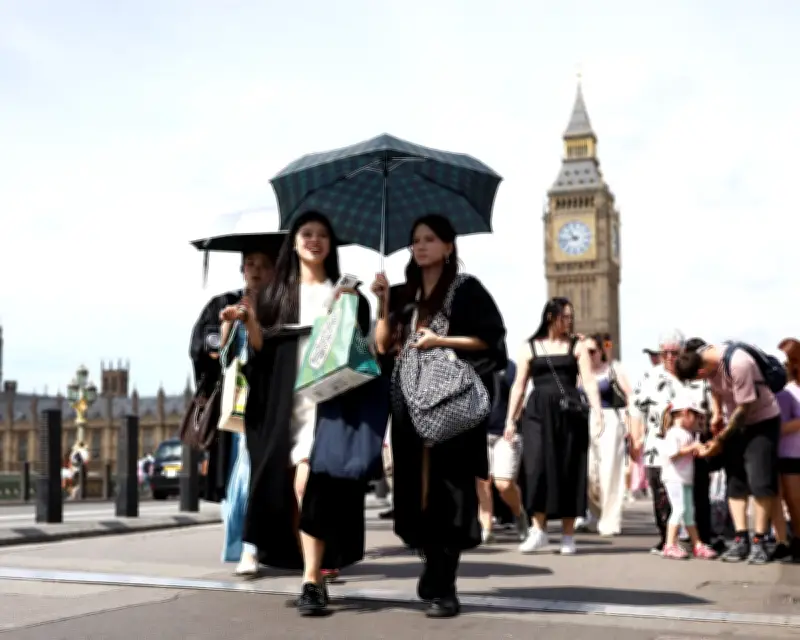
The Met Office has expanded its extreme heat warning for the UK, predicting record-breaking highs of 38°C (100.4°F) this week. The forecaster forecasts that extremely high temperatures could last from Monday until Thursday, leading to health concerns for elderly and vulnerable people.
Potential to Break June Records
The Met Office said there was “growing confidence” that this week may break the record for the hottest June temperature of 35.6°C, set in 1976 in Southampton and Camden Square, London, in June 1957. “The forecast heatwave is developing into an impactful severe weather event, with record-breaking June temperatures and very high humidity,” said Tom Crabtree, a Met Office deputy chief forecaster. “The combination of heat and humidity will be oppressive and bring impacts across society from public health and infrastructure, to power and water supplies.”
Overnight Heat and Humidity Concerns
Overnight temperatures will also be very high, with widespread tropical nights—where the temperature does not drop below 20°C—across southern parts of England and especially in urban areas. Humidity is a key factor, making this heatwave even more impactful, with heat stress a danger to all. “This will make it very hard for people to recover from the daytime heat, exacerbating the heat stress impacts,” said Crabtree. An increase in potential water safety incidents is also noted, as more people are expected to visit coastal areas, lakes, or rivers.

Timeline and Regional Alerts
Monday and Tuesday’s warning covers most of southern England, central and eastern Wales, and much of the Midlands. The peak of the heatwave is forecast for Wednesday and Thursday, when temperatures are expected to climb to 38°C, and when the Met Office alert extends to parts of Greater Manchester, Yorkshire, and Cheshire. By Friday, conditions will be less hot, with highs of 33°C forecast across eastern areas. People in the alert area are advised to drink plenty of fluids, keep out of the sun, and avoid exercising between 11am and 3pm, the Met Office said.
Health Alerts and Service Preparedness
The UK Health Security Agency (UKHSA) has also issued a series of yellow and amber heat health alerts, warning that health and social care services must ensure they are prepared. The hot, humid, and still weather conditions are also expected to bring a surge in mosquito numbers, particularly in the south of England away from coastal areas. “We are expecting a high number of mosquitoes over the next week or so, and that is certainly related to the upcoming weather conditions,” said Dan Pydynowski, a senior meteorologist at AccuWeather. “During periods of more intense heat, mosquitoes might rest in shady spots like tall grass during midday and will be most active at dawn and dusk.”
Long-Term Trends and Vulnerable Populations
Although the hottest recorded June temperature dates back to 1976, monthly average temperatures have been steadily increasing since then, with 2025 being England’s warmest June on record and the UK’s second warmest. Dr Mehri Khosravi, a senior research fellow at the University of East London’s Sustainability Research Institute, said the increasingly regular occurrence of extreme heat events was most severely affecting elderly people and those on low incomes. “Age is the strongest factor that can affect impact of heat,” she said, adding that this was due to a combination of frailer health and being less likely to take protective steps. “Their perception of risk is low compared to younger population,” she said. “Most of our buildings are not designed for this kind of heat, so how we behave when heat is present really affects our health impact.” Caroline Abrahams, the charity director at Age UK, said: “The heatwave forecast for the coming week in some parts of the country is set to be unprecedented in its intensity, so older people really do need to take care, especially if they have serious health conditions. Older bodies adjust with difficulty to extremes of heat or cold so becoming very hot is a genuine risk, if you have cardiovascular or kidney problems above all.” The UKHSA advises people to stay hydrated, avoid the sun during the hottest part of the day, and keep homes cool by closing windows and curtains during the day and opening windows to ventilate in the evening.