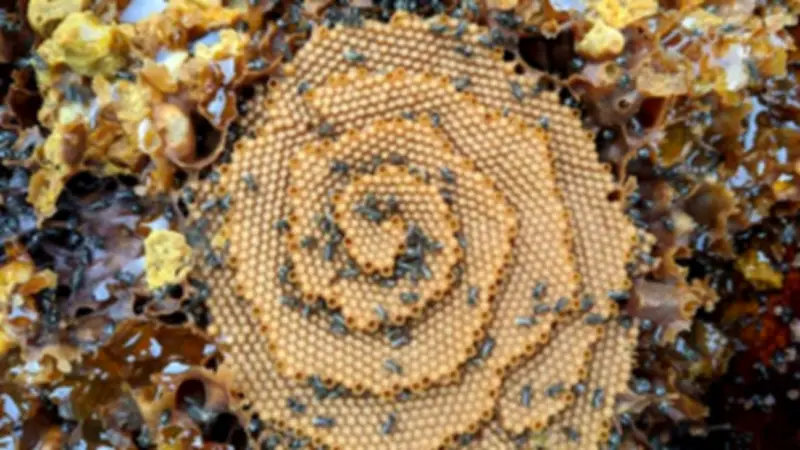
Bees have many different ways of building their homes. Many people will be familiar with the hives of European honeybees, often found in tree cavities. But many other bees – including many of Australia’s roughly 2,000 species of native bees – build their nests underground, in plant stems or in wood cavities.
Nest type determines heat tolerance
Our new paper published in Nature Communications shows that the extent to which native Australian bees can cope with increasing heat depends on the type of nest they use. Surprisingly, the species that are the most tolerant to heat are also the most vulnerable to future warming.
Understanding whether tolerance to heat can evolve is an important question for understanding how species might respond to further climate change. However, most studies show no relationship between how tolerant land-based species are to heat and the average ambient temperatures across their range (often calculated at a coarse 1 x 1 kilometre resolution). This suggests most animals will have a very limited ability to evolve greater tolerance to heat. But these studies don’t consider species microclimates – that is, the climates species actually experience depending on their behaviour. Our new study aimed to address this gap.

A four-month field trip
To understand how vulnerable bees are to warming climates, and whether bees can evolve in response to changes in climate, we set out on a four-month field trip catching bees from the north to south of Australia’s mainland and tested their tolerance to heat. In each location, we waved butterfly nets at flowering plants and sucked the bees we collected into collection tubes using an apparatus called a “pooter”. A pooter is a long flexible tube that helps us to suck bees into a collection vial with a piece of fine gauze inside so we don’t accidentally inhale bees. We brought bees back to a transportable lab and tested the heat tolerance of over 95 species of native bee. We tested species tolerance to heat by slowly increasing the temperature bees were exposed to until they lost coordination.
Microclimate temperatures linked to heat tolerance
We found the microclimate temperatures native bees experience in their nests explain their tolerance to heat. Bee species that live in the hottest nests (stem nests) were the most heat tolerant, followed by the somewhat climate-buffered cavity nesting bees. Ground-nesting bees, which can hide from extreme heat, were the least heat tolerant. We also found that closely related species shared similar nesting strategies and heat tolerances. This made it a little tricky to figure out what came first – nesting strategy or heat tolerance. But not all closely related bees shared the same nesting strategy. So we were able to use these bees to assess patterns in heat tolerance and nesting behaviour. We found both species’ evolutionary history and their nesting ecology drives how tolerance to heat evolves. This means species can evolve greater tolerance to heat over time, but heat tolerance evolution might be slow. Future research needs to figure out if bees can evolve fast enough to keep pace with climate change in the future.

The most heat tolerant bees are the most vulnerable
We also wanted to determine which bee species are the most vulnerable to climate change. To do this we calculated a metric of vulnerability called a “thermal safety margin”. This is the difference (in degrees Celsius) between a species’ heat tolerance and the hottest environmental temperature they inhabit. Typically, thermal safety margins are calculated based on the air temperatures where species live. But because we know bees that use different nests are exposed to different microclimates, we compared how predictions of vulnerability change when microclimate temperatures are used instead. We found a striking result: vulnerability predictions were completely flipped. Using air temperatures, ground nesters were found to be the most vulnerable because they have the lowest tolerance to heat. However, when the microclimates species are exposed to in their nests were considered, stem nesters were shown to be the most vulnerable. This is because they are unable to hide from extreme temperatures, like ground nesters. We also found a general trend showing that species vulnerability to climate change increases towards tropical latitudes. This means tropical bees that nest above ground are the most vulnerable to climate change.
Working to conserve bees
Tropical Queensland still has one of the fastest land clearing rates on Earth. To conserve our crucial pollinators of native plants and agricultural crops, we need to stop further land clearing of tropical forests, which provide cooler microclimates in an otherwise very warm environment. As well as conserving native vegetation, Australia needs to slow its greenhouse gas emissions so we can secure pollination (of both native and agricultural plants) and food security into the future.