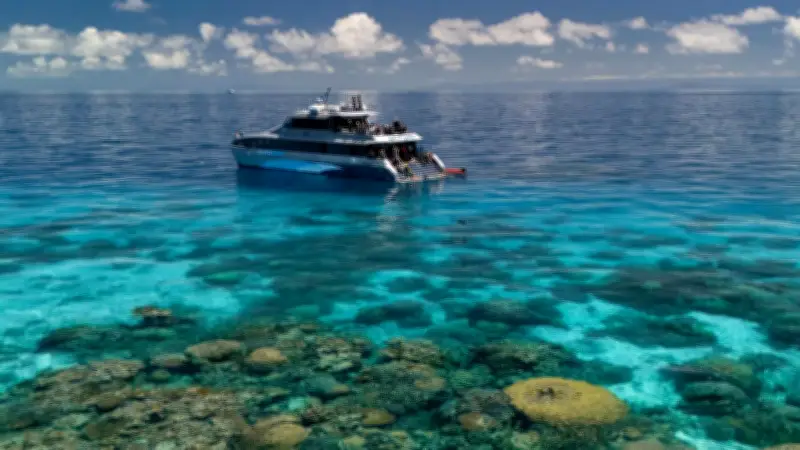
Five of Australia's largest environmental organizations have sent an urgent letter to the United Nations, calling for annual scrutiny of land clearing activities affecting the Great Barrier Reef. The letter, penned in April by the Australian Climate and Biodiversity Foundation, Greenpeace, the Australian Conservation Foundation, WWF Australia, and the Wilderness Society, requests that UNESCO require the Australian government to report annually through 2029 with evidence that land clearing is decreasing.
The Great Barrier Reef, a UNESCO World Heritage site since 1981, generates over $9 billion annually and is a major employer in Australia. However, it has been a source of “utmost concern” due to threats from climate change and water pollution, particularly land clearing in catchment areas that drain into the reef. In late 2023, the Albanese government introduced reforms under the Environment Protection and Biodiversity Conservation Act, requiring federal assessment for land clearing within 50 meters of waterways leading to the reef catchment.
Environmental Groups Sound Alarm
The environmental groups warned that while the reforms offer potential benefits, their implementation could be either effective or wholly inadequate in addressing UNESCO's concerns. They emphasized that it would take 12 to 36 months to determine whether the reforms successfully protect high-value vegetation and reduce runoff impacts on the reef. The letter also highlighted uncertainty about whether the Queensland state government, which primarily regulates land clearing in reef catchments, would cooperate with federal reforms or strengthen its own regulations.

Key issues include the lack of established National Environment Standards for judging land clearing applications, the absence of clear data or compliance mechanisms (relying instead on self-reporting), and the fact that the new National Environmental Protection Agency will not be operational until at least July 2026. The warning comes less than two months before UNESCO's World Heritage Committee meets on July 19 to discuss Australia's reef management.
Stakeholder Responses
Lyndon Schneiders, executive director of the Australian Climate and Biodiversity Foundation, called the reef “an Australian icon” needing government help. He urged Environment Minister Murray Watt to implement strong protections to stop clearing and support the reef. Richard Leck, WWF-Australia's Head of Oceans, noted that tree clearing in catchments has led to millions of tonnes of sediment washing into reef waters, choking corals and seagrass and weakening the ecosystem under climate pressure. Brendan Sydes, biodiversity policy adviser at the Australian Conservation Foundation, described the reef as “in critical need of a lifeline” and urged the government to ensure reformed laws and the new agency deliver strong protection.
Government's Position
Environment Minister Murray Watt stated that Australia's State of Conservation Report to UNESCO shows all reef-related commitments are on track. He highlighted new policies and funding, including the $200 million Landscape Repair Program and $192 million Clearer Water for a Healthy Reef package, to improve water quality and manage crown-of-thorns starfish. The government has also invested a record $3.9 billion since 2014-15 for reef health. Watt emphasized that the EPBC Act reforms, long sought by environmental groups, support further water quality improvements.
Senate Estimates Reveal Low Referral Rates
During Senate estimates, it was revealed that out of 248 calls and 11 emails from landholders to the Department of Climate Change, Energy, the Environment and Water (DCCEEW) about land clearing, only six received a pre-referral meeting. Officials expect two or three of these to become formal referrals. Declan O’Connor-Cox, head of Queensland Environment Assessments, confirmed that exemptions for continuous clearing do not apply within 50 meters of reef catchment areas. When Nationals senator Matt Canavan asked about repeated clearing, O'Connor-Cox stated that any new clearing within 50 meters requires assessment.