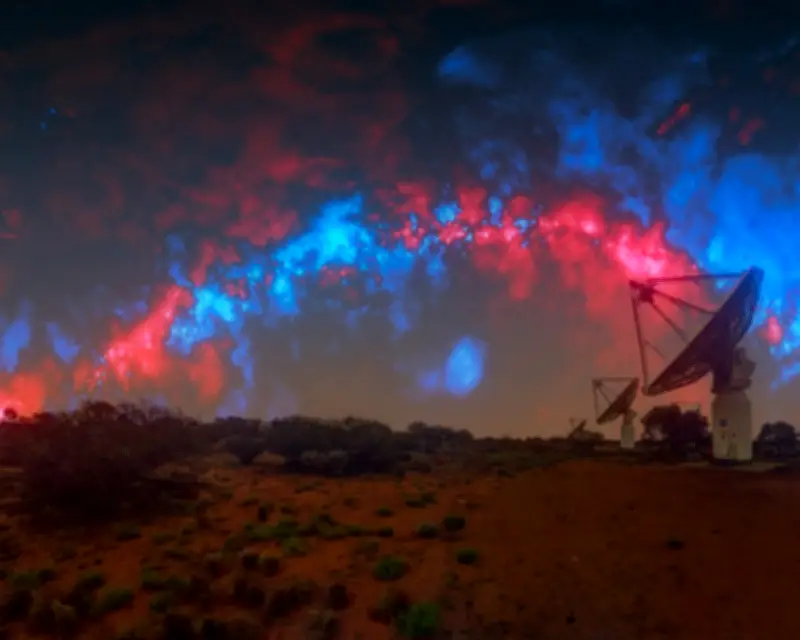
The CSIRO has used its ASKAP radio telescope to create the largest cosmic map of magnetic fields ever produced, potentially shedding light on one of the universe's most mysterious forces. The map was generated by measuring light from nearly four million galaxies as it twisted and traveled through intergalactic space.
How the Map Was Created
A global team led by Australia's national science agency, the CSIRO, charted the magnetic fields by analyzing the polarization of light from distant galaxies. The light rotates as it passes through magnetic fields, allowing astronomers to map their structure. The data was collected using the Australian Square Kilometre Array Pathfinder (ASKAP) at the Inyarrimanha Ilgari Bundara observatory in Western Australia, the country's most powerful radio telescope array.
Key Findings
Dr. Alec Thomson, a CSIRO astronomer and astrophysicist, explained that magnetic fields are present everywhere—on Earth, in stars, galaxies, and even in the space between galaxies. "We still don't actually know how magnetic fields started in the universe, or how they've changed across time since the Big Bang," he said. "This type of map helps us start to answer those questions and be able to look at the details of the magnetic universe."

The map, named SPICE_RACS (Spectra and Polarisation In Cutouts of Extragalactic Sources from the Rapid ASKAP Continuum Survey), is five times larger and much more detailed than previous efforts. It covers the southern sky, which had been largely uncharted in terms of magnetic fields.
Significance for Science
Professor Naomi McClure-Griffiths, an author of the paper and chief scientist of the Square Kilometre Array observatory, noted that previous maps were limited. "For the past 20 years, we have been working with essentially the same dataset," she said. "Now, we can finally answer some big questions with a much better picture of the universe's magnetic structures."
The dataset has been made available to scientists worldwide and published in the Astronomical Society of Australia.
Expert Reactions
Professor Lisa Harvey-Smith, an astrophysicist at UNSW Sydney who was not involved in the study, highlighted the importance of magnetic fields. "The Earth is actually a magnet; it creates its own invisible magnetic field," she said. "If you extend that into space, we learn that other objects like stars and galaxies create magnetic fields. Even in the emptiest regions of space, we still see magnetic fields."
She praised the open-access nature of the data, calling it a "true open repository for any person to use." She added, "The result of creating the map is not the end product—the end product will be over the next few years with scientists dipping in and doing their own studies. There'll be so many discoveries that flow on from this map."
Future Implications
The map is expected to help scientists investigate fundamental questions about the physics of the universe, including the origin and evolution of magnetic fields. It will also aid in studying star-forming regions and individual galaxies, potentially leading to numerous discoveries in the coming years.