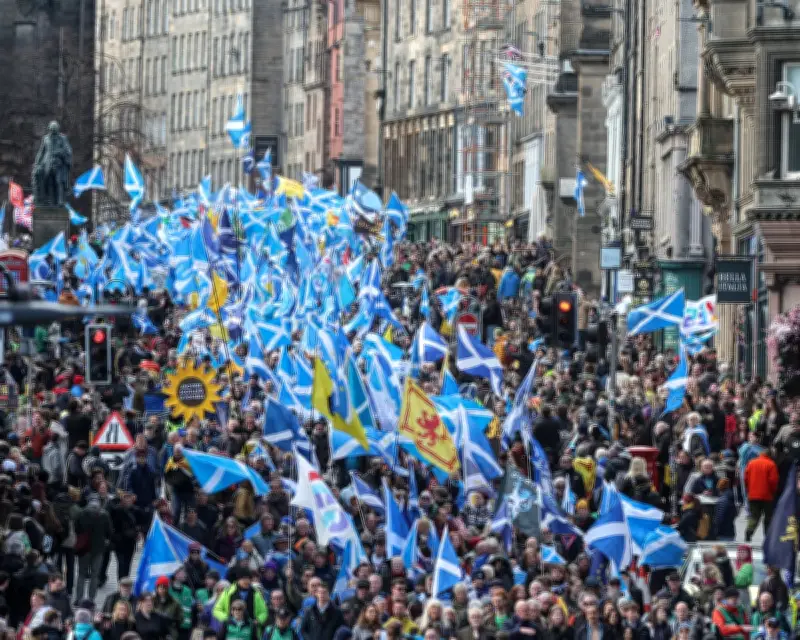
Former Scottish Labour leader Kezia Dugdale has stated that the Brexit vote fundamentally altered Scotland's political landscape, bolstering support for Scottish independence to near-record levels a decade after the referendum. Dugdale explained that the decision to leave the European Union created a 'frame around fairness' for many Scots, as 62% of voters in Scotland backed Remain in 2016, yet the country was taken out of the EU against its will. She noted that the UK government's pursuit of a 'hard Brexit' swayed undecided voters on independence, with current support standing at about 50% and reaching 55% in some polls.
Immediate Reactions to the Brexit Result
Dugdale recalled feeling 'utterly devastated' when the Leave result was confirmed early on 24 June 2016. She spoke privately to then First Minister Nicola Sturgeon, telling her: 'This changes everything.' Dugdale said many Scots felt they faced an immediate binary choice: an independent Scotland in Europe or a Boris Johnson-led Brexit Britain. This sense of betrayal, she argued, sustained support for independence that otherwise would have fallen back.
Ruth Davidson, Scottish Conservative leader in 2016 and a Remain champion, was also shocked by the result. She recalled Sturgeon seeking to persuade her to 'move forward together' with Dugdale for a second independence vote. Davidson thought 'no, no, no,' believing the Remain vote should not be co-opted for something it was not for. In her memoir, Sturgeon wrote: 'I felt distraught and enraged by the prospect of Brexit and what it said about Scotland's powerlessness within the UK. I had a strong sense of 'If not now, when?''

Support for Independence Did Not Surge as Expected
While some speculated support could surpass 60%, the anticipated tidal wave did not materialise. Over the past decade, the issue's salience faded amid political crises: Boris Johnson's hard Brexit, the Covid pandemic, the Ukraine war, and Donald Trump's chaotic presidencies, which translated into deep insecurity about the economy and public services. Davidson retained her 'animosity' towards Johnson, who she believes neglected genuine leadership and failed to articulate a coherent vision for a post-Brexit UK. However, the 'Boris effect' on independence support was less significant than feared. 'There was a hierarchy of concern for voters,' Davidson said. 'Whether we were for independence or for staying in the UK was a more material concern than the UK's relationship with the EU.'
Electoral Realities and the SNP's Decline
Electoral tensions emerged as early as 2017. Sturgeon's attempts to leverage Remain anger for a second referendum floundered as Theresa May's government resisted. Support for independence fell below 40% during 2017. In the 2017 general election, the SNP lost 21 Westminster seats and its vote share fell 13 points. Pro-UK parties enjoyed a renaissance: Davidson's Tories won 13 seats, Dugdale's Labour won seven, and the Lib Dems four. In the five subsequent UK and Holyrood elections, the SNP has never won 50% of the vote, weakening its mandate claims.
Yet during 2019, with Johnson succeeding May and pursuing a hard Brexit, followed by Covid failures, independence polling surged. As Sturgeon became a commanding presence compared to Johnson's chaotic leadership, support for leaving the UK reached 59% by October 2020.
Economic Impact of Brexit on Scotland
Economic decline and fears about the NHS now dominate the Scottish political agenda. Dugdale traces much of this to Brexit. Based on estimates from the National Institute of Economic and Social Research, Scottish Europe Minister Stephen Gethins told Holyrood on 18 June that Brexit led to £3.3bn in lost revenue for Scotland last year and added £250 to food bills. Prof Mairi Spowage, director of the Fraser of Allander Institute, argued that while Brexit clearly hit economic output, EU exports, and public finances, its precise impacts were obscured by other crises and policy failures. She noted the UK's economic decline partly traces to longer-term underinvestment since the 2008 banking crisis, with Covid, Ukraine, the Liz Truss government, US trade policy, and Middle East wars also affecting the economy. Migration has been complex: the 'Boris wave' of post-Brexit migration offset a fall in EU workers, partly due to increasing prosperity in EU member states.

Recent Elections and Voter Disillusionment
Despite First Minister John Swinney making independence and EU re-joining central to recent Holyrood elections, the SNP achieved only 38% of the vote, its lowest since 2007, winning most seats only due to a divided opposition. Reform UK, an anti-EU party, won 17 seats and is jointly Holyrood's second largest party, attracting some EU-sceptic former SNP voters. Dugdale, now an associate director at Glasgow University's Centre for Public Policy, is no longer a Labour member and voted SNP in the 2019 European Parliament election in protest over Brexit. Many voters are driven by anger and disillusionment, partly because Brexit failed to deliver on its promises. 'We've had more than 15 years of austerity and 15 years of falling trust in political institutions,' Dugdale said. 'If we sustain these things long enough, people no longer trust the system to make their lives better.'