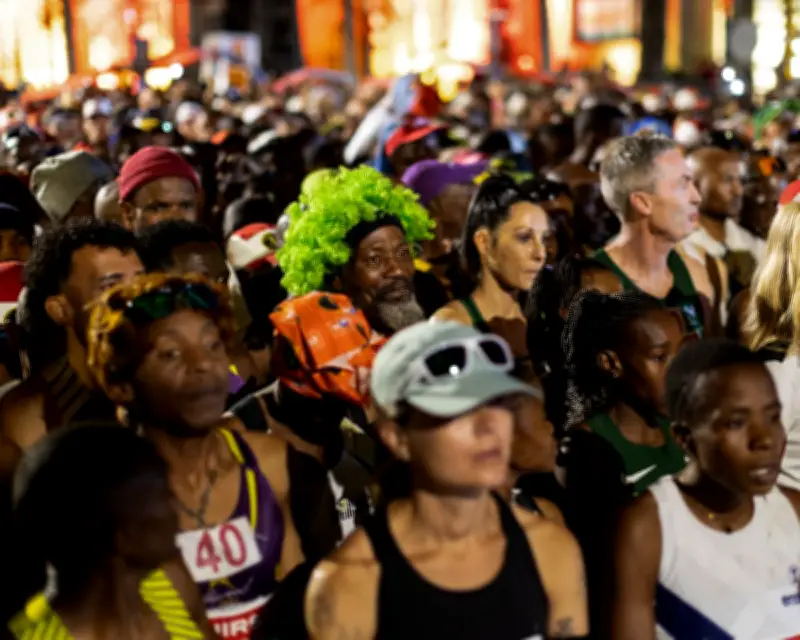
On a single day each June, South Africa's stark racial divides appear to dissolve as thousands of runners gather for the Comrades Marathon, the world's oldest and largest ultramarathon. This year, over 20,000 participants lined up outside Durban city hall on 14 June, aiming to complete the 55-mile (88 km) course to Pietermaritzburg within the 12-hour cutoff.
A Century of Tradition and Transformation
First run in 1921, the Comrades was conceived by World War I veteran Vic Clapham to honor fallen comrades. That inaugural race featured 34 runners, all white men, with only 16 finishing. Today, the event reflects South Africa's complex history. Desegregated in 1975 and opened to women, the race now includes runners from all backgrounds—security guards, bankers, celebrities, and township residents alike.
Personal Stories of Resilience
William Seleka, a 38-year-old appliance repairman from Alexandra township, began running in March 2025 after a deep depression following his marriage breakup. "I thought for me to stay alive, I had to keep myself busy," he said. Joining the Run Alex club, he progressed from 10 km runs to a 50 km ultramarathon within six months. Training for Comrades involved at least 10 km every weekday and up to 50 km on Saturdays, with recovery consisting of a half marathon. Seleka aimed to create a legacy for his children, saying, "I can't wait to have my red cap and the medal to show my kids."

The Race Day Experience
Runners started in three batches at 5:00, 5:15, and 5:30 am. The "up run" from Durban to Pietermaritzburg involves climbing about 1,800 meters (5,900 feet). Spectators lined the route, cheering and offering support. At the Run Alex aid station near the halfway point, Seleka changed shoes—a decision that later caused agony. By 34 miles, he was in severe pain, distracting himself by singing songs he didn't know the origin of. Around 46 miles, he swapped shoes again and pushed on.
Historical Context and Unity
The Comrades has played a role in challenging apartheid-era divisions. In the 1980s, televised broadcasts showed scenes of a white runner sharing water with a black runner—a powerful symbol in a segregated society. Ryan Lenora Brown, a journalist covering the race since 2017, noted, "You would have these scenes ... which was such a small gesture, but such a huge thing in that society that was so divided." Black runners like Hoseah Tjale and Sam Tshabalala, the first black winner in 1989, became proof of capability.
Finish Line Drama
As darkness fell, guns marked the 12-hour cutoffs. About 91% of runners finished, according to The Running Mann blog. The final 12-hour bus driver, Shahieda Thungo, crossed at 11:56:34, carrying dozens with her. Some runners missed the cutoff by seconds, collapsing in anguish. Seleka crossed at 10:30:49, crying as he thought of his sister, whose kidneys failed in 2018. "At the start, everything changed," he said. "I said this pain today is for my younger sister." He is already planning next year's race.