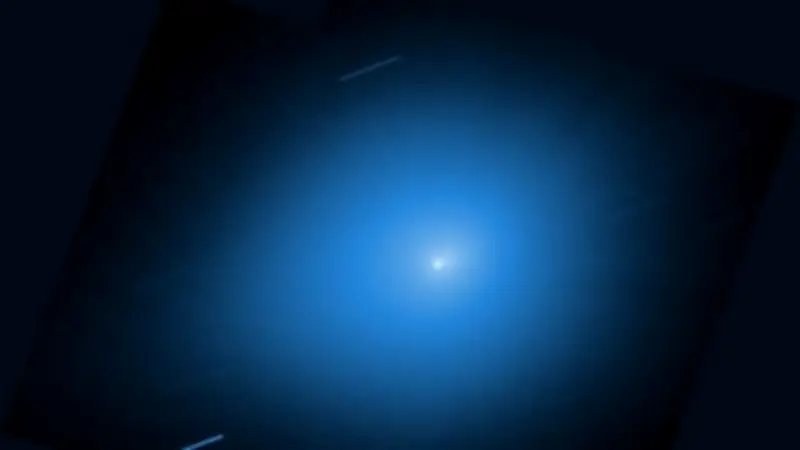
One year ago, on July 1 2025, astronomers detected a remarkable object streaking through the Solar System. Discovered by the Asteroid Terrestrial-impact Last Alert System (ATLAS) in Chile, the object was quickly identified as an interstellar comet, only the third ever observed. Designated 3I/ATLAS, it raced past the Sun at record speed and is now departing the Solar System at more than 60 kilometres per second, never to return. The discovery sparked global headlines, with some even speculating it might be an alien spaceship—a distraction from the object's true scientific marvels.
New Research Reveals Ancient Origins
In a paper published today in Nature, a team led by Martin Cordiner from NASA's Goddard Space Flight Center has provided groundbreaking insights into the comet's origin. Using observations from the James Webb Space Telescope (JWST) and the Atacama Compact Array (ALMA), the scientists analyzed the comet's chemical composition. They found that the carbon molecules emitted by 3I/ATLAS contained significantly less carbon-13—a heavy isotope of carbon—compared to similar objects in our Solar System. This isotopic deficiency indicates that the comet formed roughly 12 billion years ago, during the early stages of the Milky Way's formation, making it far older than the 4.6-billion-year-old Solar System.
What Are Interstellar Objects?
Planetary systems are inherently messy. Alongside planets, they contain vast amounts of debris left over from formation. This debris often moves on chaotic orbits and is frequently ejected into interstellar space due to gravitational interactions with planets. For decades, astronomers have theorized that if planetary systems are common, the space between stars should be filled with rocky and icy objects—the remnants of ancient and new systems. Most of these interstellar objects never approach another star, but a few inevitably pass through the inner Solar System, becoming observable. The three discovered so far—1I/'Oumuamua, 2I/Borisov, and 3I/ATLAS—are the first representatives of this population. Their detection has only become possible in the past decade thanks to advancing technology.

A Fast-Moving Ancient Comet
Upon discovery, astronomers calculated that 3I/ATLAS was moving at an extraordinary speed. At its closest approach to the Sun, it traveled at over 68 kilometres per second. Even before feeling the Sun's gravity, its velocity exceeded 58 km/s. This high speed hinted at an ancient origin. Orbital analysis suggested the comet likely came from the Milky Way's "thick disk," a population of old stars that formed billions of years before the Sun. The new chemical evidence confirms this hypothesis.
Chemistry Confirms Age
The key to dating 3I/ATLAS lies in its carbon isotopes. Almost all carbon in the Milky Way is produced by massive stars through nuclear fusion. When these stars die, they release carbon into the galaxy, where it is incorporated into new stars and planets. However, a process called "hot bottom burning" converts carbon-12 into carbon-13 over time. As a result, the fraction of carbon-13 in the galaxy has steadily increased. The extremely low carbon-13 abundance in 3I/ATLAS indicates it formed when carbon-13 was scarce—roughly 12 billion years ago. "This comet is a true galactic fossil, preserving the chemical fingerprint of the early Milky Way," said Cordiner.
The Future of Interstellar Object Discovery
Each of the three interstellar visitors observed so far has been unique. The Vera Rubin Observatory in Chile, equipped with the world's largest digital camera, is expected to revolutionize the field. Its wide-field, rapid-scanning capability makes it ideal for detecting fast-moving interstellar objects. Astronomers predict it could discover dozens of such objects within the next decade, allowing scientists to study them as a population rather than isolated cases. This will provide deeper insights into the history of star and planet formation across the galaxy.