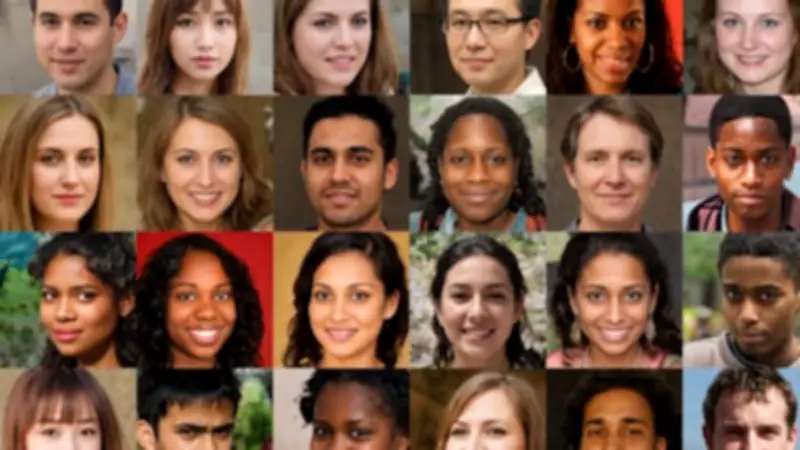
Deepfake faces generated via artificial intelligence have become so realistic that they routinely fool people, with some research suggesting there may be US$40 billion worth of deepfake-related fraud annually by 2027. Not only do most people struggle to spot AI faces, but as long ago as 2023 researchers discovered some AI faces are “hyperreal” – they look more real than actual human faces. They also found people are overconfident they can spot AI faces, with the most confident people making the most errors.
Software-based deepfake detectors do exist, but they cannot really explain the reasons for their detections and suffer from serious weaknesses. Some can be fooled simply by converting the image type, such as from png to jpg. However, new research published in PNAS shows most people can learn to spot AI faces with an hour or so of practice, using a straightforward training method that improves detection through experience rather than direct instruction.
Key Differences Between AI and Human Faces
In early research, scientists discovered a key difference between AI and human faces. AI faces are hyperaverage – they tend to be more symmetrical, proportional and attractive than human faces, but less expressive and memorable, and less likely to stand out in a crowd. Intriguingly, people can accurately and reliably judge these qualities, but frequently misinterpret the clues. For example, people often think that faces that look a bit odd are AI-generated, when in fact human faces are more likely to have distinctive, unusual features.

Although most people struggle to decide whether a face is AI or real, one group is naturally good at picking up on these clues. So-called super-recognisers, who have exceptional human face perception, seem to be attuned to hyperaverageness, making them better at spotting AI faces. This led researchers to wonder if AI detection abilities can be trained like other forms of perceptual expertise.
Training Improves Detection Dramatically
In the first study, 45 participants at the Australian National University were asked to rate around 100 faces on six qualities that can be used to tell AI faces apart from real ones: distinctiveness, memorability, proportionality, symmetry, attractiveness and expressiveness. Participants were not told how these clues might help distinguish AI from real faces – they had to figure that out themselves. They were told which faces were AI and which were human, but not that AI faces were more symmetrical or less expressive. They had to learn these clues through experience rather than direct instruction.
Before and after training, participants’ ability to tell AI faces apart from human ones was tested with new faces not used in training. In one test, participants were shown three faces – two human and one AI – and asked to select the AI face. Average accuracy doubled from 40% before training to 80% afterwards. Impressively, all participants improved in their AI detection abilities and several achieved close to 100% accuracy. Participants also became faster and more confident in their correct judgements.
Replication and Online Effectiveness
To test robustness, the Different Minds Lab at the University of Victoria in Canada conducted a replication of the AI detection training with Canadian participants. The Canadian lab obtained results as strong as those in the original Australian study, showing the training is reliable and can work for different groups. The training was also just as effective when administered online rather than in person, suggesting it could be a cost-effective remote intervention in deepfake detection.
Limitations and Future Directions
However, this does not mean the AI detection problem is solved. The training used faces produced with one particular generative AI model, StyleGAN3, one of the most realistic face generators available. Technology is advancing rapidly and there are many other models. The method has potential to adapt to new models by updating training images and using multimedia, but evidence that this will work is not yet available. The clues for spotting AI faces may shift for other models. Other important questions remain: do the training benefits hold up over time? Is the training effective for people of all ages, including older adults or children?

Practical Tips for Spotting AI Faces
If you want to get better at recognising AI-generated faces, looking at many examples is a good start. Websites such as Which Face Is Real or This Person Does Not Exist offer plenty of examples. While looking, bear in mind the six key factors: how distinctive is the face? how memorable is it? how proportional is it? how symmetrical is it? how attractive is it? how expressive is it? This exercise may improve your deepfake radar.
But the more important takeaway is that AI deepfakes are improving very quickly – they can easily fool us, even if we think we can spot them. The clues are no longer obvious: they are not based on specific details but on facial impressions which people form rapidly and naturally, but which can be misleading. At the same time, there is hope. Researchers have shown it is possible to train people to detect AI faces. By combining this human-centred approach with algorithmic detection, we may yet keep up in this cat-and-mouse game of advancing technology.