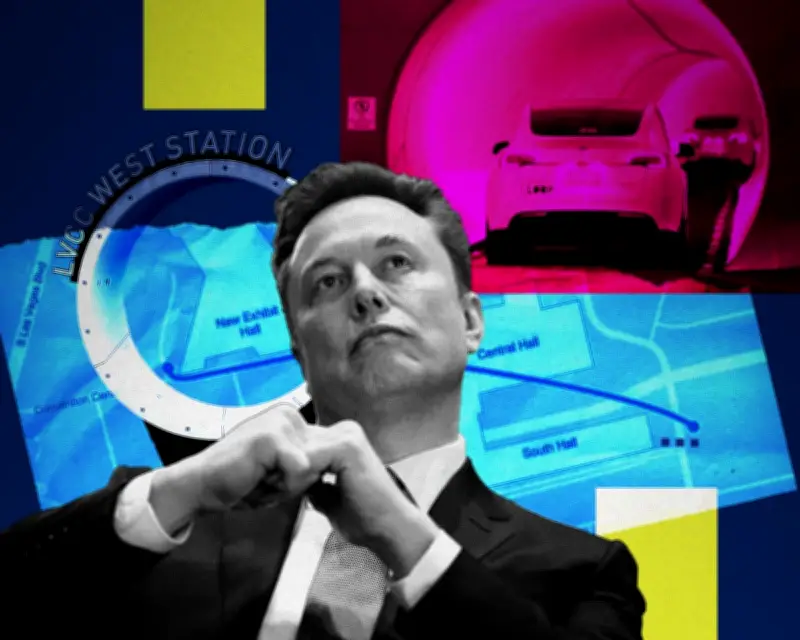
In the heart of Las Vegas, a subterranean network of tunnels promises to revolutionize urban transit. The Vegas Loop, brainchild of Elon Musk and his Boring Company, is touted as a solution to traffic congestion. Yet, a recent ride through this system reveals a starkly different reality.
The Vision vs. Reality
The concept is simple: electric vehicles whisk passengers through tunnels at high speeds, bypassing surface traffic. But the actual experience is far from the futuristic dream. The ride is bumpy, the tunnels are narrow, and the vehicles move at a pace that barely outpaces walking.
Upon entering the Las Vegas Convention Center station, the atmosphere is underwhelming. The tunnel, dimly lit and claustrophobic, feels more like a service corridor than a cutting-edge transit system. The Tesla Model 3 used for the ride is standard, offering no special modifications for the underground journey.

A Slow Crawl
Contrary to the promised high speeds, the vehicle crawls through the tunnel at roughly 35 miles per hour. The ride is not smooth; the concrete tunnel amplifies every bump and rattle. Passengers are jostled, making it difficult to read or work. The trip, though short, feels longer due to the monotonous gray walls.
The system's capacity is also questionable. Each vehicle carries only a few passengers, and with limited numbers of cars, the throughput is minimal. For a city that hosts millions of visitors, this solution seems inadequate.
The Neoliberal Undertones
The Vegas Loop is a quintessential example of neoliberal urban planning: private enterprise stepping in where public transit fails. Yet, it prioritizes profit over public good. The $52.5 million project was funded by the Boring Company, but the return on investment relies on high fares and limited access.
Critics argue that the money could have been better spent on improving public transit. The loop serves a small area, primarily the convention center, and does little to alleviate the city's broader traffic woes. It is a boutique solution for a mass problem.
Environmental Claims
The Boring Company touts the loop as environmentally friendly due to its electric vehicles. However, the energy consumption of the tunnel lighting, ventilation, and vehicle charging is significant. Moreover, the construction process was resource-intensive, involving massive concrete usage.
Compared to light rail or bus rapid transit, the loop's environmental benefits are marginal. It is a high-tech vanity project rather than a sustainable solution.
Passenger Experience
For a first-time rider, the novelty wears off quickly. The lack of windows to the outside world creates a disorienting sense of enclosure. The ride is silent except for the hum of the electric motor and the occasional rumble from other vehicles.
Safety is another concern. In the event of an accident or fire, evacuation would be challenging. The tunnels have limited exits and no emergency walkways. The Boring Company assures that safety measures are in place, but the cramped space raises doubts.
Comparison to Other Transit
Compared to the monorail or buses, the loop offers little advantage. The monorail, though older, provides a smoother ride and higher capacity. Buses, while slower, cover more routes and are cheaper.
The loop's main selling point is its novelty. It is a tourist attraction rather than a practical transit system. For locals, it offers no real benefit.
The Future of the Loop
Elon Musk envisions a vast network of tunnels under Las Vegas, eventually connecting the airport, the Strip, and downtown. But the current system is a far cry from that vision. Expansion plans face regulatory hurdles and funding challenges.
The Boring Company's other projects, such as the Chicago O'Hare express, have been shelved. The Vegas Loop may remain a one-off experiment.
Conclusion
My ride on the Vegas Loop was a neoliberal nightmare: a private solution that fails to address public needs. It is slow, cramped, and overhyped. While it may be a fun diversion for tourists, it is not the traffic fix that Las Vegas needs. The city would be better served by investing in robust public transit.