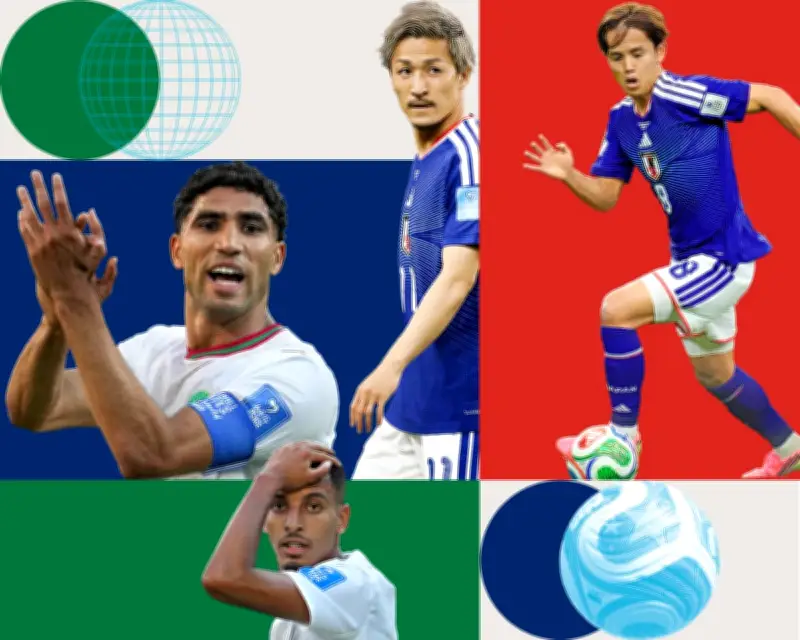
Two eye-catching last-32 ties offer hope of a winner from outside the traditional powers – Brazil and the Netherlands could be gone. Japan and Morocco face old order giants in the hope of a brave new world.
World Cup in Flux
The World Cup exists in a state of perpetual flux. It goes to new territories. It gets bigger. It experiments with second group phases and replaces playoffs for sides level on points with goal difference then head-to-head. And still one of the same eight countries from western Europe or South America wins it. Since Argentina in 1978, there have been two new winners, and those were France and Spain, from the heart of Uefa, their success based on maximising the advantages of being European and wealthy; no countries have been so successful at industrialising youth production, so much so that they now provide the models for every country seeking to invest in academy programmes.
Infantino's Global South Champion
Yet it feels that the old world has never been so at odds with the game’s leadership. Gianni Infantino portrays himself as a champion of the global south and, just like his two predecessors as Fifa president, Sepp Blatter and João Havelange, it is voters from Africa, Asia and Latin America who sustain him in power. The horrendous treatment of migrant workers in Qatar and that fans, journalists, team officials and even a referee have been denied entry to the USA and Canada make no impact on Infantino’s popularity; the delegates have their salaries and expenses, their committee posts and stipends, and none are going to rock the boat. The expanded Club World Cup may have provided useful revenue to certain western European superclubs, but it still represents the latest front in Infantino’s continuing power struggle with Uefa.

Uefa's Limited Challenge
Perhaps Europe, under more dynamic leadership, could mount a challenge to Fifa, but Aleksander Ceferin’s Uefa has so far restricted itself to little more than trolling: announcing a freeze on ticket prices for Euro 2028; appointing Omar Artan, the Somali official stopped at the airport in Miami, to referee the Super Cup final; insisting hydration breaks will not be mandatory in Uefa competition. And so Fifa goes on, the world governing body and its competitions becoming ever bigger and more bloated, sustained by the very areas on which its policies have the most negative impact. In a world of authoritarian populism, Infantino looks as untouchable as ever. Despite the morbid symptoms, there is perhaps a new world waiting to be born.
Credible Candidates from Outside
The question of whether a side from outside Europe or South America could win the World Cup has been asked with increasing urgency since Cameroon reached the quarter-finals in 1990 and Nigeria and Cameroon claimed Olympic gold in 1996 and 2000. At this tournament, the two most credible candidates take on members of the incumbent elite in the last 32 on Monday: Japan play Brazil and Morocco the Netherlands (who, despite never having won the World Cup, have been in three finals and, by dint of geography and economics, are still representative of the old order). Japan and Morocco impressed in the buildup and have – broadly speaking – maintained their form in the group stage, but they have reached this point via very different routes.

Morocco's Development System
Morocco’s World Cup achievements far outstrip what they have done in the Africa Cup of Nations. Even if the court of arbitration for sport dismisses Senegal’s protest against the decision of the appeals board of the Confederation of African Football to award the 2025 Cup of Nations to Morocco, that will be only their second success in the competition. But Morocco, in 1986, became the first African side to make it through a World Cup group stage before, in Qatar four years ago, becoming the first to reach a semi-final. They have benefited, without question, from their diaspora. Of the 26-man squad, 19 were born outside Morocco – three of them in the Netherlands. Many of those players have had the advantage of schooling in top European academies whose wealth allows them to provide an education that is simply not available elsewhere. But Morocco is funding its own development system. The Mohammed VI football academy just outside Rabat provided four players for the 2022 squad. While the midfielder Azzedine Ounahi is the only alumnus in this squad, the programme has been expanded to four more cities. It is reasonable to assume that over the next decade there will be significant elevation of opportunity for aspiring footballers who grow up in Morocco.
Japan's Homegrown Talent
In Japan, wealth is not the issue. The J League, established in 1992, has been a huge success. Western Europe still remains the destination for the best players – only three of this squad still play in Japan – but they are developed at home. There are few qualms now among major European clubs about signing players from the J League. The process of adaptation is no more fraught than it is from any other league from the tier just below the very elite. At the same time, there is a discernible Japanese style, something that has blossomed with the national team in eight years under Hajime Moriyasu. They press in organised waves and play a neat, technical, possession game; Daizen Maeda’s goal against Sweden was distinctively Japanese.
Key Matchups and Psychological Battles
Morocco will have to find a way to deal with the power of Brian Brobbey, or at least stopping the supply to him; the clash between Achraf Hakimi and Cody Gakpo looks like being vital. Japan have never won a knockout game at a World Cup and, for them at least, part of the battle will be psychological, although the fact they came from 2-0 down to beat Brazil in a friendly in Tokyo in October may mitigate that. Carlo Ancelotti’s Brazil now occupy the weird space his Real Madrid used to: obviously flawed and yet somehow blessed with enough high-class individuals to win games anyway. Perhaps Ancelotti will continue to coax match-defining moments from Vinícius Júnior, but Japan could dominate midfield and Takefusa Kubo could be back after a knee injury to add creative edge.
Conclusion
These are just two games. Both look extremely competitive. Brazil and the Netherlands could win and the two best hopes for a winner from outside the traditional powers could be gone within a few hours. But the fact those match-ups exercise such fascination is itself telling. If a new world is coming into being, it will be born on the pitch via link-ups with the European system, rather than through Infantino’s machinations.