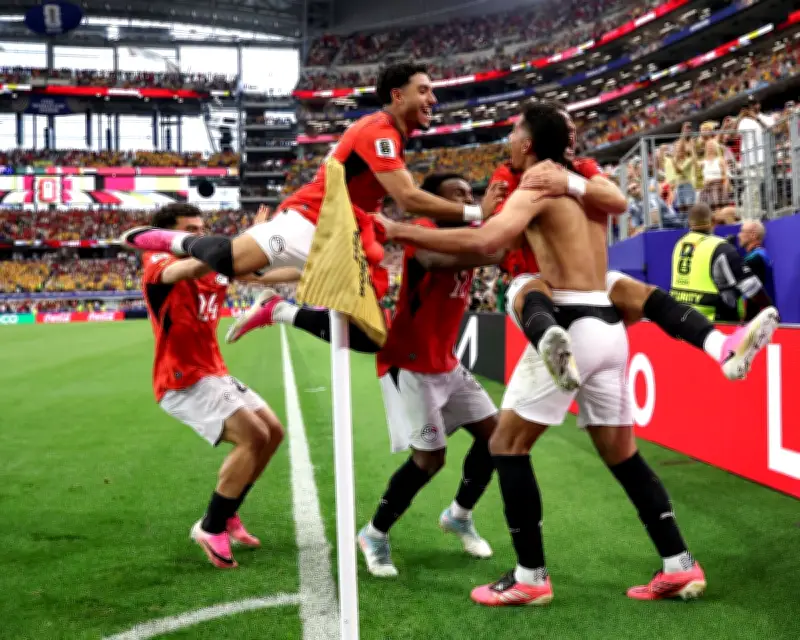
Hossam Abdelmaguid puffed out his cheeks, steadied himself, began his run up with exaggerated slowness, checked and then sent Mat Ryan the wrong way. He ran off to the corner, ripping off his shirt, and was soon joined by an ecstatic posse of Egyptian players. For the first time since 1934 when there were only 16 teams, Egypt are in the last 16 of the World Cup. At some level, football is always about the outcome; the process is just a footnote.
Penalty Shootout Decides Tense Encounter
Penalties had seemed probable from the moment 10 minutes into the second half when Mohamed Hany headed into his own goal to level the scores. What was unexpected was that Australia brought Ryan on for penalties, replacing the impressive Patrick Beach. The gamble backfired as Ryan failed to save any of Egypt's four spot-kicks, while Australia missed one.
Emam Ashour Opens Scoring
Emam Ashour has had a remarkable year. Playing in a central role behind the front two, he was arguably Egypt's best player at the Cup of Nations. Deployed on the right in this tournament, he scored his first international goal in the draw against Belgium, and then he put his country ahead here. When his shot from a cleverly worked free-kick on the left was blocked after 13 minutes, he lingered at the back post and, played onside by Lucas Herrington, was unmarked to head in when the left-back Karim Hafez returned the ball to the middle.

Australia Equalise Through Own Goal
There was a time when Egypt would have tried to sit on their lead and kill the game, but Hossam Hassan is no Hassan Shehata or Carlos Queiroz. There was remarkably little spoiling or time-wasting, in part down to the admirably no-nonsense approach of the Uruguayan referee, Gustavo Tejera, who seemed able to diagnose (non-)injuries from a distance of 20 yards while jogging backwards. The paucity of Australian chances was more about their lack of creative spark than anything Egypt did. Cristian Volpato had flicked the top of the bar early on, but that aside what half-opportunities did arise for Australia before half-time tended to be from half-cleared set-plays. Sure enough, it was a set-play that brought the equaliser 10 minutes into the second half, Mohamed Hany heading an Aiden O'Neill free-kick into his own net.
Mohamed Salah's Impact
Mohamed Salah has often been criticised for his lack of effectiveness for Egypt but often that's been because he has been the sole attacking figure in a team that doesn't do much attacking. The emergence of Omar Marmoush has eased the dependency to an extent but he too has struggled to produce his best form for his country. He had squandered a golden chance to double Egypt's lead in the first minute of the second half, shooting wide with just the keeper to beat. For much of the second period so little happened the temptation was to wonder whether 11-a-side might be a couple too many. But when Hafez overstretched and was forced off, Hossam Hassan switched to a back three, bringing on Trezeguet to play as a left wing-back. Suddenly, Egypt – and Salah in particular – had renewed life. First, in injury time, he arced in a cross for Ramy Rabia, whose header was tipped over spectacularly by Beach, and then early in extra-time he blasted a decent chance over.
Goalkeeper Gamble Backfires for Australia
Patrick Beach, who had a strong game, was replaced by Mathew Ryan just before the penalty shootout. According to reports, Tony Popovic made the change hoping Ryan's experience would pay off, but it did not. Egypt scored all four of their penalties through Abdelmaguid, Ashour, Trezeguet, and Salah, while Australia's Aiden O'Neill hit the post and Ryan failed to make a save.

Off-Field Incident Overshadows Build-Up
Egypt's build-up had been overshadowed by a clash between the team director Ibrahim Hassan, the twin brother of the coach, and a Dallas police officer at the team hotel the day before the game. Video footage appears to show the officer intervening with needless aggression to prevent a player posing for a photograph with a child. Hassan, though, is not somebody to take a backward step. He once grabbed a rifle from a Lebanese army officer to prevent him striking his brother when a game got out of hand, missed the 1998 Africa Cup of Nations after raising a middle finger at Moroccan fans and habitually sits at the back of national team press conferences taking issue with questions he feels tonally inappropriate. After the officer had shoved Hassan in the chest, the former defender squared up to him, two huge bald men going nose to nose. The officer appeared to be reaching for his handcuffs when the forward Trezeguet intervened and both eventually backed down. Although a federation source dismissed the incident as "a minor altercation", he also criticised local security's "poor handling" of the arrival and the "harsh demeanour" of police officers. Dallas Police later acknowledged an incident had occurred, blaming "individuals" for not "displaying credentials properly".
Egypt's Historic Achievement
But Egypt can forget about that for now. They are still in this, going on to Atlanta to face either Cape Verde or the world champions Argentina. According to FIFA, this is Egypt's first appearance in the knockout stage since 1934, when the tournament featured only 16 teams. The win marks a historic moment for Egyptian football, with coach Hossam Hassan leading the team to unprecedented success.