After storming through the playoffs, the New York Knicks have a chance to win their first NBA title since 1973. For 25 years, the Knicks have given just enough hope to keep me from walking away. Four wins from watching an NBA title with my father, I know why I stayed.
The New York Knicks are four wins from hallelujah. I’ve been waiting for this since 2002. I was baptized in blown leads. Never, not once, considered leaving. This type of immolation requires explanation.
The Knicks have not won an NBA championship since 1973. Maybe I’m bad luck, or maybe losing is what shaped me.

2012 was the year I started thinking about death. I was suicidal. I got very close. It was also the year I got my first playoff win. I don’t say this to shock. I say it because you need to know what was on the line – what kind of person was watching those games, what the myth of a Knicks championship was doing inside the gut of someone who needed it to mean something real. Call me simple, but watching the Knicks win a title with my pops is all I want in this life.
Let’s talk about that first playoff win. In 2012, Miami had taken a 3–0 lead over the Knicks in their first-round series. No team in NBA history has, and still hasn’t, come back from three games down. Game 4 was a formality – a perennial suffering the Knicks and their fans had been enduring, in one form or another, since 2002, the year I became a Knicks fan.
To watch that game, my pops and I tried every sports bar in Dallas, but none would show it. One bartender, mouth comically agape, responded to my request to put on the game with, “Why the hell would anyone want to watch the Knicks?”
As we always have, pops and I found a way to watch the Knicks together. That time, it was on a small television in the kitchen of a Mexican restaurant in south Dallas. We sat side by side on packing crates, our feet white with maiz powder, the smell of carne asada rising off the plancha behind us. The TV was used by the cooks, flickering through whatever the world had to offer that night. That night, it offered Carmelo Anthony, my favorite Knick of all time.
Melo lit up for 41 points. For one night, he slayed giants: LeBron James, Dwyane Wade and Chris Bosh. The defending champs. It meant nothing in the series. It meant everything to me. And when the final buzzer sounded – Heat 87-89 Knicks – I fell into my father’s arms. I am not a small man, and neither is he, but we crashed together in sweat and tears. The carne asada sizzled around us, indifferent to all of it. He spoke a benediction into my tousled hair: “This win is for you, son.”
That first playoff win came wrapped in the specific, bittersweet logic that would define the next decade of my life: something real and true and worth feeling, shadowed at every edge by the knowing that it wasn’t enough, that it would never quite be enough, that the Knicks had perfected the art of giving you just enough to keep you from walking away.
Three days later, Miami won Game 5. The Knicks went home. I lurched back to whatever my life was then, which was not good. But for years afterward, that night in the restaurant kitchen remained the closest thing I had to proof that hope could survive humiliation.
That was 13 years ago. This is now.
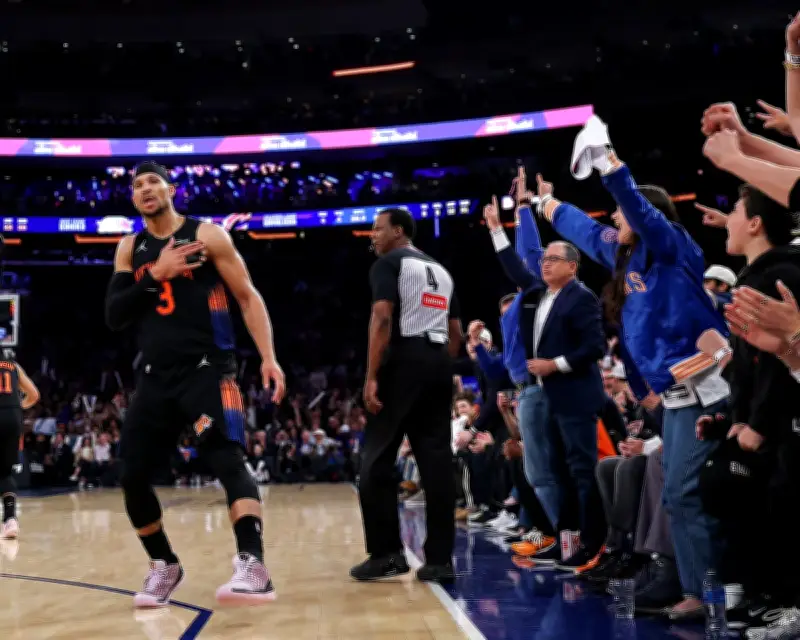
It’s spring 2026, and the New York Knicks have swept the Philadelphia 76ers in four games. Then the Cleveland Cavaliers in the Eastern Conference finals. They have 11 wins in a row. They have outscored their playoff opponents by 262 points – the most lopsided 11-game stretch in NBA history, regular season or playoffs. They’ll play the San Antonio Spurs in the NBA finals, their first since 1999. Almost every other team who ran a streak like this won the title.
Between the end of the semi-finals and the start of the Eastern Conference finals, my dad’s best friend, Al Jerry, died. I wrote about him in my first essay for the Guardian – about the two of them, really. They called themselves Thunder and Lightning, a one-two punch that owned South Floral Park, the Long Island neighborhood where my dad grew up. They played at the Hill, some cracked blacktop court that meant everything to the kids who claimed it, and they beat everybody.

Al and my dad watched the 1970 championship together. They watched ’73 together too. They were young men then, in their prime, the city at its loudest, Willis Reed limping out of that tunnel. They had their whole lives in front of them, and they spent a piece of it watching the Knicks win it all. Twice.
They won’t get to watch the next one together. But my dad’s still here. And so am I.
To understand what the next few weeks will mean, you have to understand what Knicks fans have climbed out of. From 2002, when I started my fandom, to 2020, when Leon Rose took over as team president, the Knicks compiled a winning percentage of .391. I signed up to be a fan right at the start of one of the worst runs in the history of any North American professional sports franchise.
The numbers from those years are written in blood. A 23–59 season in 2005/06. Franchise-worst records of 17–65 in 2014/15 and again in 2018/19, the second of those featuring an 18-game losing streak. It was a famine of winning so complete that Knicks fans wore paper bags over their heads to games. And over all of it, always, was James Dolan. It was solipsistic governance – the franchise as mirror, held up only to reflect the owner back to himself.
I watched all of that from Dallas, 1,600 miles from Madison Square Garden. I have written before about what the Knicks meant to my survival during the darkest years of my 20s – how the prospect of watching a championship with my father was, on more than one occasion, the specific prayer that kept me here. I meant it then. I mean it now. The losing was the medium through which my hope traveled.
What Rose built was boring in the best way. No ego-driven, vanity moves. No $100m contract for a 31-year-old with a bad knee. Tom Thibodeau arrived as head coach and ended the playoff drought in his first season. Jalen Brunson arrived in 2022 on a four-year deal. He became one of the five best offensive players in the NBA before his second season was finished. Karl-Anthony Towns was acquired via trade. Mikal Bridges came over from Brooklyn. The Knicks have made the second round of the playoffs every year with Brunson. Last spring, they reached the Eastern Conference finals for the first time since 2000. They lost to Indiana in six games. Three days later, Dolan fired Thibodeau.
Mike Brown replaced Thibs as head coach, guiding the Knicks to 53 wins this season. The Garden has been loud all spring, as my father described it when he was a teenager on Long Island, listening to Marv Albert on a crackling car radio.
Pops and I have been on this ride for a quarter of a century. I don’t know how to want something this much and not be afraid of it. I am not, by nature, a lachrymose man. I’ve cried over worse things than a basketball game, but I’m not making any promises about the next few weeks. I’ve been practicing hope for a long time, and I’ve gotten very good at protecting myself from pain, keeping one hand, always, on the door.
This time feels different. Now, the door is open, and Pops and I are standing in the frame. Together.