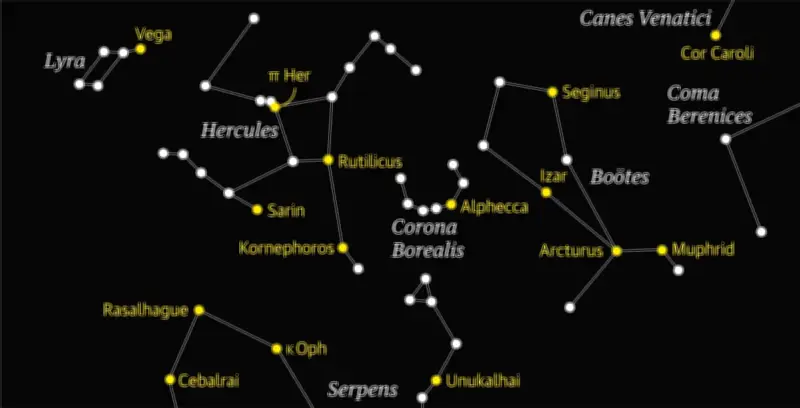
As summer nights stretch long and warm across the Northern Hemisphere, one of the most rewarding constellations for stargazers climbs high overhead: Hercules, the hero. This sprawling pattern of stars is not the brightest in the sky, but it rewards patient observers with one of the great deep-sky treasures—the Great Globular Cluster, also known as M13.
Locating Hercules
To find Hercules, look for the keystone-shaped asterism that forms the hero's torso. This distinctive quadrilateral of four stars sits between the bright stars Vega (in Lyra) and Arcturus (in Boötes). A good way to start is to find the Summer Triangle—the bright stars Vega, Deneb, and Altair—and then look for the keystone just below Vega. The constellation is visible from mid-northern latitudes throughout summer, reaching its highest point around midnight in late June.
The Great Globular Cluster
Within Hercules, about one-third of the way from the star Zeta Herculis to Eta Herculis along the western side of the keystone, lies M13. This globular cluster contains hundreds of thousands of stars packed into a sphere only about 145 light-years across, located about 25,000 light-years from Earth. To the naked eye under dark skies, it appears as a faint, fuzzy patch of light. Binoculars or a small telescope reveal it as a brilliant, sparkling ball of stars—a true jewel of the summer sky.

Viewing Tips
The best time to observe M13 is on moonless nights when the sky is darkest. Use averted vision—looking slightly to the side of the object—to see more detail with the naked eye. With a telescope, magnifications of 50–100x will begin to resolve individual stars at the cluster's edge. According to astronomer and author Fred Schaaf, "M13 is the finest globular cluster visible from mid-northern latitudes, a stunning sight even in small telescopes."
Historical Significance
Discovered by Edmond Halley in 1714, M13 was later observed by Charles Messier, who catalogued it as the 13th object in his famous list of non-cometary nebulae. In 1974, the Arecibo radio telescope transmitted the Arecibo Message toward M13, a binary-encoded message intended to communicate with any potential extraterrestrial intelligence. The message will take approximately 25,000 years to reach its destination.
Conclusion
Whether you are a seasoned astronomer or a casual skywatcher, Hercules and its globular cluster offer a rewarding target for summer nights. With just a pair of binoculars, you can glimpse one of the most magnificent star clusters in the sky—a true celestial jewel.