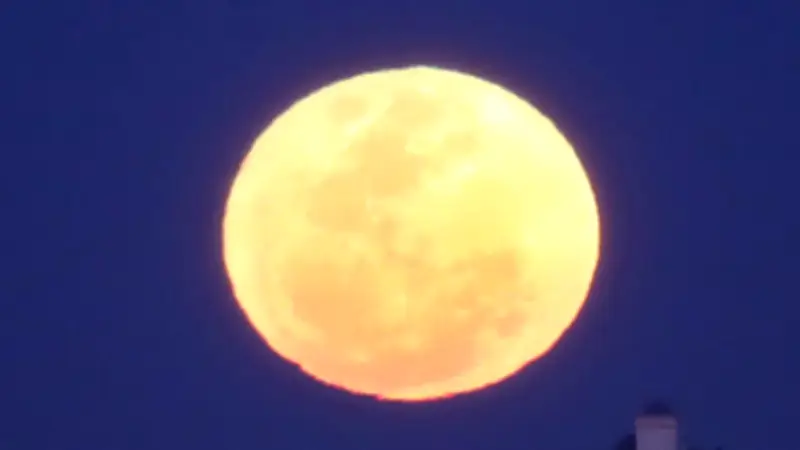
A rare lunar event combining two celestial phenomena will light up Australian skies this Sunday evening. Skywatchers across the country can witness a blue micromoon, an occurrence that merges a blue moon with a micromoon.
What is a Blue Micromoon?
A blue moon does not refer to the moon turning blue; rather, it is the second full moon appearing in a single calendar month. This happens because the lunar cycle does not align perfectly with our calendar, allowing two full moons in May. Sunday's event also coincides with a micromoon, when the moon is at its farthest point from Earth, known as apogee. Micromoons appear about 6% smaller than an average full moon and over 12% smaller than a supermoon.
Visibility and Timing
Laura Driessen, a postdoctoral researcher at the Sydney Institute for Astronomy, described the event as “incredibly bright” and visible anywhere in Australia. “It’s tens of thousands of times brighter than the brightest star in the night sky,” she told SBS News. The best time to observe the blue micromoon is on Sunday, May 31, when the sky is clear and dark.

- In NSW, Queensland, Victoria, the ACT, and Tasmania: peak fullness at 6:45 pm AEST.
- In South Australia and the Northern Territory: peak at 6:15 pm ACST.
- In Western Australia: peak at 4:45 pm AWST.
For optimal viewing, look towards an open eastern horizon. The moon may appear golden-orange near the horizon at moonrise or after sunset. No telescope is required, though binoculars can enhance the view of the moon's surface.
Size Perception
Ms. Driessen noted that human eyes cannot detect the size difference of a micromoon. “You can only tell the difference if you have a photo of an average moon next to a photo of a micromoon,” she said. “It will look like a beautiful full moon to us.”
The next blue moon will not occur until December 31, 2028, making this weekend's event a must-see for astronomy enthusiasts.