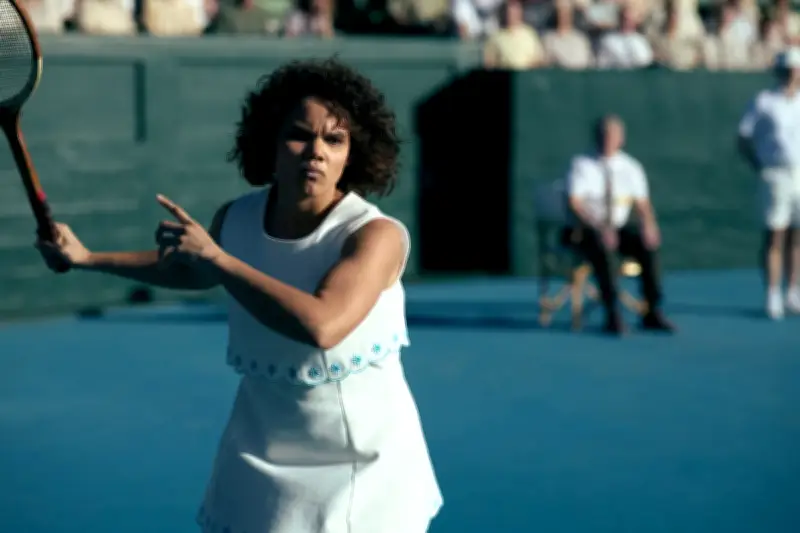
The three-part ABC drama Goolagong opens with Ann Peebles' soulful track 'It's Your Thing', a fitting anthem for a series celebrating the life of Aboriginal tennis legend Evonne Goolagong. Played by Lila McGuire, Goolagong is shown preparing for her first Wimbledon match, a moment that marked her as the first Indigenous player to compete at the tournament. She would go on to win the ladies' singles title twice, in 1971 and 1980, along with a doubles win in 1974. Across her career, she claimed seven grand slams and was ranked world No. 1.
A Tribute Heavy on Flashbacks
The series is unapologetically a tribute, leaning heavily on flashbacks to Goolagong's childhood. Young Evonne, played by Eloise Hart, is shown repeatedly hitting a ball against a wall with a plank of wood in rural Barellan, New South Wales. While charming at first, the repetition becomes excessive, and the saccharine tone of early scenes—such as a teenage Evonne wandering starry-eyed through Wimbledon's corridors—feels heavy-handed.
Addressing Darker Themes
The drama takes a sharp turn when it addresses the financial abuse and sexual harassment Goolagong allegedly suffered at the hands of her coach, Vic Edwards, played by Marton Csokas. Edwards moved Goolagong from her Wiradjuri family in Barellan (population in the hundreds) to his Sydney home when she was 14, grooming her for fame but also raising uncomfortable questions. 'When it stops being fun, come home,' her mother Linda (Chenoa Deemal) says, foreshadowing later events. After family tragedy and Edwards's manipulations, Goolagong declares tennis 'not fun any more,' echoing her mother's words.

Weaving in 1970s Issues
The series skillfully incorporates the big issues of 1970s tennis—race, gender, and pay equity—without feeling like a Wikipedia summary. McGuire's portrayal of Goolagong as a clueless upstart who tells a journalist she'd play for free is particularly effective. This comment riles Billie Jean King, leading to Goolagong's ostracisation by fellow women players. The performances anchor the story: Hart, McGuire, and Rilee Clarke (who plays Goolagong at different ages) are compelling, as is Luke Carroll as her father Kenny.
A Trans-Hemisphere Romance
The budding romance between Evonne and English tennis journalist Roger Cawley (Felix Mallard) adds warmth, though Edwards allegedly lied about not being invited to their wedding and unilaterally announced Evonne's retirement. The series struggles tonally, often feeling lightweight despite its darker moments. The final episode's climax—Goolagong's return to tennis months after giving birth to daughter Kelly in 1977—drags with forced tension before ending with her miraculous recovery, family reunion, and second Wimbledon win.
An Uneven but Lovely Tribute
Goolagong is uneven, but the story deserved to be told. The series ends with a slideshow of the real Evonne, which underscores the sense that a documentary might have been more compelling. We learn she 'seeks out a new generation of talented Indigenous children' through her tennis charity, and she and Roger have been married for 51 years. A brief clip of McGuire and the real Goolagong waving to extras is moving. It's not quite smashing, but it is lovely.