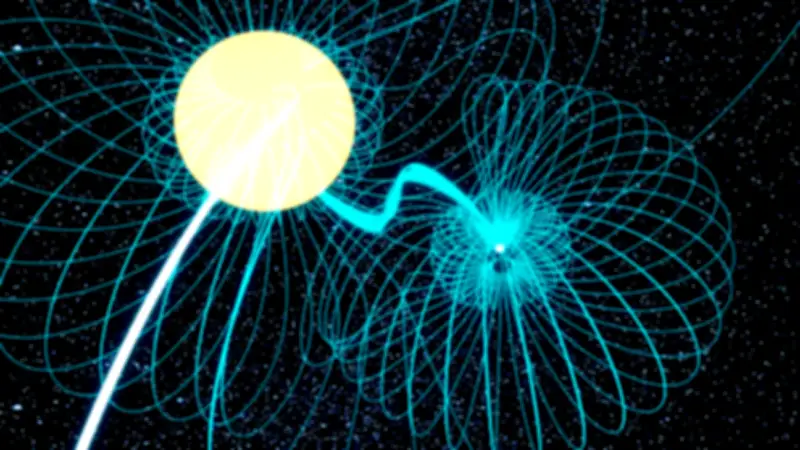
Mysterious signals from space have puzzled astronomers for years, but a new discovery is helping to decode their origins. A pair of stars spiralling around each other has been identified as the source of a repeating radio burst known as ASKAP J1745. This finding, published in Nature Astronomy, marks a significant breakthrough in understanding long-period transients.
What Are Long-Period Transients?
Long-period transients are astronomical objects that emit bright, repeating bursts of radio waves at intervals ranging from minutes to hours. Unlike typical pulsars, which rotate every few seconds, these transients repeat much more slowly. To date, only a dozen such sources have been discovered, and their origins have remained largely mysterious. Many are located near the dusty center of our galaxy, making them difficult to observe with visible-light telescopes.
The Rosetta Stone of Radio Astronomy
ASKAP J1745 is unique because it has been observed across multiple wavelengths—radio, X-ray, and optical—providing a comprehensive picture of its nature. This multi-wavelength approach is akin to the Rosetta Stone, which helped decipher ancient Egyptian hieroglyphs by presenting the same text in three scripts. Similarly, ASKAP J1745 offers a key to understanding other long-period transients.

Lead researcher Joshua Preston Pritchard from CSIRO explained: "This is the first time we've detected both radio and X-ray bursts repeating with each orbit of a binary system. It gives us a wealth of information that we can use to interpret other mysterious signals."
What Is ASKAP J1745?
ASKAP J1745 is a cataclysmic variable, a binary system consisting of a white dwarf and a lower-mass star orbiting closely together. The white dwarf's gravity pulls material from its companion, a process known as accretion. This infalling material heats up, producing X-ray emissions. The radio bursts, meanwhile, are generated by energetic particles interacting with strong magnetic fields—thousands of times stronger than an MRI machine.
"We have the perfect combination: two stars with strong magnetic fields and charged particles flowing from one star to the other," said co-author Carl Knox from OzGrav/Swinburne. "This explains the bright radio pulses we observe."
Implications for Future Research
This discovery provides a new laboratory for studying extreme physics, such as plasma flows and magnetic fields under conditions that cannot be replicated on Earth. By understanding the mechanism behind ASKAP J1745's radio bursts, astronomers can now better interpret other long-period transients that lack multi-wavelength data.
"ASKAP J1745 is the first long-period transient showing signs of accretion across the entire spectrum—from radio to X-rays," noted Pritchard. "This stream of charged material is crucial for producing the radio light we detect."
The research was conducted using the ASKAP radio telescope, located at the CSIRO Murchison Radio-astronomy Observatory in Western Australia, on Wajarri Yamaji Country. The team acknowledges the Traditional Owners and Native Title Holders of the land.
As more such systems are discovered, astronomers hope to unravel the remaining mysteries of long-period transients, potentially revealing new insights into the life cycles of stars and the dynamics of binary systems.