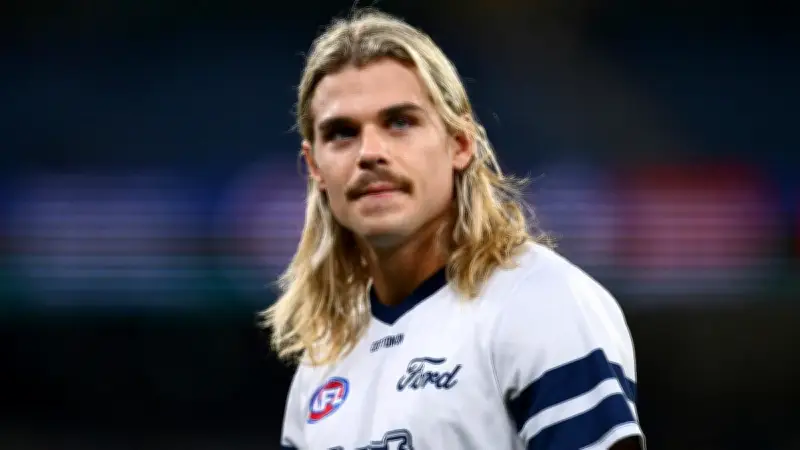
Bailey Smith has credited pursuing cognitive behavioural therapy for his career-best year in 2026, both on and off the field. The superstar AFL midfielder already elevated his game in his first season at Geelong in 2025, leading the Cats to a grand final, finishing top three in the Brownlow Medal, and winning his maiden AFL Coaches' Association Champion Player Award.
Smith achieved this after 12 months out of the game due to a ruptured ACL sustained in his final year at the Western Bulldogs in 2024. However, that period was marred by off-field controversies. AFL chief executive Andrew Dillon visited Smith's home on the surf coast in June 2025 to address his behaviour, and the league issued a formal warning in October 2025. The warning followed a six-month span in which Smith gave a double middle-finger gesture to a fan at Adelaide Oval, referred to "nose beers" in an Instagram post, verbally abused a veteran photographer at Geelong training, and faced accusations of homophobia over social media posts during the Cats' Mad Monday celebrations.
Smith's On-Field Dominance in 2026
In 2026, Smith is again among the Brownlow Medal favourites, averaging 32.3 disposals per game for a Geelong team contending for the premiership. This time, he is doing so with minimal off-field drama. Those close to Smith believe he has matured significantly over the past 12 months, and the 25-year-old agrees.

"I'm a lot less emotional," Smith told 7NEWS. "I think last year, the whole year I had a chip on my shoulder; I wanted to return well and show that I still love the game and want to be one of the best. I think a lot of that came out of anger, weirdly, after the year I had, and resentment towards just people, the footy world, and I probably wasn't in a good place the year before that."
Metacognitive Awareness and CBT
Smith highlighted his work on metacognitive awareness, a concept central to cognitive behavioural therapy (CBT). "It's the notion that you're not your thoughts, you're purely an observer of them, and understanding that how I think doesn't need to be how I feel," he explained. "Just learning to be more aware and curious of why I'm thinking or why I'm feeling some sort of way each day, rather than acting on it and making permanent decisions based on temporary emotions. That's been a big thing. It's called cognitive behavioural therapy, which I do with my psych."
Smith emphasised his effort to avoid reactivity: "I'm trying to not be so reactive. Yes, still be emotional — I'm not emotionally numb — but just learning to be aware of the tricks your brain's trying to play on you and triggers and being reintegrated into all the media again, because I kind of had a year off of it when I did my knee. Last year I didn't handle it too well, and I don't really want to let my emotions get the better of me again with a lot of the ways I acted at times."
Reflections on 2025 and Personal Growth
Despite his self-criticism, Smith's 2025 season established him as one of the league's premier midfielders. However, he now believes that good football should not come at the expense of being a good person. "Yeah, but that shouldn't come at the cost of (being a good person)," Smith said. "I think it's (being a) good human first, and then the byproduct of that is you play good footy, and if you don't, at least at the end of the day, you're still a good person. Whereas last year, I was sort of at all costs wanted to play good football, and I think my ego got the better of me with a lot of things."
Smith added: "Just learning to channel your ego when you need it very well, and not let it take a hold of you, and sort of tame that beast. Because it's important, but not at the detriment of losing your character."
No Regrets, but Room for Improvement
When asked if he harbours regrets from his past antics, Smith said no, but acknowledged he could have handled situations better. "Not regrets, because I feel like everything we've been through leads us to where we want to be, currently, right now. And I'm a believer in 'everything happens for a reason', as corny as it sounds," he said. "But I think I could handle things better, obviously. Without the bad, or without the handling situations poorly, you don't learn to handle them well, so you can't really have one without the other."