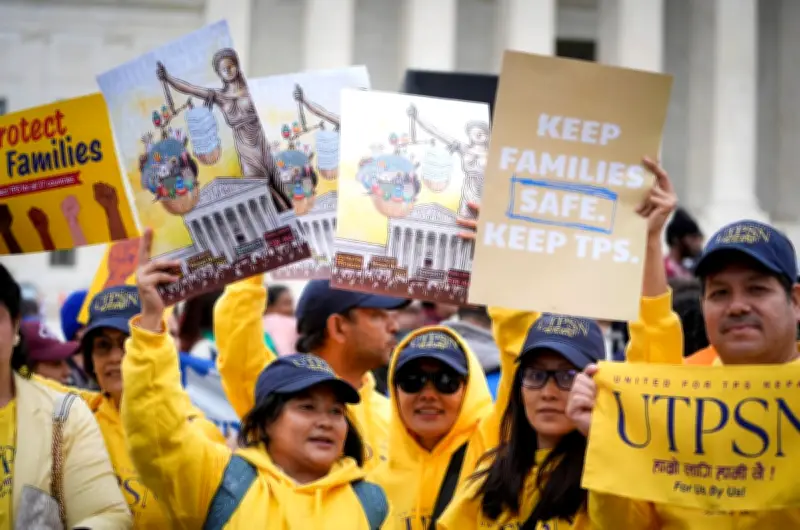
The US Supreme Court dealt a significant blow to approximately 1.3 million immigrants in the United States, many of whom have lived legally in the country for decades under Temporary Protected Status (TPS). The court's conservative majority ruled that the Homeland Security Secretary's decisions regarding TPS designations are generally not subject to judicial review, making it easier for the Trump administration to end these protections.
What is Temporary Protected Status?
TPS was established by Congress in 1990 to protect individuals already in the US when their home countries face disasters that make return unsafe. These disasters can include natural catastrophes, epidemics, armed conflicts, or other extraordinary conditions. TPS designations last between six and 18 months, during which beneficiaries receive work permits and deportation protection. Individuals with serious criminal records are typically ineligible. The Homeland Security Secretary decides whether to extend, redesignate, or terminate TPS for a particular country based on conditions there.
The Supreme Court's Decision
In a 6-3 ruling, the court held that TPS determinations by the Homeland Security Secretary are largely immune from judicial review, except for constitutional claims. The sole constitutional claim in the case—alleging racial animus by the Trump administration against Haitians—was deemed unlikely to succeed. Justice Elena Kagan dissented, warning that the ruling allows the Secretary to make decisions without consultation or evaluation of country conditions, leaving courts powerless to intervene. Kagan cited Donald Trump's derogatory comments about immigrants of color, particularly Haitians, as evidence of racial bias.

Who is Affected?
The case directly involves over 300,000 Haitians and thousands of Syrians with TPS. They are expected to lose their status and work authorization once the ruling takes effect, potentially facing deportation. Affected individuals include Fritz Emmanuel Lesly Miot, a Haitian Alzheimer's researcher with type 1 diabetes, and Laila Doe, a Syrian behavioral technician. The decision also threatens TPS holders from other nations, as the precedent reduces judicial oversight, making it easier to terminate protections for countries like El Salvador, Honduras, Nepal, and Venezuela.
State Department Warnings
The US State Department has issued "do not travel" advisories for both Syria and Haiti due to extreme dangers. Syria faces terrorism, armed conflict, and kidnapping, while Haiti suffers rampant violent crime, gang activity, and kidnappings. In Haiti, law enforcement has limited capacity to respond to serious crimes.
Economic Impact
TPS holders contribute significantly to the US economy. According to Fwd.us, they pay $7.8 billion in taxes annually and have contributed $262 billion since 2001. Many work in essential industries: among Haitian TPS holders, there are 13,000 nursing assistants caring for 65,000 patients daily, 3,000 school assistants serving 57,000 students, and 22,000 cooks and servers providing 880,000 meals each day. The elder care industry is particularly affected, as TPS holders make up 8% or more of caregivers in some areas.
What Happens Next?
Without TPS, individuals without other legal status face arrest, detention, and deportation. Some may have existing removal orders, while others may enter removal proceedings. Options for relief are limited; asylum requires proving individual persecution, which many TPS holders cannot do. The Trump administration has also suspended processing for asylum applications from several TPS countries.
Other Supreme Court Immigration Rulings
The same day, the court upheld the "metering" policy at the US-Mexico border, which limited asylum processing at ports of entry. In another landmark case, the court upheld birthright citizenship, though four justices did not explicitly reject the constitutional challenge, raising concerns among advocates.