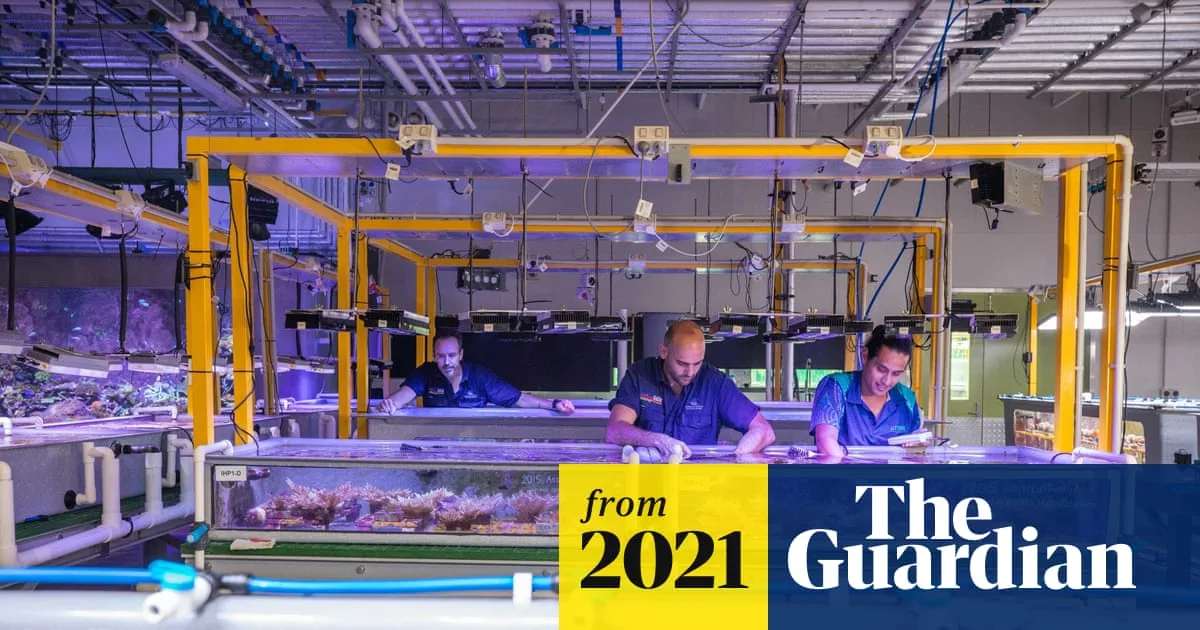
Scientists are working late into the night at the Australian Institute of Marine Science's National Sea Simulator in Townsville, collecting coral spawn bundles under moonlight to breed heat-tolerant corals. Dr Kate Quigley, a reef restoration researcher, uses red lights to inspect corals for signs of imminent spawning, such as pimply surfaces indicating the release of sperm and eggs in colorful bundles.
The annual mass coral spawning, which occurs after the November full moon, is one of Earth's great biological spectacles. At the SeaSim, corals spawn in captivity simultaneously with their wild counterparts, allowing researchers to collect bundles for a selective breeding program. The facility pumps over 3 million litres of filtered seawater daily and houses thousands of coral colonies in tanks calibrated to specific temperatures and carbon dioxide levels.
Quigley's team collected hundreds of potentially heat-resilient corals from the far northern Great Barrier Reef, 875 km away, using a machine learning algorithm she developed. These corals survived high temperatures during mass bleaching events in 2016, 2017, and 2020. The researchers will breed these heat-hardy corals with more vulnerable specimens from the southern reef, mixing spawn to create offspring with a combination of genetic traits.

The research aims to accelerate natural gene flow, which spreads heat-adaptive genes across the reef but may be too slow to keep pace with current warming rates. By controlling parentage, scientists hope to produce baby corals better suited to withstand rising ocean temperatures.