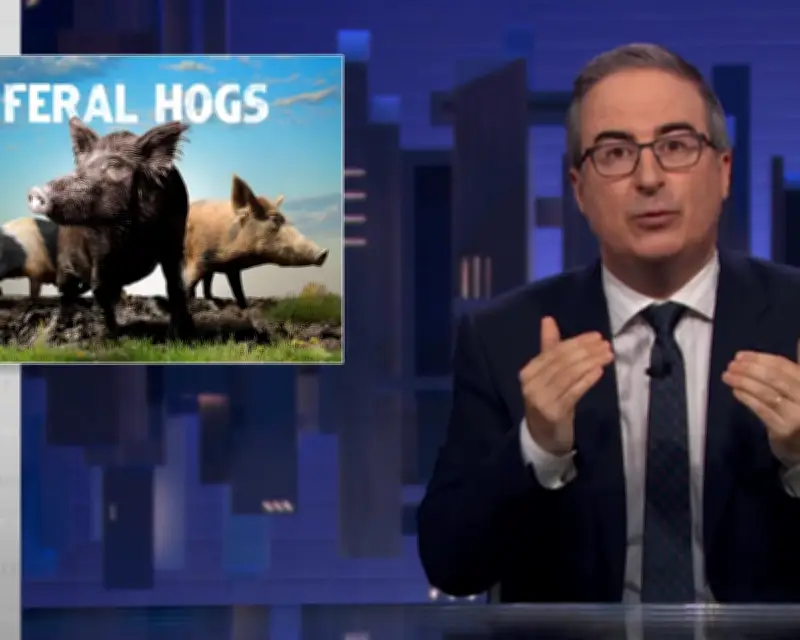
John Oliver dedicated the latest episode of Last Week Tonight to the growing problem of feral hogs in the United States, calling them a 'four-legged, tusked, hairy apocalypse' that cause billions of dollars in damage annually. The segment, which aired on June 22, 2026, has sparked widespread discussion about invasive species management and government inaction.
The Scale of the Problem
Feral hogs, also known as wild pigs, are estimated to number over 9 million across at least 39 states, according to the US Department of Agriculture. They cause an estimated $2.5 billion in agricultural damage each year, destroying crops, polluting water sources, and rooting up pastures. Oliver highlighted that the animals are not only a nuisance but also a threat to native wildlife and ecosystems.
In the episode, Oliver noted that feral hogs have been clocked running at 30 miles per hour and can weigh up to 400 pounds. He quipped, 'They are essentially a Toyota Corolla with a bad attitude.' The segment also pointed out that the animals reproduce rapidly, with a sow capable of having two litters of up to 12 piglets per year.

Ineffective Control Methods
Oliver criticized the current methods used to control the feral hog population, including hunting and trapping, which he argued are often ineffective. He highlighted the controversial practice of using helicopters to shoot hogs from the air, which he called 'a very expensive way to make a very angry pig.' The segment also explored the use of poison, which has raised concerns about collateral damage to other wildlife.
According to the Texas A&M AgriLife Extension Service, hunting alone only removes about 20-30% of the population annually, which is not enough to keep numbers from growing. Oliver emphasized that the federal government has spent over $100 million on hog control efforts in the past decade with limited success.
Government Response and Criticism
The episode took aim at the US Department of Agriculture's Wildlife Services program, which Oliver described as 'a shadowy agency that kills millions of animals every year.' He questioned the effectiveness of the program and called for more innovative solutions. 'We need to think bigger,' Oliver said. 'Maybe we can train wolves to hunt them. Or maybe we can turn them into a food source. Or maybe we can just accept that we've created a monster and move to Canada.'
The segment also highlighted the lack of political will to address the issue, with Oliver noting that feral hogs do not have a powerful lobby. 'They don't make campaign contributions, they don't vote, and they don't care about tax cuts,' he said.
Public Reaction and Impact
The episode quickly went viral on social media, with many viewers expressing shock at the scale of the problem. Environmental groups praised Oliver for bringing attention to the issue, while some farmers expressed frustration that the government has not done more to help them.
Dr. John Mayer, a wildlife biologist at the Savannah River National Laboratory, said in an interview that Oliver's segment was 'accurate and entertaining' but noted that the problem is even worse than portrayed. 'Feral hogs are not just an agricultural problem; they are an ecological disaster,' Mayer said.
The episode has already prompted calls for increased federal funding for hog control and research into new management strategies. As Oliver concluded, 'If we don't do something soon, the only thing left will be feral hogs and cockroaches.'