Three years ago, M John Harrison told Chris Power about the novel he was working on, speaking purely about the challenge it presented. Now, that book—The End of Everything, his 13th novel—is about to be published. It describes a disintegrating Britain ruled by the iGhetti, monstrously sized lifeforms that look like powdery, slow-motion explosions. The novel is more alien evasion than invasion, unwilling to divulge more than its characters know.
Alien Enigmas and Human Epistemologies
No one knows where the iGhetti came from—maybe the astral plane or 'out of the internet.' Their purpose is obscure. The authorities treat them as hostile, but the incomers might be engaging in 'spiritual tourism and gentrification.' Harrison says, 'If we were to meet a real alien, we would have no clue whatsoever what they quote "thought", or why they did anything.' Science fiction often pays lip service to that idea, he notes, but 'never passes that feeling on to the reader.'
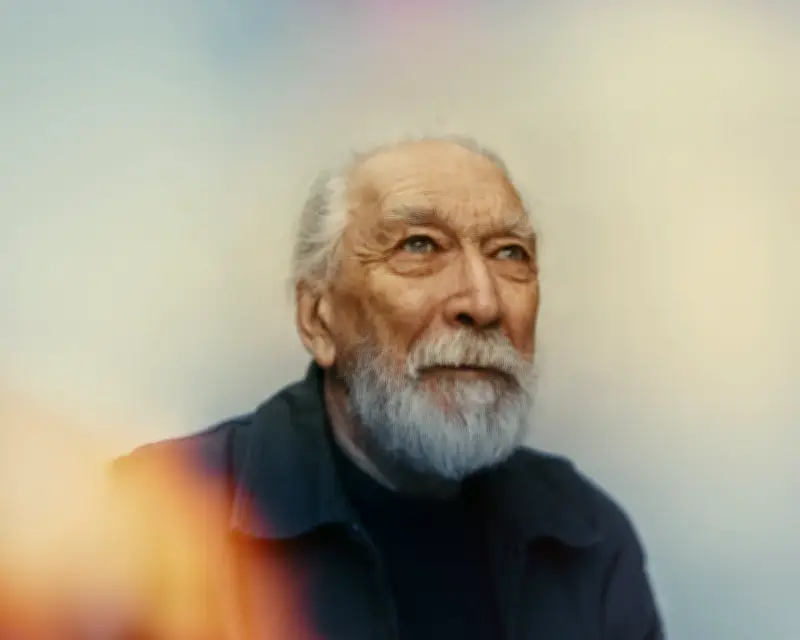
Harrison, a slim, nimble 80-year-old with a full white beard and long hair, speaks eagerly about meeting the demands of the new book. This wasn't always the case. In 1998, a year after his bleak dystopia Signs of Life, Iain Banks took him out for a night of drinking in Soho to persuade him to return to purer sci-fi. 'I always keep in mind what Iain said to me,' Harrison admits, 'which is that I don't have enough fun on the page. That was hurtful.' The next day, he started writing notes for Light, the first volume in his Kefahuchi Tract trilogy—a parody of space opera.

From Rugby to New Worlds
Harrison was born in Rugby, Warwickshire, in 1945. He had a difficult relationship with his father, an engineer, who died when Harrison was 13. He truanted from school, spending time in the local library. 'The great thing about libraries then was there weren't so many dust jackets about,' he says. 'I would pick a book up, read the first two pages, think, "Oh wow, that's weird", and it would turn out to be a Robbe-Grillet, and it would open a door to the anti-novel.'
When Harrison began writing as a teenager in the 1950s, monthly magazines supported fantasy and sci-fi. In 1966, one accepted his story. He moved to London, met Michael Moorcock, and became a regular contributor to New Worlds. 'I had to be in New Worlds because it was Ballard's main medium for short stories at that time,' he says.
The Breakthrough: Finding His Voice
Harrison describes The End of Everything as the kind of book that might have been serialised in New Worlds circa 1967. 'I think it might have been too much even for them,' he agrees. 'I wanted it to have the flavour of the novel that I would have submitted then if I'd had any technique, skill or talent.'
The 1970s saw him strain against genre conventions. A breakthrough occurred when he resolved to write a short story without planning. The New Rays is 'about Katherine Mansfield. And it's for Katherine Mansfield.' He admired what Mansfield and Virginia Woolf had done with fragmented narrative but didn't know how to approach it. 'The only techniques I had were almost exactly opposite to what I needed. They were the techniques of genre fiction.'
By 1982, Harrison had left London for 'the boondocks outside Huddersfield' to pursue rock climbing. The next two decades saw the publication of Climbers (1989), The Course of the Heart (1992), and Signs of Life (1997). 'I let it take over,' he says of writing. 'And I produced several short stories and three novels that had real depth and density of observation.'
Climbers: A Masterpiece
Climbers follows a group of climbing junkies around the Peak District. It is still criminally obscure despite enthusiasm from Robert Macfarlane and Olivia Laing. Harrison recalls the moment the book became possible: leaving a quarry at sundown, he noticed 'the way the sun related to the jagged top of the quarry meant the shadows looked like the turned-down pages of a book. I stopped and scribbled that in one of my notebooks. I suddenly thought, I can do this.'

Harrison, 'utterly determined to stop apologising for not being an SF writer,' now produced work he fully believed in. But he had an uneasy relationship with his creativity. 'It was like discovering a different voice inside you. And it was better than me. He knows more than I do, he's more mature than I am, he's a better writer than I am, and he has very considerable contempt for me.'
Return to London and a Prize
Having moved back to London, in 2012 Harrison found himself suddenly overcome with anger at a publishing party. 'I got outside, and the rain was pissing down and I flashed back to 1968: same street, same rain, same sense of failure.' He moved to Shropshire with his partner, Cath Phillips, and started writing The Sunken Land Begins to Rise Again. That book won the Goldsmiths prize in 2020. Frances Wilson, chair of judges, called it 'a literary masterpiece.' Harrison remembers: 'I felt so relieved. I had a drink or two and fell asleep. I relaxed for the first time in about 40 years.'
The End of Everything: Commitment to Inexplicability
The problem presented by The End of Everything was how to leave so much out while exploring how 'human beings are working with broken epistemologies to try and understand the world that we've made.' Conveying bafflement without sacrificing readability is Harrison's recurring problem. 'You've got to be so careful with explanation. If you help the reader too much, you lose that inexplicability. You've got to commit.'
The book is dizzying in its invention—from the 'clean arch of brand new stars' to the 'rich surf of objects' scavenged from the sea. It is also a continuation of that late-night Soho conversation with Iain Banks. 'I thought: OK, here you go, Iain. I'm having fun but I'm also gonna commit. This is gonna be the one that is written without any compromise.'
If the title sounds ominously final, we shouldn't read into it. 'I've got two or three short stories which are being very intractable,' Harrison says with relish. On to the next problem? He laughs. 'Yeah, what's the next problem? What impossible thing can I try and do now?'