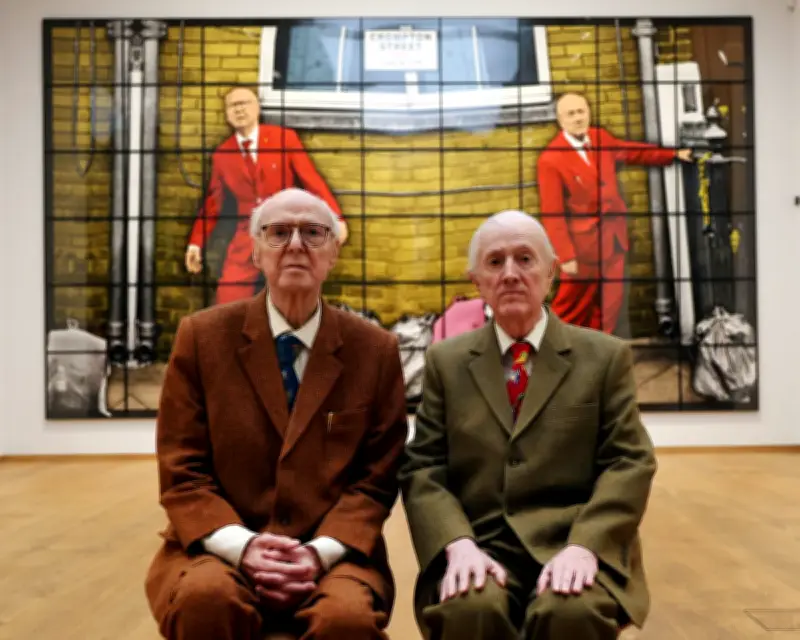
‘Sandra brings us sausages every day’ … Gilbert & George (George, left) pose at the preview of Our George Crompton, Worlds and Windows. Photograph: Andy Rain/EPA
‘You learn how to be idiotic artists’: Gilbert & George on fame, rebellion and their mystery new collaborator
The Britart mavericks have now teamed up with an unlikely artist. Is their odd throuple an elaborate prank – or are the duo passing down their legacy?

‘Hello girls,” greets 82-year-old Gilbert Prousch, one half of art duo Gilbert & George, as he shakes my hand when I arrive at his house with a very important guest in tow. He kisses his other guest on the cheek. Gilbert is Italian after all.
“This way,” he says, ushering us into the four-storey, 18th-century Georgian townhouse in Fournier Street, Spitalfields, east London, where he and the other half of his duo, George Passmore, 84, have lived since the late 1960s. Back then, they rented the ground floor for £16 a month. Now, they own the whole house. I bet it costs a bit more now.
I sneak a peek through a door at one of many living rooms crowded with antiques. As I walk further into the house, something feels odd. I realise that there’s no kitchen. Then I remember: Gilbert & George famously have no kitchen. They have long regarded cooking as time wasted when they could be making art – they balk at the idea that the “average housewife spends 27 years in the kitchen”, as they put it – and so eat out or have food brought in every day (more on their favourite haunts later).
We cross the courtyard into an impossibly warm studio to find George, dressed in a brown Irish tweed suit to complement Prousch’s green. The pair switched from Scottish to Irish tweed in 2014 to mark their disapproval of the Scottish independence referendum. Together in their colourful suits, they are unmistakably the Gilbert & George I’ve come to recognise: part artist duo, part double act known for being deadpan, mischievous and defiantly unchanged. The contrast is the point: here are two polite gentlemen in beautiful tailoring, whose art has for decades revelled in sex, bodily fluids, swear words, religion, death, urban grime and (ahem) schoolboy smut.
Endless’s Crotch Grab, made for the Guardian. Illustration: Endless/the Guardian
We sit at the long studio table, which is crowded with works in progress: medicine from the chemist, newspapers (George is reading today’s Telegraph) and cured meat.
“What have you two been doing? Eating sausages?” asks the guest, taking the mick.
“Yes. Sandra brings them in every day,” says George.
Which Sandra he’s talking about is unclear. It could be Sandra, the waitress at the Golden Grill, the local cafe where they used to eat daily as part of their “Living Sculpture” philosophy, which stipulated that even their daily routines became a work of art. But the Golden Grill closed years ago, and I’m not sure there’s a Sandra at their current favourite, east London’s Mangal 1 Turkish grill. Or it might be Sandra Esqulant, landlady of the nearby Golden Heart pub, who has looked after them for decades. Or perhaps everyone who feeds them just becomes a Sandra. At least I recognise the other recent visitor they mention, “Tracey” – as in Emin – who popped round on Monday. Her arrival caused a brief panic because they didn’t know her preferred tea. Earl Grey, it turns out.
“We know her quite well,” says Gilbert. It’s not surprising – Emin also lived nearby in the 90s, when all three were part of the Britart scene.
“This is my friend, Rich,” says the guest. “He’s a writer.”
“You write? Marvellous,” says George. “What sort of thing? Novels?”
“No, for newspapers. Have you got today’s Guardian?” I say, keen to show off my byline.
“Certainly not,” says George, flapping his copy of the Telegraph at me. “What do you think we are?”

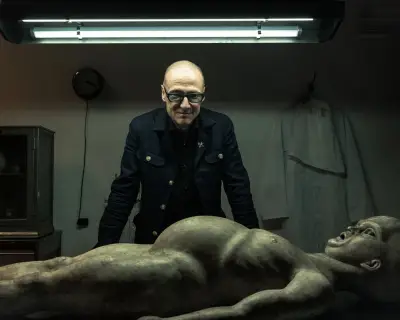
I am here at their house as the plus one of the 41-year-old London artist Endless. He was the first street artist to exhibit at the Uffizi Gallery in Florence, an institution better known for Botticellis and Michelangelos than pieces by artists armed with spray cans. That work, which he donated to the museum in 2021, is called ExG&G, and features Endless alongside Gilbert & George in their studio: the duo are shown as living sculptures, while Endless hides behind a magazine.
It’s a sign of the unlikely bond that has formed between them. Endless has become such a part of the furniture at Fournier Street that he can knock on the door more or less whenever he likes (Gilbert & George do not have mobile phones). Their friendship has prompted some rumours in the art world: are the duo quietly handing their expertise – and even legacy – down? This is something I’m keen to find out.
The trio seem unlikely collaborators: tweed-suited conservative mavericks on the one hand, an edgy street artist on the other. How did they meet?
“It has nothing to do with public lavatories,” jokes George.
The truth is that the pair, who like to source subject matter within walking distance of their home, noticed an Endless street piece on a nearby wall and photographed it to feature in a 2015 exhibition in Singapore. When Endless discovered this, he got in touch, both baffled and flattered. They began corresponding by letter; a decade later, Endless now visits them on a weekly basis.
The piece that got Gilbert & George’s attention – entitled Crotch Grab – is a signature of sorts for Endless, and is a reworking of a 90s Calvin Klein advert featuring Mark Wahlberg in his underpants (Endless has also made a new customised version of the artwork for the Guardian). What was it they liked so much about it?
“It’s difficult to explain. It just appealed,” says George. In 2018, Endless depicted Gilbert & George grabbing their crotches in Union Jack boxer shorts.
Gilbert & George in front of Death Hope Life Fear at the Gilbert & George Centre. Photograph: Wiktor Szymanowicz/Future Publishing/Getty
Conversation turns to the duo’s new exhibition, a reworking of their 1990 London and New York Worlds and Windows exhibition. It is on display at the Gilbert & George Centre, a converted 19th-century brewery that opened in 2023 round the corner from their home. In line with their “Art for All” ethos, the centre offers free admission, and attracts, according to the pair, “a small but serious, or perhaps unserious, crowd”.
Some preliminary prints for the show are hanging on the wall.
“You know George is dead – George Crompton?” says George, pointing to a figure in one of the new artworks. Crompton was a homeless man – a “lost soul”, as they put it – who would turn up most days, and who they’d invite inside to keep warm. “He’d had a lot of bad luck in life, so it should be a lesson to us all,” says George. “We could all be Georges if something had gone a bit wrong.”
Crompton would sit in what Gilbert calls “the relaxing chair” in the corner of the studio, watching the pair at work. “It was intriguing for him,” says George. “He was a harmless, nice person, very calm. He felt part of things.”
“We went to see him when he died in the hospice,” adds Gilbert.
“He wasn’t unhappy,” says George. “I think he knew and accepted that he was going to fade away.”
Crompton now appears, posthumously, in two new works at the duo’s latest show, standing outside their famous front door.
“You’ve immortalised him,” I say.
“I like to think so, as near as we can,” says George.
With a shifting cast of visitors – friends, neighbours, food providers – passing through their home, I wonder how the octogenarians feel about an artist half their age inviting himself round, seemingly any time he likes. “It has worked out well so far,” smiles George.
And how does Endless feel about his place in this revolving cycle? “You learn how to be an artist from people who are greater than you,” he says.
“How to learn to be big-headed, idiotic artists,” George says.
Endless studied Gilbert & George at Cambridge School of Art (“Cambridge? You must be very clever,” pipes in Gilbert). Gilbert studied in Val Gardena, Hallein and Munich; George at Dartington and the Oxford School of Art (“I’m overtrained,” he says). They later met at St Martin’s School of Art on London’s Charing Cross Road in the 60s.
“St Martin’s was extraordinarily famous all over the world at that time,” says Gilbert.
“Charing Cross Road in the late 60s was the centre of the universe for fashion and music,” adds George. “Every minor actor had to be photographed there.” Did St Martin’s make them feel famous? “Yes,” says George.
“But you rebelled against what they were teaching,” says Endless.
“We didn’t accept formalism: shapes and colours,” says Gilbert. “We did our own thing.”
Why did they decide to work as a pair? “For a living sculpture, it was a very good idea to have two people, not one,” says Gilbert.
“Two makes a composition; one doesn’t,” adds George. “The world is twos. In the cities, in the jungle, even in the animal kingdom.”
“Have two now become three?” I ask. “Huh?” “He’s asking if we’re a threesome,” says Endless.
What I want to know is: are you handing down your legacy to Endless?
“I don’t even know what ‘legacy’ means,” counters Endless.
“Leg over-sy,” says George, his schoolboy smut returning.
Writing on the wall: Art UK digitises thousands of murals as street artworks go mainstreamRead more
Gilbert & George are staying put – lunch is due any minute – but there’s just time for Endless to sneak me into the Gilbert & George Centre, where the previous exhibition is being dismantled to make way for the next. On the wall, George Crompton already looms several metres high: the lost soul from their studio chair now getting the full Gilbert & George send-off.
The artists have long planned for their own absence, treating even death as part of their project. The works still in their possession are to be left to the centre, free to the public – a final extension of Art for All. If they are handing anything down to Endless, it may be less about ownership than attitude.
“It’s seeing how they live, hearing their stories from the past, and how they have it in their minds that they’ll always push forward and never stop,” he says. “They’ve got their vision, their focus, and they never veer away from it. Whatever they feel in that moment, they turn into art. That’s inspiring.”
Perhaps that’s how legacies are really passed on: not by inheritance, but by example. Endless has certainly been pushing forward this year: working on a giant mural on the side of Indelible Fine Art Gallery in Brighton; and preparing for exhibitions in London, Milan and Rome.
“You can’t take over what they’ve done,” says Endless. “But you can carry the spirit forward.”
Our George Crompton, Worlds and Windows is at the Gilbert & George Centre, London, to 2027; Endless X London is at Cris Contini Contemporary, London, to 25 July.