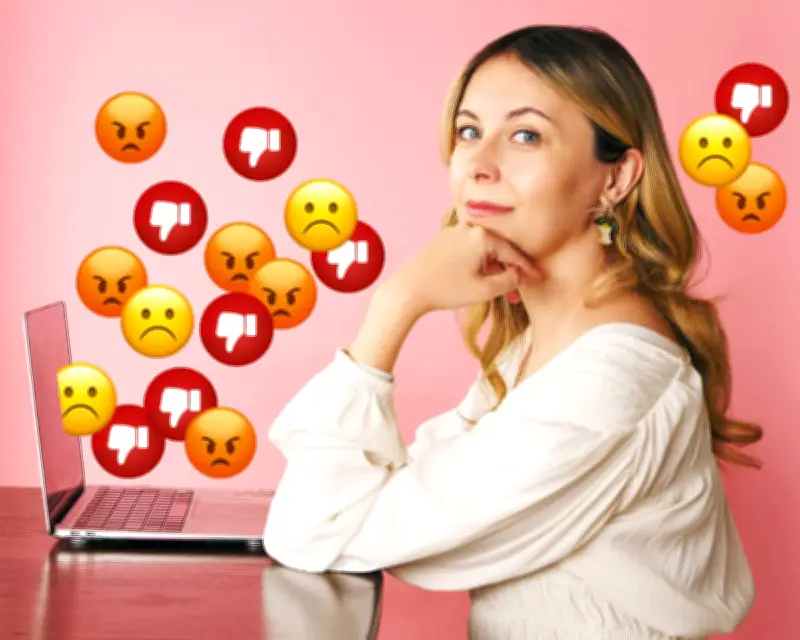
Twenty years ago, Amelia Tait briefly became the victim of a viral pile-on, all because of a silly YouTube video. But she's glad she had the chance to embarrass herself and move on. Are today's teens so fortunate?
A Teenage Viral Moment
As a teenager, Tait went kind of viral, and the most amazing thing about that is it had absolutely zero effect on her life. It was the summer holidays in 2006, and she and her friends Jessie and Emma decided to film themselves singing along to their favourite song. They were overheated and hyperactive, jumping up and down and headbanging, stretching their arms to the heavens as they confessed to their mamas that they'd 'just killed a maaaaaan' before asking Scaramouche if he'd do the fandango.
Later, Tait added a couple of captions to the video implying they were drunk, even though she was 14 and the closest she'd been to buzzed was the pure placebo of clutching a glass bottle of J2O. Then, for reasons now lost to her, she uploaded the video to YouTube a month later, on 19 September 2006, under the title 'Bohemian Crap-sody'.

The Hate Comments Pour In
The comments drizzled in, then came the downpour. 'There is a special place for girls like you in hell,' wrote one man. 'I now understand why people become serial killers,' offered another. A far more straightforward missive simply announced: 'They must die!' The video ultimately accumulated 48,526 views. And while that might not seem viral by today's standards, in May 2006 the most-subscribed YouTube channel didn't even have 3,000 followers. More than 100 pages of hate comments will never not feel like a lot.
You would think this experience might have left a scar, but Tait didn't even mention it in her teenage diary. Five years later, in 2011, an almost-14-year-old named Rebecca Black posted her debut music video, 'Friday', and went eye-wateringly viral. The song became the most disliked YouTube video that year. Black had to drop out of school due to intense bullying, and the police even got involved after she received death threats. In the following years, the same thing happened to numerous other teenage girls.
The Changing Internet
Social media changed a lot between Tait's video and these ones, but it has transformed even further since then, to the extent that the UK government wants to ban under-16s from the platforms. People have always hated teenage girls, of course, and there have never not been death threats. But once upon a time, the internet was a place you visited, a place you could leave. No one at school saw Tait's video, and no one could easily screenshot it, download it or send it to each other's phones, which meant she retained the power to erase every last trace. Today, the internet is all around us, all of the time, and many of us feel stuck. It's no wonder that a Yahoo/YouGov poll discovered this April that more than half of gen Z adults 'have avoided expressing themselves freely online for fear of coming across as cringe'.
Reflections on Youth
As a debut children's author, Tait has spent much of the last few years reconnecting with her younger self. Rereading her teen diaries and rewatching her sort-of-viral video has made her reflect on how adolescent life has altered since she was a teen. When she was young, she was cringe, and she was free. Her experiences with 'Bohemian Crap-sody' reveal a lot about children's changing aspirations and limitations, and the way that today's internet can hold them back. But other traces of her younger self online also tell a more complicated story, about the mistakes young people make, and the conflict between being forced to remember and desperately trying to forget.
Tait doesn't know why they filmed their video. She does know that they'd been out playing in the local river, and they'd eaten a truly outrageous amount of fizzy strawberry laces. Perhaps it was the sheer novelty of being able to record anything that inspired them. And so they positioned themselves in front of the computer in her family's mint-green dining room and sang Bohemian Rhapsody, at one point so passionately that she hit her head on the ceiling light.

Back then, a funny quirk of YouTube meant that you could reply to videos with another video, thereby linking them together. Tait set their video as a response to the real Bohemian Rhapsody, which meant that everyone who pressed play on the music video would see their version directly underneath it. Watching the video back now, she can see that she intermittently shushed her friends or made sure the door was shut properly, clearly embarrassed that her parents or siblings would hear. It's funny to think that her fear of being perceived somehow didn't extend to the entire internet.
The Aftermath
Because Tait repeatedly turned the video from public to private over the years, the comments are now totally wiped, but she can still read them via her old inbox, because YouTube used to email you every time someone commented. Hunting through her teen inbox like this makes her feel a bit like an archaeologist, digging for memories.
Shortly after Christmas in 2007, her friend Emma emailed to say that she'd been reading the comments on the video and 'they're mean'. Tait's response was blase, filled with the indestructible ego of youth. 'There are, like, five nice ones, though,' she wrote before a smiley face emoji, adding, 'And a few people just wanna assault us, s'all good.' Only she didn't use the word 'assault', and neither did the commenters. There were numerous rape threats.
The reason they angered so many men to the point of threatening them is simply because they were dumb. Tait titled their video 'Bohemian Crap-sody' to reflect the fact that their singing was crap, but the commenters interpreted the name as a slight on the song. They thought they were personally insulting Freddie Mercury, and informed them he was 'shaking his head in shame in his grave'. While the threats, slurs, and 'sluts' and 'slags' under the video aren't remotely funny, looking back at some of the comments now makes Tait weep with mirth. 'U look like the aunts from james and the giant peach,' one person wrote. 'Please respectably kill yourselves' still intrigues her deeply. And she adores the exceptionally authored: 'Each of you are despicably ugly in your own special way.'
Tait has no real explanation for why this didn't bother her at the time, except perhaps that it felt novel, that any attention seemed like good attention at that age, and it had zero impact on her real life. She must have understood the video was a little embarrassing before posting it, otherwise why would she have tried to seem cool by pretending they were drunk? But she wasn't embarrassed enough to hide it away for good until she turned 18. Perhaps she thought that people on the internet were a strange subsection of society, rather than, as is the case now, literally everyone. Or perhaps it's because the horror stories were yet to come, so she didn't even realise what could happen when people online got angry.
A Darker Side
Or, it could be that the truth is more terrible and less logical, as it often is: Tait wasn't just a victim, she was a perpetrator, too. Two months after posting her video, she left her own hate comment on a video of a much younger, more vulnerable girl. She was small, angelic and singing about her brother, a soldier who was at war. Her video was going viral, the real, written-up-in-local-newspapers kind. Tait recalls that she and her friend were sitting at the computer, giddily egging each other on. She wants to say they knew their comment would be lost in a sea of thousands of others, that they didn't think the little girl would ever read it, that they were actually super-smart and disgusted by the cynicism of a parent exploiting their child to make musical military propaganda. In actual fact, they just thought they were funny, and thrilled with the ease by which they could do something bad. The exact cadence of the comment is burned into her brain: 'Shut up, your brother's dead.'
Perhaps Tait remembers this so clearly because she worried it would come back to haunt her. It's almost pointless for her to write this, it's such a defining fact of our age, but the things people have posted on the internet have often destroyed their lives. Even telling this story now, directly, herself, worries her. She's taking something that was gone from the internet and ensuring it lives there permanently, on a newspaper's website, no less. But at least that's her choice. She's worried about today's teens and how their digital histories will affect their lives. Of course, she doesn't think they should be freely allowed to be as cruel as she was without repercussions, but she does worry that their mistakes now seem to be eternally etched in stone.
The Right Time to Be Young
People Tait's age often express gratitude that the social media sites they used as teens have died and taken their Myspace pouts and blingy Bebo selfies with them. Meanwhile, older people seem delighted that they didn't have to grow up on the internet at all. Again, Tait believes something more complicated and less logical: like most people, she's somehow convinced herself she was young at exactly the right time. Growing up when the internet existed but wasn't their entire existence was fun and freeing, for good (it allowed them to play with different personae) and for ill (sometimes that persona was 'internet troll'). When she sees her younger cousins delete all their Instagram pictures and start again, she feels both sad and simultaneously relieved for them. And yet, equally, there's so much she wishes she could delete that's now out of her hands.
Until a few short years ago, a forum was still home to comments she made about her eating disorder as a teenager in 2008. The website has since thankfully been deleted. She rediscovered it as a young journalist writing an article about 'chew and spitting disorder' when she searched the relatively underdiscussed topic, her own ancient comments came up. On the thread, other anorexia sufferers and she discussed their experiences of chewing and spitting out food to avoid consuming calories. She lamented that 'towards the end of the day i get so hungry i pig out on cereal'. When she gained a few pounds she wrote: 'OMG. how do i lose this weight?' Then she came back a few months later having gained more: 'im such a huge hideous beast i want to die.'
Lauren Willey's Story
Tait's eating disorder wasn't remotely related to 'Bohemian Crap-sody', and ultimately she emerged relatively unscathed from her viral video. The same can't be said for everyone. When she was 17, Lauren Willey, in California, and her friend created a satirical music video called 'Hot Problems', with the lyrics: 'Hot girls we have problems too, we're just like you, except we're hot.' The video was uploaded in 2012 and went viral almost instantly; it now has nearly 3 million views. Commenters assumed the girls weren't in on the joke, and labelled them tone-deaf. Willey was considered a distraction by teaching staff, which is why she wasn't allowed to return to school. The video followed her to college, where she developed an eating disorder.
'It was hard as a 17-year-old girl getting thousands and thousands of people commenting on your looks,' says Willey, now a 31-year-old publicist. 'People got off on the hate of 17-year-old girls; I think it's really sad.' Nonetheless, some of the attention was exciting and fun. Willey was invited on to breakfast television and had meetings with reality TV producers, and she says she doesn't regret the video because it is a good representation of her humour and personality. Still, it had an unexpected, lasting impact on her life. 'I did feel like less of a person and more just like a piece of pop culture,' she says. Over the years, she experienced stalking, judgmental colleagues and, to top it all off, ultimately made no money from the song. 'There are people that I don't stand a chance with that already just hate me. Sometimes people will be so mean to me, and then I'm, like, 'Ohhh, OK, it's because they know who I am.''
Today, Willey avoids posting on the internet too much, and she advises young people to protect themselves online. But, like Tait, she finds it complicated, because she hopes they continue to express themselves, too. 'I hope it doesn't discourage people from being themselves and being goofy, because that's kind of the spice to life,' Willey says. 'If we're all afraid of being ourselves and being lighthearted and wanting people to laugh, then we're not going to have joy.'
Conclusion
Now that the distinction between 'real life' and 'the internet' is completely blurred, Tait fears that limiting teenagers from expressing themselves online means limiting them full stop. It truly is no mystery why teens today look scared to dance in footage from concerts, clubs and Coachella. She still yearns for the time when the internet was something they turned on and off.
How lucky she was that she could press the power button off on the computer and leave the comments on 'Bohemian Crap-sody' behind. How equally lucky she is now that she can retrieve those comments and laugh about them to the point of tears. 'Just one word fock you' is a favourite, for reasons she doesn't have to explain. She is especially charmed by the person who wrote 'Please, die soon!' and followed it up with '(sorry bad English)' – apologetic for the language barrier but not the fact they wished them dead. Even the kind comments are comedic, such as this person who believed there are but two options that face all teens. 'It's just a bunch of happy go lucky kids having fun and enjoying themselves,' they wrote. 'It is better than going round the street corners mugging people.' And do you know what? It was!