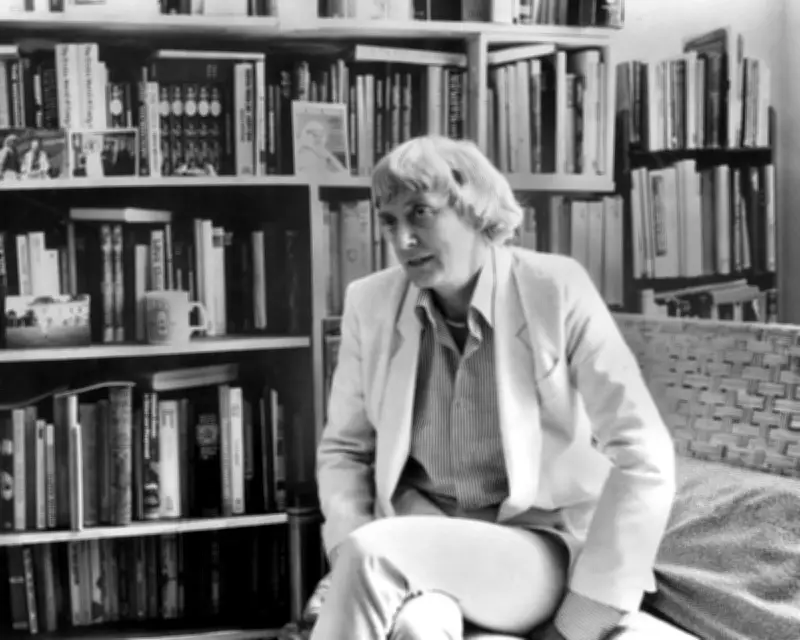
Maureen Duffy, the prolific British poet, playwright, and novelist who campaigned tirelessly for gay rights and the welfare of fellow authors, has died at the age of 92. Last year, when asked about being hailed as a pioneer after winning the inaugural RSL Pioneer prize, she said: 'It's a funny old thing. I suppose I'll get used to it.' The prize, established by Bernardine Evaristo and the Royal Society of Literature, honors British writers over 60 who have made significant contributions.
A Life of Writing and Activism
Duffy authored more than 60 works, including novels, non-fiction, poetry, and dramas for theatre and TV. She was also a campaigner for animal rights and authors' welfare, often attending literary events in a smart three-piece suit, her blue eyes surveying the scene. In a 1980 address to the Gay Humanist Group, she reflected on visibility as a gay woman: she came out as a trouser-wearing lesbian when the term 'came out' was unknown, and wearing trousers with fly fronts was considered risque, often leading to public scorn.
Outsiders in Her Work
Her awareness of challenges facing outsiders infused her writing. Her 1966 novel The Microcosm, set in the London nightclub Gateways, featured a butch lesbian protagonist and was banned in Ireland, the Vatican, and South Africa for depicting black and white characters together. Other works explored outsiders such as an unkempt amateur archaeologist in Capital (1975) and a boy genetically engineered from human and gorilla in Gor-Saga (1981), adapted into the TV miniseries First Born starring Charles Dance.

Early Life and Influences
Duffy considered herself an outsider from birth. Her parents fled east London for Worthing, West Sussex, to escape the stigma of her illegitimacy. Her Irish father left when she was two months old, and her mother, Grace Wright, raised her alone while working as a tailor and battling tuberculosis, which claimed her life when Maureen was 15. They survived a bombing during the Blitz that killed an aunt. Despite stays in care and with relatives due to her mother's illness, Duffy expressed no bitterness, saying she was encouraged to be independent and brave.
Literary Beginnings
After her mother's death, Duffy moved to Stratford, east London, living with an aunt and later with her Latin teacher, who became her foster mother. She fictionalized this experience in her first novel, That's How It Was (1962), praised by Doris Lessing. She published her first poem at 17 after winning a contest, and her full-length play, written while studying English at King's College London, won a competition judged by theatre critic Kenneth Tynan, leading to an invitation to join the Royal Court's playwrights' group.
In 1961, she made her TV debut with Josie, part of Granada TV's The Younger Generation, about a wannabe fashion designer. The commission bought her a houseboat on the Thames, which inspired her 1967 novel The Paradox Players. In 1968, her all-female adaptation of Euripides' The Bacchae, titled Rites and set in a public toilet, was performed by the National Theatre under Joan Plowright, challenging feminist campaigns for single-sex spaces.
Activism and Legacy
Duffy's writing and activism were intertwined. In 1977, she published The Ballad of the Blasphemy Trial protesting the trial of Gay News for blasphemous libel. She became the first president of the Gay Humanist Group in 1980. In 1972, she co-founded the Writers' Action Group, lobbying for authors' rights, which led to the Public Lending Right Act in 1979, granting royalties for library borrowings. She also co-founded the Authors' Licensing and Collecting Society (ALCS) in 1977, which distributes secondary royalties to authors.
Animal Rights and Later Works
A vegetarian and anti-vivisectionist, Duffy signed a 1970 open letter to The Times promising never to wear fur, alongside Elizabeth Taylor. She outlined her philosophy in Men & Beasts: An Animal Rights Handbook (1984). A vice-president of the Royal Society of Literature, she received its Benson medal in 2004. She continued writing into her 80s, publishing her final poetry collection Wanderer in 2020 and making her children's fiction debut with Sadie and the Sea Dogs in 2021.

Her back catalogue is being rediscovered: her 1977 biography of Aphra Behn was republished in 2020, and First Born was reissued in 2024 as part of the Gollancz SF Masterworks series. A long-lost secular mass, Missa Humana, composed by Dolly Collins from Duffy's poems, premiered at Conway Hall in London in 2023. Maureen Duffy was born on 21 October 1933 and died on 27 May 2026.