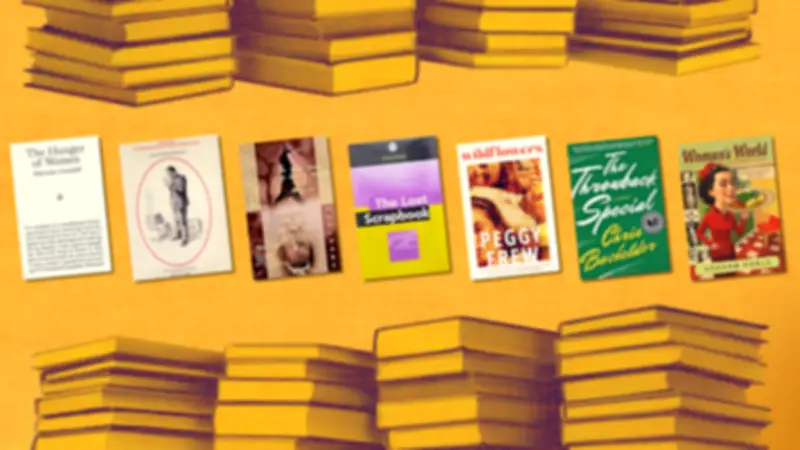
Recognised classics and bestsellers tend to hog the literary limelight. But dedicated readers know there are plenty of great books out there that don’t necessarily get the attention they deserve. There is a particular pleasure in an unexpected recommendation or new discovery, so we asked some literary experts to nominate their favourite obscure book. We were looking for lost treasures, works they think deserve to be better known – and they gave us some excellent responses.
Alex Cothren: The Throwback Special
Do not google “Joe Theismann broken leg”! All it will bring you is grainy 1980s footage of the beloved Washington Redskins quarterback getting his tibia snapped horizontal. It is a cursed image. Stay away! You should, however, read Chris Bachelder’s fourth novel, The Throwback Special (2016), which was serialised in The Paris Review, but remains underread in Australia. The premise alone won’t explain why: for the 16th year in succession, 22 middle-aged men gather at a crappy hotel to reenact the play that ended Theismann’s NFL career. That’s it! And yet it’s more than enough for this book about obsessive male ritual that is itself obsessive about details. Over the 24 hours covered in the plot, everything from how the men snore (“like a cartoon hound”) to what turns them on (illustrated mothers in picture books) is excavated with dry Beckettian wit. While their distinctive travails are each spotlighted (one’s voice is too high, one’s wife doesn’t like their shoes, one’s son keeps hurting the family cat), the characters eventually merge into a collective voice producing “waves of masculine sound, the toneless song of regret and exclamation”. It’s all as gruesomely compelling as a certain grainy video on the internet: I can’t stay away.
Delia Falconer: Arrowroot
Jun'ichiro Tanizaki is the author of two of my favourite novels, The Secret History of the Lord of Musashi and The Makioka Sisters, which need no rescuing from obscurity. However, I would like to recommend his essay-novella Arrowroot (1937), which has been eclipsed by those well known works and his slighter stories of sexual intrigue. This first-person account of a trip taken with a childhood friend to the mountains of Yoshino in 1912 has the weirdly hallucinatory quality of haiku. The houses’ overly white paper screens and a local delicacy, persimmons ripened in cellars until they are as translucent as jade, conjure the remoteness of this place, with its centuries of local crafts, half-forgotten legends, and fox-lore. As the story unfolds, the narrator’s friend Tsumura, an orphan, reveals that he is searching for a connection with his dead mother, who was sold from this district into Osaka’s pleasure houses. And so it gradually becomes clear that Tanizaki’s true subject is his terrible longing. At the heart of Tsumura’s search is a family relic, a drum made out of two fox skins, which, when struck, summon their orphaned fox-child. It’s hard to think of a more piercing metaphor for a child’s yearning for a lost parent, or a sadder novel.


Emmett Stinson: The Lost Scrapbook
Evan Dara’s The Lost Scrapbook (1995) is the great lost maximalist novel of the 1990s. It deserves a spot among the other monoliths of the era, such as David Foster Wallace’s Infinite Jest, Don DeLillo’s Underworld and Thomas Pynchon’s Mason & Dixon, but virtually no one has read it. Part of this has to do with the strange provenance of the book. It was published by the small United States press FC2, after it was selected by William T. Vollmann as the winner of their annual fiction prize. It garnered early praise from Richard Powers and was positively reviewed in major outlets, such as the Washington Post. However, FC2 was never going to get The Lost Scrapbook on the New York Times bestseller list. It did not help that no one had (or has) any idea who Dara is. “Evan Dara” is a pseudonym. The author has never given any interviews, though he has been known to correspond over email. The Lost Scrapbook is one of the most formally unusual novels I have ever read. It opens with what appears to be a discussion between a college student and his career counsellor; rather than selecting one possible future profession, the student opts for all of them at once, saying “I am interested, almost exclusively, in being interested”. The novel’s early chapters move through a montage of laterally related scenes and characters. The transitions typically occur mid-sentence, which produces a wonderfully disorienting effect. It can often be difficult to tell exactly where one section ends and another begins. The final section abandons this panoply of voices for a unified chorus that describes the environmental degradation of a small town in the US. It provides the oblique link between the novel’s seemingly disparate narratives. There is also a literal lost scrapbook that appears at different points. The Lost Scrapbook is complex and difficult, while also being deeply human and emotionally satisfying. It fell out of print for nearly 14 years, but Dara began self-publishing through Aurora in 2008 and it is now more widely available. It is one of the most singular novels of the last 30 years; it deserves a wider readership, particularly among fans of the experimental novel.
Georgia Rose Phillips: The Hunger of Women
The Hunger of Women (2012), written by the Neapolitan avant-garde writer and artist, Marosia Castaldi, and translated to English by Jamie Richards, is a sprawling poetic novel that explores the inner life of an Italian widow named Rosa. In the aftermath of her only daughter leaving the family home, Rosa’s newfound solitude drives her to open a restaurant in Lombardy. As the customers flood into this new locus, she discovers an emboldened sense of independence in the primordial art of cooking. With it, a more uninhibited version of self surfaces and Rosa embraces new types of relationships with a series of women that culminate in a rompish celebration of feminine desire, connection and excess. What ensues is a deeply satisfying aesthetic degustation, where every aroma, ingredient and texture of experience is catalogued with abundant sensuality. In this aesthetically radical work, Castaldi liberates the novel form and her protagonist from the strictures of tradition. Nearly all conventional punctuation marks are shed. Only capital letters are used to hint at new beginnings. Beyond the exquisite prose, one of the most satisfying elements of the work is the way the absence of full stops reinforces the novel’s commitment to transcending conventional restrictions. In removing the small dots of finality that terminate a sentence, the novel develops its own poetics of expansion as it explores – without pause – the unencumbered possibilities of feminine desire and connection.
Sascha Morrell: Woman’s World
“I took the long way round, past the rail-way arches, keeping to the shadows, fearful of running into a policeman. With each step, the coins in Mr Hands’s trousers chinked against my thigh … Some things in Marcia Modes I could have looked at, but I didn’t want to linger and for once I’d lost my appetite for window shopping.” In an era when generative AI can produce a formulaic novel in seconds, drawing on a massive archive of existing texts, how about a graphic novel, assembled over five years with old-fashioned scissors and glue from a treasure trove of vintage women’s magazines? Anything but gimmicky, Graham Rawle’s Woman’s World (2005) is gripping, hilarious and endlessly startling. It is a tightly plotted psychological thriller and a biting interrogation of the inscription of human character by mass media. It is also a stunning visual artwork. Once you get used to the jumble of typefaces and font sizes, the story moves at a pace that belies the pedantic process of its assembly. Through two gut-wrenching twists, the novel’s painstaking form turns out to have a deeply meaningful relationship to its subject matter, which yields deeper understanding of its wayward and vulnerable first-person narrator. Simpsons creator Matt Groening is a fan. I recommend it to everyone.
John Kinsella: Brennan’s Manuscripts
I have a copy of the 1981 facsimile edition of Sydney poet C.J. Brennan’s remarkable manuscripts PROSE-VERSE-POSTER-ALGEBRAIC-SYM-BOLICO-RIDDLE-MUSICOPOEMATOGRAPHOSCOPE and the shorter POCKET MUSICOPOEMATOGRAPHOSCOPE. Brennan created these works out of experiencing French poet and critic Stéphane Mallarmé’s textually radical Un coup de dés with its typographical, calligraphic, free verse, concrete poetry incitement of what later might have been called “the field of the page”. He encountered Mallarmé’s poem in Cosmopolis journal in the New South Wales Library. Mallarmé was almost an escape route for Brennan, who inscribed the first page of his PROSE-VERSE-POSTER (with mellifluous and self-aware irony): “direct from Paree / Invented by the well-known / Hieratico-byzantaegyptic-Obscurantist / MALAHRRMAY / With many improvements / freer use of counterpoint…” Brennan was feeling aggrieved at the non-reception of his book XXI Poems (1897), and basically went to graphological “town” to contest, bewilder, address and counter a belief that his verse was wilfully obscure and difficult. He created a handwritten riposte of lyrical beauty and evasion, left sloping, upright and right sloping lines of flowing text and loud bold caps: a paradoxical hermetic parodic construction, loaded with quips and wordplay, and addressed to an indifferent public (and a friend). As scholar Axel Clark says in his introduction to the two works: “they can be seen as one manifestation of the continuing tension between the European and the Australian, the metropolitan and the colonial or provincial, which has marked the cultural life of the white man in this country since 1788.” Clark’s comment is obviously dated and reductive, but he makes a point we might expand into questions of how the handwritten manuscript in such a context becomes an artefact of patriarchal colonial presence (rather than “being colonial”), and how much it might, potentially, contest that position. Brennan practically worshipped European symbolism, Mallarmé in particular, and as Clark notes, he felt alienated from his own “home” community. As such, we might read “the fair white page whose candour illumes the mystic signs / Abracadabra” with or against the grain of its pages. But the text has to be seen in its handwritten form to bear witness to its complexities.
Tegan Bennett Daylight: Three Australian Novels
Three superb, surprising and complex novels by Australian women in their 40s, all published in the last five years: Peggy Frew’s Wildflowers, Alice Robinson’s If You Go and Gretchen Shirm’s Out of the Woods. In Wildflowers, Nina has entered into a dubious arrangement with her older sister to kidnap the younger and hold her captive until she is no longer addicted to drugs. This set-up is like looking up a cliff and seeing a boulder about to fall – terrifying at speed, and even more so in the slow motion of a novel. If You Go concerns Esther, who wakes in a place she’s never seen, with a breathing tube down her throat and her children gone. Not knowing where she is quickly expands into not knowing when she is, and her struggle to escape and find her kids plays out against this. This is a truly literary thriller, and what it has to say about motherhood and divorce is imprinted in me forever. Jess in Out of the Woods is an isolated, silent, single woman working as a legal secretary in the Hague during the trial of Radislav Krstic for the 1995 murder of 8,000 Bosnian Muslim men and boys. Carefully and thoughtfully, Shirm considers trauma in the life of her main character and in the living victims of the genocide, drawing no simplistic conclusions. I won’t lie; I know all of these writers. I know how intensely talented they are, I know how hard they work and I know that their struggles with ill health, parenthood and the horrible job of being an Australian writer have only led them deeper into the work. You’ll be a richer person for reading them.