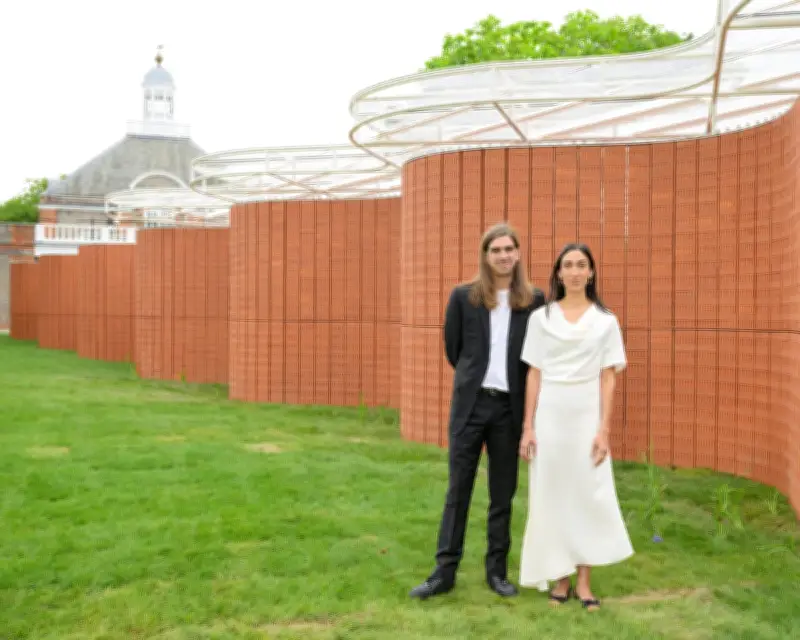
For the past quarter-century, the Serpentine Pavilion in London's Kensington Gardens has served as a showcase for architectural haute couture, with designs ranging from Frank Gehry's explosive lumber-yard aesthetic to Peter Zumthor's introspective charcoal-walled garden. This year, Lanza Atelier, a Mexico City-based studio founded in 2015 by Isabel Abascal and Alessandro Arienzo, offers a refreshingly literal interpretation: a serpentine-shaped wall made of rust-colored brick, known technically as a crinkle-crankle wall.
A Return to Basics
The crinkle-crankle wall, originally introduced by Dutch engineers in rural Suffolk during the 17th century to drain marshlands, is called slangenmuur (snake wall) in Dutch. Similar structures appear in Mexico and ancient Egyptian excavations. Mathematically, these sinusoidal curves provide inherent stability and resist lateral forces, requiring only a single layer of bricks without additional buttressing. Built on an east-west axis, the south-facing side captures sunlight, historically used to cultivate fruit trees and extend growing seasons. "They're structures that temper climate, create shelter and enable growth," says Abascal.
Reframing the Wall
In an era where walls often symbolize division—notably Trump's proposed border wall—Lanza Atelier aims to reframe the narrative. "We're doing a wall that attracts instead of divides, becoming a gathering place and creating a series of little rooms," explains Abascal. "A wall doesn't necessarily need to be built for division." The design embraces "gentle geometry," which is "continually responsive to those who move through it," adds Arienzo. The serpentine form originated from tracing the building line around existing tree canopies, echoing the Serpentine pond in the park. A serpentine-shaped bench serves as a miniature companion to the pavilion.

Innovative Use of Brick
For the first time in Serpentine history, brick has been employed—a material previously considered too permanent for a temporary structure. The bricks, manufactured in Surrey at a historic London supplier, are standard size but transformed by Lanza's design. Set without mortar joints, they are threaded through reinforcing bars like beads on a chain, facilitating easy dismantling without waste. Unconventionally, the bricks are placed back to front, with ribbed sides outward, creating a woven textile-like texture that adds visual interest.
Structural and Aesthetic Details
The pavilion is topped with a flat glass roof supported by a steel grid, featuring fixed louvres to deflect summer sun and cast cooling shade. A row of glittering lights along the wall's top adds a touch of drama. The design alludes to the weathered red brickwork of the neighboring Serpentine South Gallery and the Victorian brick mansion blocks of South Kensington, including the Royal Albert Hall.
Frank Lloyd Wright once said, "A brick is a small, ordinary, worthless thing that costs 11 cents, but give me a brick and it becomes worth its weight in gold." Arienzo echoes this sentiment: "A brick is nothing very sophisticated, but once you see it laid down or built in a different way, it sparks curiosity and makes people enjoy it more." After 25 years, brick's time at the Serpentine has finally arrived.
Lanza Atelier's Serpentine Pavilion is open from June 6 to October 25.