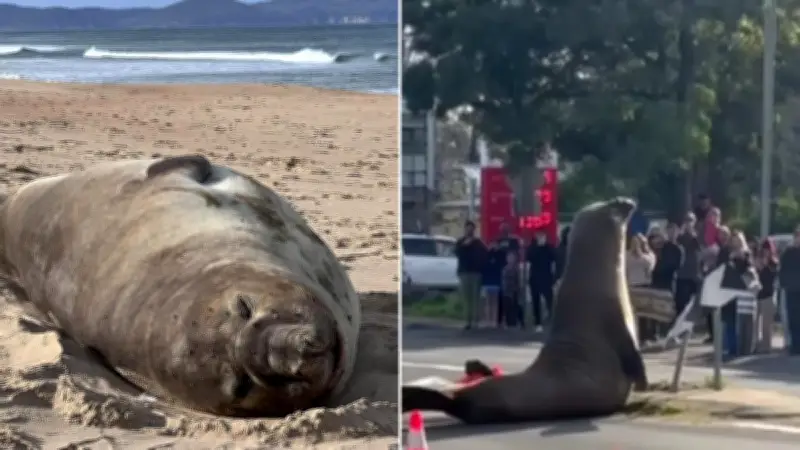
For weeks, a 1000kg southern elephant seal has delighted the world — crushing bollards, climbing onto parked cars and bringing Tasmanian streets to a standstill. Neil the Seal's antics have transformed him into Australia's favourite wildlife celebrity, earning millions of views online and turning him into a global name far beyond Tasmania.
But while Australians, and increasingly people around the world, have fallen in love with the boisterous young elephant seal, wildlife scientists are watching his rise to fame closely with a sense of deja vu. They've seen this story before. They know how it can end. And they're determined to make sure Neil's story ends differently.
A Warning from History
Four years ago, a walrus named Freya became an international sensation after hauling herself onto boats across Norway's Oslofjord. Like Neil, she attracted enormous crowds. Her playful antics made headlines around the world and turned her into an unlikely wildlife celebrity. Then came the decision that shocked millions. After repeated warnings from wildlife experts were ignored, Norwegian authorities concluded Freya had become an unacceptable risk to public safety and she was euthanised.

The decision sparked international outrage and has since become a cautionary tale for wildlife managers around the world. Scientists have been quick to stress that Neil is far from that point. In fact, they say that's exactly why they are speaking out now.
Last week, Tasmania's Department of Natural Resources and Environment warned there was a real risk of people “essentially loving Neil to death”, describing the seal's celebrity as a “double-edged sword”. Officials stressed euthanasia is not their preferred management approach but acknowledged it could become a last-resort consideration if dangerous public behaviour continues.
The warning struck a nerve. More than 60,000 people have since signed a petition calling for a non-lethal management plan, arguing Neil is “more than just a viral internet trend or a holiday photo opportunity” and urging the Tasmanian Government to introduce stronger crowd control, temporary exclusion zones and public education before considering lethal measures.
Practising How to Be a ‘Big Boy’
For southern elephant seal researcher Sophia Volzke, one of the biggest misconceptions about Neil is that he is being deliberately destructive. “From a behavioural perspective, he's trying to play,” she told 7NEWS.com.au. “He's trying to practise how to be a big boy one day and how to assert some dominance behaviours over an area because these are a highly polygynous species.”
To millions online, Neil is the lovable larrikin flattening traffic cones and climbing over parked cars. To Volzke, and researchers across the globe, he's simply a juvenile seal rehearsing for adulthood. “One male beachmaster ... will take care of a harem of females and he will defend that harem in the breeding season and he will fight with other males to do so,” she said. “So while Neil's growing up, he's practising some of those movements and pumping his chest into things and bouncing into the fence or into cars because that's what they do to each other as well as juveniles when they fight.”
Without other young elephant seals around, Neil has simply found makeshift and rather unusual sparring partners. “It's not loneliness per se,” Volzke said. “But it is fair to say that he would be fighting with other juveniles if they were around ... He would be practising some of those movements with other individuals rather than with cars and fences.”
When Admiration Becomes Dangerous
Ironically, it is those playful moments that have made Neil so famous. Every viral video has brought more people to Tasmania's coastline in the hunt for an interaction with Australia's most famous seal, and that's exactly what worries scientists most. “The crowding is a concern,” Volzke said. “We can't get too close to him. We can't be in his path. We need to let him do his thing and decide what he's doing. We can't be interfering with him in any way, and we also can't let him get used to humans.”

Volzke said people often do not realise just how much Neil still has to grow. “People underestimate how big he's going to get if he continues to come back,” she said. “At some point there's going to be a cutoff of how dangerous it is for anybody to be around him, especially if people are trying to seek him out for his fame.” Adult male southern elephant seals can eventually reach around three times Neil's current weight, meaning interactions that seem relatively harmless today could become far more dangerous in the years to come.
Not Every Seal Becomes Neil
For all the chaos Neil leaves in his wake, Australians are often surprised to learn he's far from the only seal living alongside people. Sydney Harbour is regularly visited by fur seals. In fact, the city's most famous resident, Benny the Seal, has become such a local icon he even has his own landmark on Google Maps. But most of Australia's seals quietly haul out on rocks and quieter stretches of coast before slipping back into the water with little fanfare.
Neil is different — partly because of his species, partly because of his age, and partly because the internet happened to take notice. Volzke said social media has also created a distorted picture of Neil's life. “Whenever I post him just sleeping, people get really confused,” she said. “That's him 90 per cent of the day.” The videos that race around the world — the traffic cones, the flattened bollards and the parked cars — capture only fleeting moments in an animal's day. The rest of the time, Neil is doing what elephant seals do best: resting.
For scientists, that's an important distinction. The concern isn't that Neil is an unusually destructive seal. It's that an ordinary wild animal behaving exactly as nature intended has become an extraordinary internet celebrity. And with that fame has come attention he never asked for.
The Greatest Act of Love
For Neil's supporters, the mere mention of euthanasia has been heartbreaking. For scientists, it's something they hope never becomes more than a hypothetical. Volzke believes there is still time to avoid that outcome but only if Australians change the way they interact with Neil. She said respecting his space, resisting the urge to get closer for a photo and allowing him to remain a wild animal are the best ways to ensure he can continue returning to Tasmania's coastline safely.
“I don't think it's any valid option right now to be interfering with his life,” Volzke said. “I think it's more of a discussion of what will happen down the line in the future, and it's a bit of a warning to the public to behave, and to educate.” Education and better crowd management, she argues, are far more effective than trying to intervene once a dangerous situation has already developed. This is the reason she deliberately avoids revealing where Neil is. “I do not location tag him ... I try not to share his immediate location.”
Her advice to Australians who adore Neil is remarkably simple: “Just keep your distance. Appreciate the moment that you get to observe him, a wild animal that is just absolutely fascinating.”
On Wednesday night, Neil returned safely to sea as expected, with wildlife authorities continuing to monitor the area ahead of his likely return to shore. Freya's story ended in heartbreak. Scientists hope Neil's ends differently — and say that outcome may ultimately depend on the actions of the people who love him most.