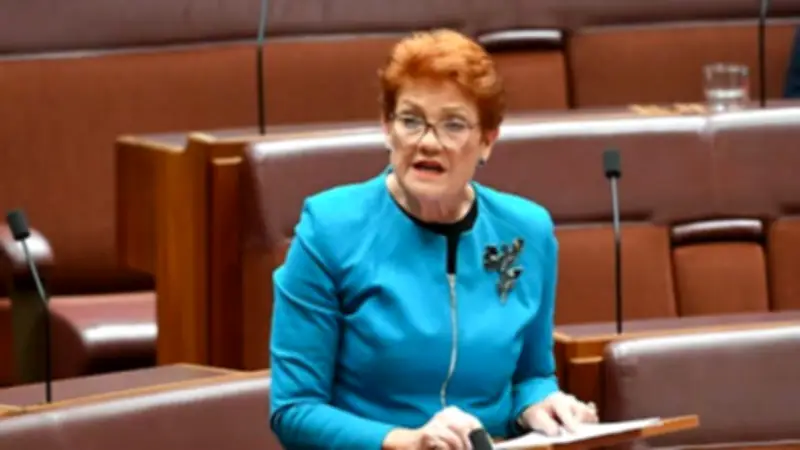
Pauline Hanson delivered her 2026-27 Budget Reply speech in the Senate chamber at Parliament House, Canberra, on Thursday, May 14, 2026. (Lukas Coch/AAP)
View from The Hill: Could One Nation be the unofficial opposition at the 2028 poll?
Published: June 1, 2026 5.34pm AEST
Despite One Nation holding only two House of Representatives seats, politically-savvy observers now believe it is possible that the insurgent party could become the de facto opposition that Labor faces in 2028. Two Redbridge polls have reinforced this message.

The first, a seat-by-seat mapping of the country published by the Australian Financial Review last month, suggested that in an election held now, the Coalition would be almost wiped out by the One Nation surge. The latest poll, taken in the wake of the budget and published by the AFR on Sunday, has One Nation ahead of Labor for the first time, with the Coalition continuing to languish. One Nation’s primary vote stands at 31%, compared to Labor’s 28% and the Coalition’s 20%. It appears One Nation is the party that has received a “bounce” from an unpopular budget, gaining four points in a month, while both Labor and the Coalition have gone backwards.
As preferred prime minister, Pauline Hanson trails Anthony Albanese 25% to 31%, with Angus Taylor on 14%. When Taylor first entered parliament in 2013, and even before that, he was seen as a potential leader and a possible future prime minister. When Pauline Hanson arrived in the House of Representatives in 1996, she was regarded as a political outsider, having been disendorsed by the Liberals for racist comments. Now, Hanson is being asked seriously if she wants to be prime minister.
When that question was put to her on Sky by Andrew Clennell on Sunday, Hanson repeated it rhetorically before answering: “Do I want to be prime minister? Well, I’ll tell you what, I won’t knock back the job Andrew, because I believe that I have the ability to do it. I’m not going to underestimate myself or say ‘no, I can’t do it’ because you know, have a look at what we’ve got now.” She echoed her self-confidence on Monday. Most leaders in Hanson’s situation – a senator leading a party with just six seats in total, including both houses – would probably have demurred, saying “we’re a long way from talking about that”. But in that answer we see the unvarnished Hanson: a woman who both believes in herself and thinks, and resents, that she has been underestimated all her political life. Of course, she is convinced she could do the job, and she has reached the stage of saying that outright.
Taylor must find it hard to believe things have come to this. A senior minister in the Morrison government, which won a “miracle” election victory, he now presides over a party that appears to be declining by the week, with its supporters and some rank-and-file members jumping to Hanson. Albanese, for his part, cannot quite get his head around the fact that a woman who does not even bother turning up for parliamentary business when she does not feel like it, and used to be a near political pariah for her more extreme views, is now, according to the polls, in line to win a heap of lower house seats at the next election.
The attention has been on the threat One Nation poses to the Liberals and Nationals, but within Labor, strategists are taking the rapidly changing political landscape seriously. Although the election is two years off and everything could change, Labor planning is underway for the contingency that come 2028, the main fight could be between the government and One Nation, with the Coalition a secondary player. In 2025, Albanese had to adapt and adopt appropriate tactics to combat what appeared to be a surging Coalition (in retrospect, that was probably never as real as it looked at the time). Next election, a similar adaptation to new circumstances might be required.

The challenge for Labor, while being mulled over currently, lies in the future. For the Liberals, things are desperate now. In this situation, the wisdom of installing Tony Abbott as their federal president is still an open question for Liberals. Shadow Treasurer Tim Wilson said Abbott’s role would be “administrative”. Abbott’s take certainly seemed more expansive. “I don’t expect to be in the media every day,” he told the ABC. “But on the other hand, I do think that my presence now, in this senior role will demonstrate to people who might have been sceptical that the Liberal Party is fair dinkum about abolishing net zero, fair dinkum about cutting back mass migration, fair dinkum about scrapping taxes - because my government was actually very good at that. My presence, I think, is an indicator that the Liberal Party hasn’t forgotten how to be a very, very good government. Look, the party president is the organisational leader, not the political leader. But I don’t think there’s ever been a party president who’s taken a vow of silence, and I’m certainly not going to start.” Taylor’s problem is that Abbott is better media talent than he is, and their mutual problem is that Abbott loves the spotlight.