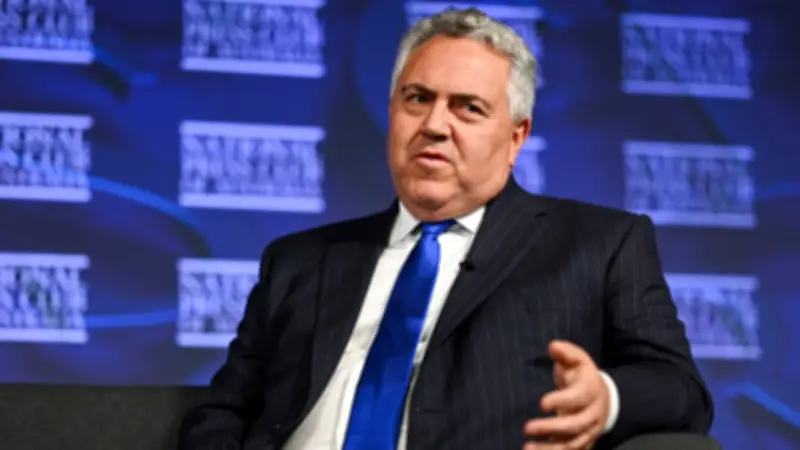
Former Coalition treasurer Joe Hockey has weighed into the unprecedented collapse in support for the major parties, branding One Nation's surge to become the most popular political party in the country as 'predictable'.
It comes as a new Redbridge/Accent poll shows One Nation on 31 per cent, ahead of Labor on 28 per cent and the Coalition on 20 per cent.
Mr Hockey said growing anger with the political establishment had driven voters away from the two major parties.

“It’s pretty predictable, I think there's a lot of anger in the community … it’s a reaction,” Mr Hockey told Sky News.
“People don't want the status quo; they don't want the same old behaviour from political leaders; they want change.”
Despite Labor’s efforts to sway voters through controversial changes to negative gearing and capital gains tax concessions, the government sank by three points in the post-budget poll.
Treasurer Jim Chalmers announced changes to capital gains tax in last month's budget, replacing the existing 50 per cent discount with an inflation-adjusted model that includes a minimum 30 per cent tax rate.
Business leaders have expressed concerns that Australia's new tax settings could make it harder to attract investment compared with overseas competitors.
New Zealand Finance Minister Nicola Willis recently promoted the local tax system, telling investors and entrepreneurs the country is a 'great place to do business'. Speaking to Sky News, Mr Hockey said Australia was at risk of companies or startups leaving for countries like New Zealand or Singapore due to more attractive tax settings.
"It's a huge risk," he said. "And, why not? If the Kiwis are saying, 'We've got zero tax on the capital gain, start up a business over here', are you going to start up the business in Australia where you end up giving 50 per cent? Or, are you going to go to New Zealand where you don't have to pay anything to the government? That's the issue - that's a fundamental issue."
The former treasurer said entrepreneurs who succeed after risking their own capital and time would naturally look at alternatives if they believed the tax burden was too high.
"If you are investing your time, effort, and money in trying to start a business, and if you succeed, you end up giving half to the government. You will look at other options," he said.
Mr Hockey, who served as treasurer between 2013 and 2015, argued the CGT reforms created a stronger incentive to invest in property rather than businesses and shares. He said governments had traditionally structured the tax system to encourage investment into productive assets that create jobs and grow the economy.
"What these guys have done is they've turned it on its head," he said.
Mr Hockey argued investors would increasingly favour real estate over business investment because the tax treatment would now be similar, despite the vastly different levels of risk.
"If I have $500,000, I've got more of an incentive to put that $500,000 into a house in Glebe or Pakenham than I have to put it into a share or into your business," he said.
The Albanese government has argued the changes will help level the playing field for first-home buyers and encourage investment in housing supply. Treasury estimates the reforms to capital gains tax and negative gearing will help about 75,000 additional owner-occupiers over the next decade.
However, Mr Hockey said the changes would discourage investment and entrepreneurship at a time when Australia needed more innovation, not less. He linked that concern directly to the rise of artificial intelligence, warning Australia was falling behind the pace of technological change taking place overseas.
However, he also warned that accounting, legal and medical professions would all face significant change.
"We will probably end up with 15 per cent unemployment based on today's participation rate within the next three or four years," he said.
During a recent address to the National Press Club, Mr Hockey predicated that Australia could face 15 per cent unemployment as early as 2030.
Mr Hockey argued governments would eventually struggle to fund growing welfare demands if large numbers of people were displaced from the workforce. He said future governments could increasingly target wealth and assets rather than income.

"Governments will start talking about putting taxes on the family home, about death taxes, about new taxes on your assets," he told Sky News.
Despite his warning, Mr Hockey said there was still a pathway forward.
"The hope is that we innovate, that we come up with good ways to respond," he said.
But he argued that becomes harder if governments increase taxes on entrepreneurs and investors.
"That's why it's bad policy to increase taxes on innovation, which is exactly what's happening at the moment," he said.
"The best way we can address that is having an entrepreneur in Dubbo or some young kid in Geelong come up with a great idea that changes the world. You're not going to do that if you're going to tax them 50 per cent."