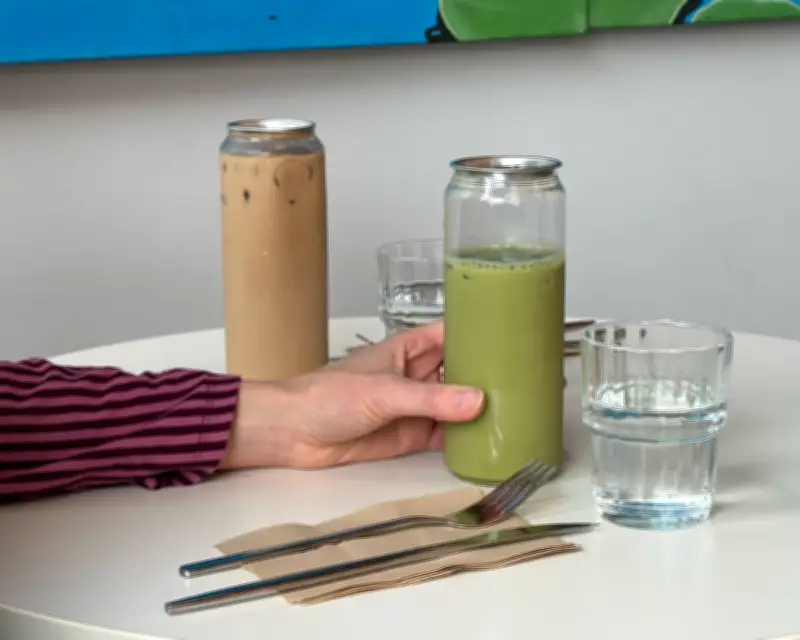
The inaugural Unpackit Award for Australia's worst packaging has been awarded to a single-use plastic and metal drinking vessel, described as a 'franken-can' that 'ticks every box for problematic packaging'. This hybrid container is not accepted by container refund schemes and is difficult to recycle, leading to its dubious recognition.
Franken-can wins Unpackit Award
The plastic-metal hybrid can, which is already banned in Western Australia, was named the worst packaging at the first Unpackit awards, established by the Australian Marine Conservation Society (AMCS), Plastic Free Foundation, and WWF-Australia. These awards highlight the estimated 1.3 million tonnes of plastic packaging used annually in Australia.
Cip Hamilton, plastics campaigns manager for AMCS, stated: 'The franken-can is a completely unnecessary plastic-metal hybrid can that essentially ticks every box for problematic packaging.' She noted that cafes are using these single-use items for dine-in customers, replacing reusable cups and glasses. 'They're likely to end up as street litter, and they're not accepted by container refund schemes as other beverage containers are. They're really problematic and really have no place in our economy.'

State-by-state approach and national packaging laws
Hamilton criticised the state-by-state approach to packaging regulation, calling for national packaging laws that make producers responsible for the full life cycle of their packaging. 'The Australian government's very overdue in its national packaging laws,' she added.
Best packaging winner: Udder Way refillable milk kegs
In contrast, the award for Australia's best packaging went to Udder Way's 18-litre refillable milk kegs, which work like beer kegs and have averted the need for an estimated 4.5 million single-use plastic milk bottles since 2021. WWF-Australia's No Plastic in Nature policy manager, Malene Hand, described the kegs as 'a brilliantly simple alternative to single-use plastic milk bottles,' originating from Tasmanian cafe owner Ed Crick's frustration with plastic milk bottle waste.
Hamilton noted that the milk kegs are available in high-volume venues like cafes and event spaces and are beginning to be rolled out in supermarkets for individual consumer refills, a timely development given rising resin prices for plastic containers.
Dishonourable mentions and honourable mentions
Dishonourable mentions for worst packaging included major supermarkets for wrapping avocados in unnecessary plastic netting and individually wrapped Mentos mints. Honourable mentions for best packaging went to Bearhug for its reusable pallet wrap system, which displaces 350kg of single-use plastic over its lifetime, and to Cercle's cafe-based reusable coffee cup system.
Bearhug was started by a truck driver who noticed pallets being reused but single-use wrap discarded. One Bearhug wrap avoids 25 tonnes of soft plastics annually.
Impact and call for producer responsibility
Hamilton said Unpackit was inspired by similar awards in New Zealand, where businesses changed packaging in response. 'The only way we will end plastic pollution is cutting back on how much plastic is being produced, and holding producers responsible for what they're putting on their shelves.' The winners were announced in Canberra by independent MPs Zali Steggall, Sophie Scamps, and Kate Chaney.
Stuart Alexander & Co., which manages the Mentos portfolio in Australia, was contacted for comment.