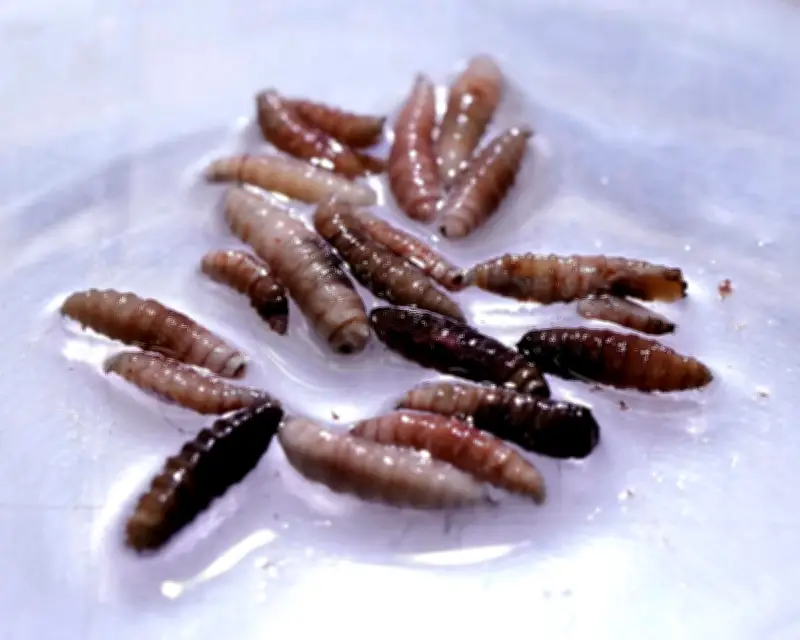
Agriculture officials have confirmed the presence of a flesh-eating parasite rarely seen in the United States in six decades in a calf in Texas, raising alarms for the country's cattle industry. The New World screwworm fly (NWS) was detected in an animal in southern Texas, approximately 50 miles from the Mexico border, Agriculture Secretary Brooke Rollins announced late Wednesday.
For over a year, the U.S. Department of Agriculture (USDA) and Texas officials have been warning livestock owners about the parasite's advance across Mexico. The screwworm fly larvae feed on the blood of warm-blooded animals. While the risk to humans is low, the parasite can spread quickly in areas where large numbers of cattle and other livestock are kept together.
The screwworm was eradicated from the U.S. in the 1970s after causing tens of millions of dollars in losses. Officials now fear a resurgence at a time when food prices, especially for beef, are at record highs across the country. The flies pose no threat to food safety, but officials worry about potential shortages if they take hold in cattle and poultry populations.

Official Reactions and Measures
Texas Agriculture Commissioner Sid Miller expressed concern in a statement, noting that despite the USDA's efforts, the screwworm has advanced rapidly through Mexico. "Even though billions of sterile flies have been dispersed by USDA, the screwworm has still advanced over 1,100 miles from southern Mexico to Texas," Miller said. He criticized the USDA for missing an important component in its strategy, warning that the consequences are now evident.
Rollins defended her agency, stating there is no threat of mass infestation. "There is no reason to believe this incursion will result in establishment of the pest in our country," she said, noting that the Texas case is the only one so far and the first confirmed detection in the state since 1966.
Previous Cases and Biology
In August 2025, federal health officials confirmed a case in a Maryland resident who had traveled to El Salvador, but the victim recovered and no transmission was found. The last outbreak before that was in the Florida Keys in September 2016, primarily among wild deer, and it was contained early the next year.
Female screwworm flies target open wounds on cattle and other animals to lay eggs. When the eggs hatch, the larvae feed on the blood and flesh of the host, which can be fatal if untreated.
Control Efforts
In March, Rollins announced a partnership between the USDA, the Army Corps of Engineers, and Mortenson Construction to build a new sterile fly production facility at the Moore Airbase in Edinburg, Texas. Female screwworm flies mate only once in their lives, and eggs from sterile males do not hatch, which helps reduce the population over time.
Miller urged the Trump administration to increase deployment of the Screwworm Adult Suppression System (SWASS), which uses attractants, bait, and targeted insecticides to reduce adult populations before sterile fly releases. "SWASS was developed by USDA, tested by USDA, and successfully deployed by USDA to eradicate screwworm in Mexico and Texas when it last appeared," Miller said. "USDA already owns the playbook; the only question is whether USDA will use it before this situation gets worse."
Past eradication efforts were so successful that the U.S. shut down facilities for breeding sterile flies, leaving only one in Panama for decades. In Mexico, high medicine costs have forced ranchers to use crude methods like applying gasoline or lime to open wounds to remove worms.