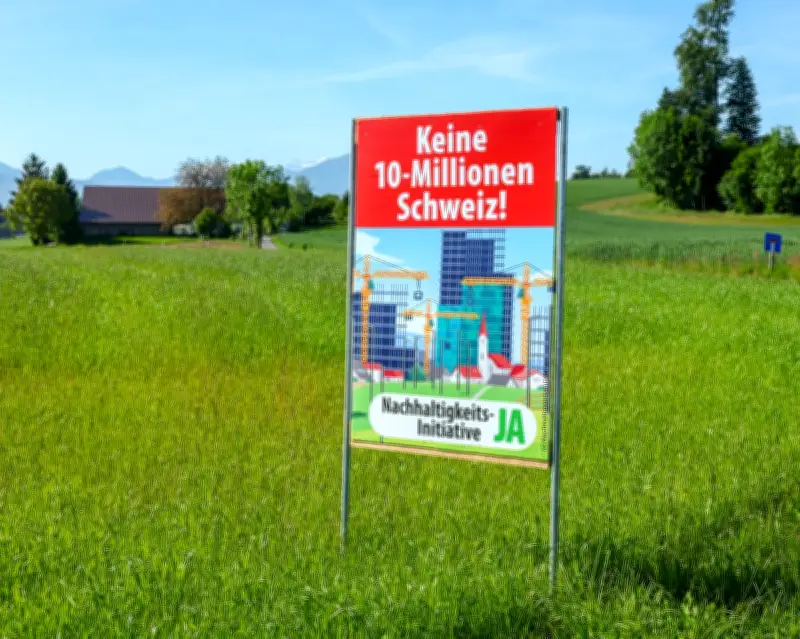
An SVP campaign sign in a field in the canton of Zurich reads: ‘No Switzerland with 10 million. Yes to the sustainability initiative.’ The image captures a pivotal moment as Swiss voters prepare to decide on a far-right proposal that could reshape the nation’s future.
A Nation at a Crossroads
Is Switzerland tired of prosperity? That is the question raised by the upcoming referendum on capping the permanent population at 10 million. On 14 June, voters will decide whether to freeze growth, a move that critics argue would dismantle the openness that has driven the country’s wealth.
Zurich on a Sunday morning can feel like the day after Armageddon: so empty, so calm, despite being Switzerland’s biggest city. But then the church bells erupt across the lake basin, and a jogger trots by like a polite deer in aerodynamic sunglasses, and one knows that all is fine in this proudly impeccable place, where little is left to chance and the authorities even track the city’s pigeons with GPS.

Swiss people know they are lucky. A highly diversified economy keeps salaries high and income inequality comparatively low. A British friend once remarked that our supermarkets feel like the gourmet hall at Harrods. The state makes business easy. Hiking paths are maintained by armies of volunteers. The flip side is our reputation for being a nation of humourless control freaks, but there are benefits to trains running on time. In a restless world, Switzerland remains a place where one can exhale.
The Fear of Losing Fortune
The problem with luck, of course, is that one becomes afraid of losing it. But fortune has a tendency to make conservatives of us all, of course. Yet how to preserve what one cherishes? The answer offered by the far-right Swiss People’s Party (SVP) is to freeze the country. On 14 June, Swiss voters will decide whether the permanent population should be capped at 10 million. That threshold could be reached sometime between 2033 and 2041. Polls suggest the vote will be on a knife edge.
Switzerland’s population has indeed grown rapidly. In the last 25 years, it jumped from 7.2 to 9.1 million, with roughly four-fifths of that increase driven by immigration. The SVP, the country’s largest political party, blames this for rising rents, crowded trains and “density stress”: a reminder to democrats across Europe that a healthy economy won’t stop the far right. There will always be voters receptive to immigrant-blaming for whatever ails the moment. For their leaders, the boat is always “full” – the metaphor famously used by the SVP’s predecessor party, when its justice minister Eduard von Steiger in 1942 compared Switzerland to a “small, crowded lifeboat with limited capacity” to justify turning away Jewish refugees.
Reality Check on Crowding
By most measures, Switzerland is not especially crowded. Population density in Zurich is lower than in spread-out Berlin and less than a quarter of that of packed Paris. Living space per inhabitant is above the European average. Rents have risen, certainly, but so have wages. In 2006, the average household saved roughly 10% of its income after taxes, housing and consumption. By 2023, that figure had climbed to about 18%. There are real growing pains. Low-income earners devote a slightly larger share of their earnings to rent than 20 years ago. But that is simply an argument for building more, especially Swiss-style public and cooperative housing, not for shutting the borders.
The SVP’s framing of immigration as the culprit for strained infrastructure is also a bit rich, given the detrimental policies it supports: weakening tenant protections, deprioritising rail investment and championing the low-tax policies that attract corporates and wealthy foreigners in the first place.

Swiss Brexit by Stealth
Coherence may not be a valuable currency in politics. But if the initiative is so dangerous and the debate about it so fractious – it is opposed by every other party in parliament – it is also because it is about much more than migration: it is a Swiss Brexit by stealth. Should this referendum pass, and should the population then exceed 10 million, Berne would be required to terminate its agreement with the EU on the free movement of people. The agreements linking Switzerland to the EU’s single market would become null and void, opening the way to the SVP’s long-held dream: reimagining Switzerland as a deregulated, buccaneering hub trading freely with the world. A sort of Alpine Dubai.
It is a fundamentally unserious fantasy. The heyday of free trade is over. Swiss exports going to Asia have dropped by 6.5% since 2022. Tariffs have caused sales to the US to fall by 25% this year. Like it or not, 51% of what Switzerland sells goes to Europe, which remains by far the most important growth market for its exporters.
The Lesson of Openness
If there is one near-uncontested lesson from modern economic history, it is that open societies win. Openness to immigration was long the defining superpower of the US. Japan’s strict immigration policy explains its dismal growth performance, and the fact that its average effective retirement age for men stands at 69.5 years. Switzerland’s remarkable ascent from peasant backwater to high-tech economy in 200 years tells the same tale. With no natural resources, Switzerland has grown wealthy because it has provided a stable economic climate that attracted foreign innovators. Nestlé, Swatch, and pharma giant Novartis – these iconically “Swiss” firms were all founded or built by immigrants.
Threat to Rights and Family
Moreover, beneath the economics lies something even more troubling. What makes the Dubai model so appealing to the radical right is that abandoning EU treaties would not only allow the SVP to cut immigration but also to strip foreigners of their rights entirely. For instance, they have proposed barring German and French workers from bringing their families. Switzerland would join the league of autocratic states that deny foreigners what conservatives claim to hold most dear: a life rooted in family.
The true miracle of Switzerland’s long economic success is that it avoided the “Buddenbrooks trap”. In Thomas Mann’s novel, successive generations of a prosperous German family grow more comfortable, self-focused and emotionally fragile, losing the pragmatism that created their fortune. Switzerland, by contrast, has maintained discipline and adaptability. Perhaps that tradition is now fading. If the vote is as tight as forecasts suggest, it is because even many center-right voters have come to believe they can afford themselves the decadent dream of stasis.
What is certain, however, is that freezing the country would not preserve it. It would do exactly the opposite, dismantling the very openness that made it prosperous. History is not especially kind to societies that confuse preservation with paralysis.