Florida-based artist Robert Wyland, known simply as Wyland, was busy in his studio in the Florida Keys a few weeks ago, painting and sculpting vibrant scenes of aquatic life as he always does. Then his assistant walked in with troubling news.
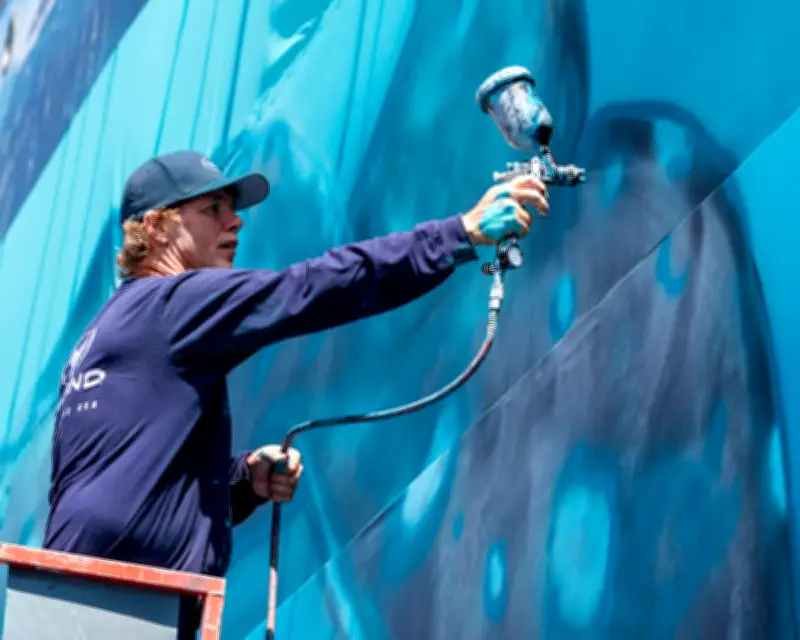
Wyland, 69, has earned international acclaim for his "whaling walls," a series of larger-than-life murals across the United States and abroad, many of which have become iconic parts of American cities. These murals peacefully depict the largest mammals on earth on warehouses and office buildings, offering city dwellers moments of tranquility amid chaos.
In the late 1990s, Wyland created a mural called Ocean Life in Dallas, Texas. At 82 feet tall, it was among his favorites. Over the next 30 years, the community grew attached to it, but the mural also began to age—the blues and blacks faded, and cracks appeared in the paint. Wyland frequently touches up his work, and restoring Ocean Life was on his to-do list—until his assistant delivered the bad news.

"She told me someone had called and said they were whitewashing the wall, or blue-washing it, I guess," Wyland told the Guardian. "I was shocked. It really caught me off guard."
Photos of the wall soon appeared on social media. Initially, it was unclear why this longstanding public art had been painted over. Wyland and his foundation struggled to understand what happened. Some of his work has disappeared over the years when buildings were demolished, but this time, no one consulted or warned him.
What ensued has thrust Wyland into a battle with the most powerful sporting organization in the world, a local organizing committee, and sparked a debate about the ownership and importance of public art.
Wyland learned that his work had been entirely erased to make way for a new mural promoting the upcoming FIFA World Cup. His team immediately filed a cease and desist, and days later, a lawsuit seeking $25 million in damages against FIFA.
"This is a David and Goliath thing for sure," said Wyland. "They are a multi-billion dollar organization, and I am a single artist with a small foundation. But I tell you, they picked the wrong artist and the wrong artwork. I am not going to stand by and let them get away with this."
Wyland's Lifelong Passion for Ocean Conservation
Wyland's fascination with ocean life began at age 14 during a family trip to California. Growing up in Detroit, his exposure to marine life was limited, but in Laguna Beach, he saw a pod of grey whales migrating—a 12,000-mile round trip from the Arctic to Mexico. That sight hooked him, and he grew up idolizing oceanographer Jacques Cousteau.
About a year later, he painted his first mural for a teacher who owned an ice cream and burger shack. It paid $100. Over the next few years, he took any work he could find, eventually moving to California to pursue art full-time. At one point, he subsisted on a single Snickers bar a day.
Over the next half-century, Wyland focused on ocean conservation. His life's work is the whaling walls. He painted the first one in 1981 in Laguna Beach, near where he fell in love with whales. The scene—a California grey whale with her calf—was an instant hit. Inspired, he set out to paint 100 murals. He achieved that feat in 26 years, 11 months, and five days, with murals in 17 countries.
The Destruction and Its Aftermath
The destruction of his Dallas mural sparked widespread outcry. Multiple parties are involved: the North Texas World Cup Organizing Committee, the city of Dallas, its local economic development agency, FIFA, and the building's owners and managers. Assigning blame has been tricky, with few parties offering comment. The city claimed Wyland was contacted, which he calls a "blatant lie."
Wyland believes FIFA is responsible. "They need to come clean," he said. "They're responsible. They are saying they're not. Does that pass the smell test to you? It's their event."
His lawsuit cites the Visual Artists Rights Act (VARA) of 1990, which protects artists of "recognized stature" from intentional destruction of their work. The $25 million claim would be the largest under VARA. Wyland says he will donate any proceeds to charity.

"Sometimes, money is the only thing people understand," said Wyland. "The number had to be big enough to wake up people who come into a community and destroy art that's part of its fabric. Artist's rights aren't just about the artist; they're about public art that gives joy to residents."
Work on the replacement mural has stopped. The building's owners said they donated the space for public art and are not profiting. FIFA told the Guardian they have "no involvement whatsoever," referring inquiries to the host city committee. The local organizing committee acknowledged communication shortcomings, while Downtown Dallas, Inc. (DDI) distanced itself, saying it was only involved in early discussions.
Emails obtained by the Dallas Morning News show a DDI employee describing Wyland's mural as "over 30 years old and past its useful life." Wyland responded, "Is the Mona Lisa beyond its usable life? Would you say a Van Gogh is beyond its usable life? My murals have been around a long time. Maybe it's faded or cracking. That's bull—who makes that judgment on behalf of all Dallas? They'll try to spin everything."
Questions remain, including why a temporary solution wasn't used. For eight years, Wyland's mural was covered by ad banners before re-emerging during the pandemic. Wyland hopes to get clarity in court, where his legal team can "follow the money." Even if given the chance, he likely won't repaint the wall due to the effort required at age 69.
The local organizing committee hasn't revealed details of the planned replacement mural, and it's questionable whether it will ever go up given the backlash. None of it matters much to Wyland, who is still grappling with the loss. "These walls are like my kids," he said. "This is really, really personal."