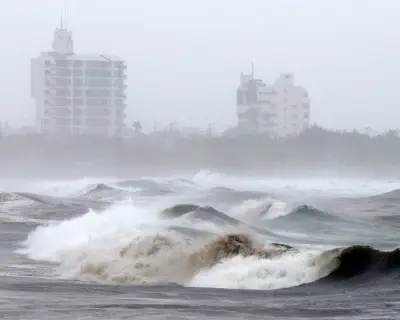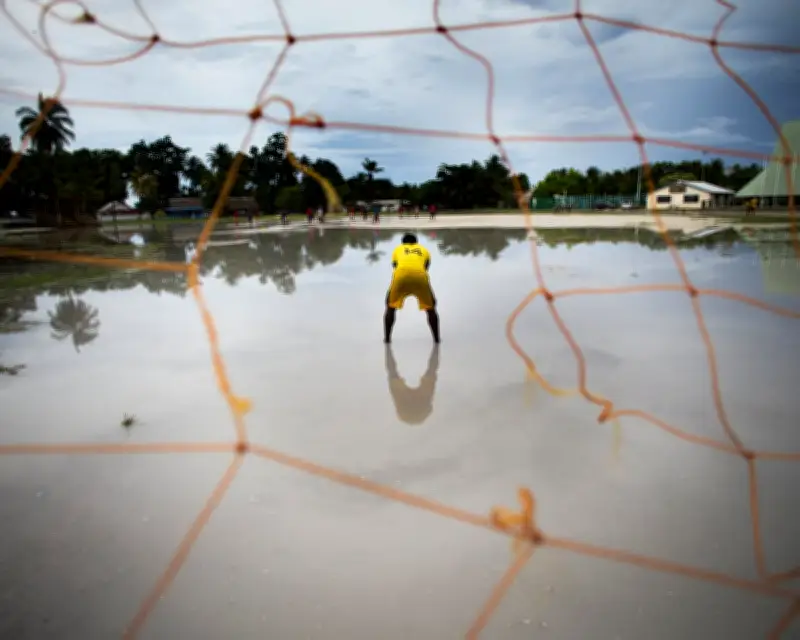
In a football derby played at a flooded stadium in Bairiki, South Tarawa, the capital atoll of Kiribati, the reality of climate change is impossible to ignore. The Pacific island nation, home to 138,000 people, is racing against time to secure its place in World Cup qualifying for the 2030 tournament, hoping to draw global attention to its existential threat from rising sea levels.
Football as a Lifeline
Eriati Reebo, president of the Kiribati Football Federation, emphasizes that this effort is about more than sports. "This is not just about football, it's about building something from scratch," he says. "A legacy, a story, that the world will always remember." Kiribati, the only nation spanning all four hemispheres, is rapidly disappearing from the map and could become the first country rendered uninhabitable by seawater. To preserve its spirit, it aims to professionalize its football setup and gain full membership in the Oceania Football Confederation (OFC), opening a path to compete with larger nations.
"Football is our passion and, despite our small territory, we dream big," Reebo adds. "In Kiribati you're born knowing how to play football. This may be our last chance." He believes that World Cup participation would give Kiribati unprecedented visibility, uniting people and transforming the nation's future.

Progress on the Global Stage
Reebo attended April's FIFA Congress in Canada to advocate for Kiribati's inclusion in the OFC, where they would face teams like New Zealand, a participant in this summer's World Cup. Engaging with FIFA President Gianni Infantino and other football leaders marks significant progress. "When I was young we did not even know who the president of FIFA was, so attending congress is a fantastic milestone for Kiribati," Reebo notes.
Joining FIFA and the OFC would bring funding to improve resources and facilities in Kiribati. However, a vicious cycle exists: current infrastructure—sand pitches and beach football—may not meet OFC criteria, hindering full membership.
Climate Change and Survival
Kiribati gained independence from the United Kingdom in 1979, but rising sea levels demand a different future. Government policies encourage migration abroad, and Kiribati has purchased land in Fiji to relocate climate refugees. Football's popularity is undeniable, with the Te Runga Games—a quadrennial multisport event—drawing 23 teams from across the atolls. In 2023, Kiribati skipped the Pacific Games to attend the Te Runga Games, such is its importance. Participants travel to Tarawa by small plane or boat, and passionate crowds watch inches from the pitch.
The Premier League and La Liga are popular, but foreign matches are not always accessible. Plans to broadcast the World Cup live on television are underway, with Reebo working with FIFA on an agreement. He will be watching his favorite players, Lamine Yamal and Neymar, closely.
Regional and Global Context
Kiribati is not alone; the Marshall Islands and Tuvalu face similar threats. The Marshall Islands Football Federation produced a "disappearing shirt" to raise awareness. Mirey Atallah of the United Nations Environment Programme states, "Talking about climate change is much more prevalent because it's a fundamental issue of survival. It's not a luxury issue; it's a certainty. The question is when."
Plans are in place to bring Kiribati's best 24 players to Tarawa for full-time coaching. "If Pep Guardiola wants to come, he'd be very welcome," Reebo says hopefully. While the most polluting World Cup in history prepares to kick off, Kiribati battles for survival.

Other Notable Stories
Heat stroke, sportswashing, and VAR psychology—the Guardian's Science Weekly podcast on the World Cup. England cricketer Matthew Potts recalls collapsing with heat stress on his ODI debut. The Japanese Football Association will no longer stage tournaments in July and August. Tumaini Carayol reports on players wilting at the French Open under a May heatwave. Nick Ames covers FIFA's ban on reusable water bottles in stadiums. Sam Cunningham interviews Germany's Antonio Rüdiger, whose parents fled civil war in Sierra Leone. Jonathan Watts reports on the World Inequality Lab's findings on an equal, habitable world. Adam Morton and Petra Stock explore the Australian household battery revolution. Wildlife photographs feature an osprey, macaque, bee, and frog.
Conference Insights
At the British Association for Sustainable Sport conference, speakers like Emma Pinchbeck and Ruth Davis provided sobering analysis. Athletes Jamell Anderson, Beth Durant, and Olivia Broome expressed willingness to engage publicly on climate issues but lack time, calling for well-packaged, reliable information to discuss with fans.