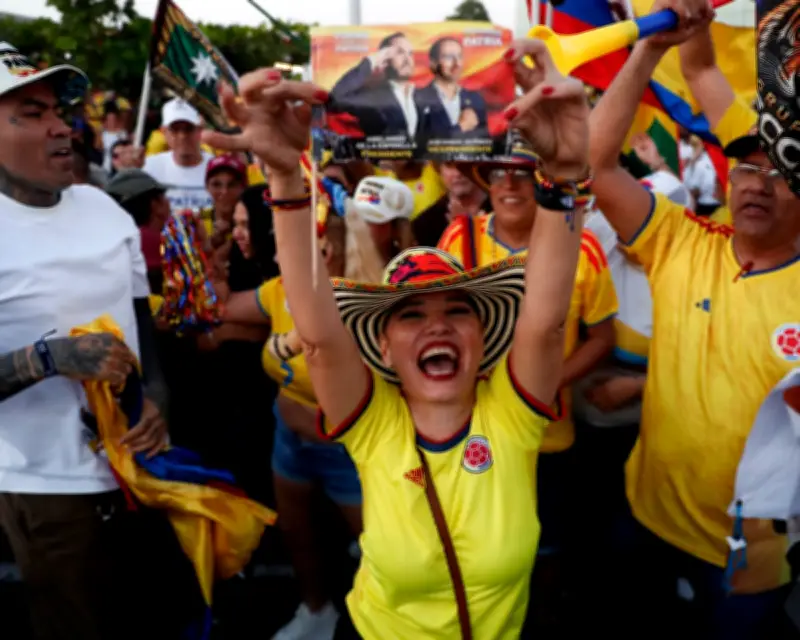
Supporters of Abelardo de la Espriella celebrated in Barranquilla, northern Colombia, on Sunday after the far-right lawyer won the first round of the country’s presidential elections. The victory came as a surprise to most analysts and politicians, as polls had consistently shown a solid lead for leftwing senator Iván Cepeda, who is backed by President Gustavo Petro.
Close Race Ahead
De la Espriella and Cepeda now have just under three weeks to compete for the roughly 3.6 million votes that did not go to either candidate in the first round. De la Espriella’s lead over Cepeda was narrow, amounting to just over 670,000 votes—43.7% to 40.9%.
An admirer of Donald Trump and other far-right leaders, De la Espriella campaigned amid controversies and promised to end Colombia’s decades-long armed conflict within 90 days. The conflict has claimed nearly half a million lives.

Collapse of Traditional Conservatives
De la Espriella’s lead is seen as a sign that the radical right has overtaken Colombia’s traditional conservative forces. This was reflected in the collapse of the candidacy of rightwing senator Paloma Valencia, a loyal follower of former president Álvaro Uribe Vélez. Valencia spent months in second place but finished with just 6.9% of the vote.
Political scientist Yan Basset said, “What really helped De la Espriella was Valencia’s collapse. There was a tactical shift of rightwing voters towards De la Espriella, who appeared to be the safest rightwing candidate to reach the runoff.”
Nadia Jimena Pérez Guevara, another political scientist, noted that De la Espriella “managed to consolidate the vote of the dissatisfied citizen, not only those opposed to Petro and leftwing policies, but also people who are simply fed up with politics.”
Opposing Approaches to Violence
De la Espriella and Cepeda offer starkly different approaches to dealing with the resurgence of violence, now at its highest levels since the 2016 peace agreement with the Farc. De la Espriella advocates military alliances with the US and Israel, total confrontation with criminal groups, and the construction of mega-prisons. Cepeda supports Petro’s “total peace” strategy of negotiating the dismantling of all criminal groups.
On Monday morning, Cepeda challenged De la Espriella to a debate. In his Sunday night speech, he described his rival as a “misogynist,” “homophobe,” and “lawyer for paramilitaries and drug traffickers.” De la Espriella called Cepeda and Petro “a pair of delinquents” and “miserable criminals,” and attacked the president as a “miserable drug addict.”
Controversy Over Election Results
Petro sparked controversy by refusing to recognize preliminary results from the National Civil Registry, alleging without evidence that the count included “800,000 additional people.” Guevara described the allegations as “not healthy” for Colombian democracy. She added that Cepeda’s focus on that issue instead of speaking directly to supporters was misguided and “gives ammunition to those who want to equate De la Espriella and Cepeda, when in reality they represent completely different styles of leadership.”
Both analysts described De la Espriella’s first-round victory as surprising but noted that second-place candidates have come back to win in 1998 and 2014, making the runoff on June 21 a challenging but not impossible task for the left.